Event submissions
Published
This submission belongs to the session S1. Environmental Assessment Methods and Management Technologies of the event The 1st International Online Conference on Environments
Published date
27 Feb, 2026
Academic Editor
'%3e%3cpath%20d='M12.6657%2010.9104C12.4185%2010.325%2012.0599%209.79327%2011.6097%209.34482C11.1609%208.89508%2010.6293%208.5365%2010.0442%208.28888C10.0389%208.28626%2010.0337%208.28495%2010.0285%208.28233C10.8446%207.69279%2011.3752%206.73249%2011.3752%205.64904C11.3752%203.8542%209.92103%202.39999%208.1262%202.39999C6.33136%202.39999%204.87715%203.8542%204.87715%205.64904C4.87715%206.73249%205.40774%207.69279%206.22393%208.28364C6.21869%208.28626%206.21345%208.28757%206.20821%208.29019C5.62129%208.5378%205.09463%208.89284%204.64265%209.34613C4.1929%209.79493%203.83432%2010.3266%203.58671%2010.9117C3.34345%2011.4845%203.21226%2012.0987%203.20023%2012.7209C3.19988%2012.7349%203.20233%2012.7488%203.20744%2012.7619C3.21255%2012.7749%203.22022%2012.7867%203.22998%2012.7968C3.23975%2012.8068%203.25142%2012.8147%203.26431%2012.8202C3.2772%2012.8256%203.29105%2012.8284%203.30504%2012.8284H4.09109C4.14874%2012.8284%204.19459%2012.7825%204.1959%2012.7262C4.2221%2011.7148%204.62823%2010.7676%205.34617%2010.0497C6.08899%209.30683%207.0755%208.89808%208.1262%208.89808C9.17689%208.89808%2010.1634%209.30683%2010.9062%2010.0497C11.6242%2010.7676%2012.0303%2011.7148%2012.0565%2012.7262C12.0578%2012.7838%2012.1037%2012.8284%2012.1613%2012.8284H12.9474C12.9613%2012.8284%2012.9752%2012.8256%2012.9881%2012.8202C13.001%2012.8147%2013.0126%2012.8068%2013.0224%2012.7968C13.0322%2012.7867%2013.0398%2012.7749%2013.0449%2012.7619C13.0501%2012.7488%2013.0525%2012.7349%2013.0522%2012.7209C13.0391%2012.0947%2012.9094%2011.4855%2012.6657%2010.9104ZM8.1262%207.9024C7.52486%207.9024%206.9589%207.6679%206.53312%207.24211C6.10733%206.81633%205.87283%206.25037%205.87283%205.64904C5.87283%205.0477%206.10733%204.48174%206.53312%204.05596C6.9589%203.63018%207.52486%203.39567%208.1262%203.39567C8.72753%203.39567%209.29349%203.63018%209.71927%204.05596C10.1451%204.48174%2010.3796%205.0477%2010.3796%205.64904C10.3796%206.25037%2010.1451%206.81633%209.71927%207.24211C9.29349%207.6679%208.72753%207.9024%208.1262%207.9024Z'%20fill='%235D1EE1'/%3e%3c/g%3e%3c/svg%3e) Milena Horvat
Milena HorvatCitation
Branislava Teofilović, Snežena Papović, Ivana Đuran, Emilia Gligorić, Milica Vidić, Nevena Grujić-Letić, Milan Vraneš, Hydrophobic Menthol–Dodecanoic Acid Deep Eutectic Solvent as a Sustainable Extractant for Phenolic Compounds from Lamiaceae Herbal Drugs, in Proceedings of The 1st International Online Conference on Environments, 2 March–4 March 2026, MDPI: Basel, Switzerland
Share
Email
Facebook
Twitter
LinkedIn
Hydrophobic Menthol–Dodecanoic Acid Deep Eutectic Solvent as a Sustainable Extractant for Phenolic Compounds from Lamiaceae Herbal Drugs
'%3e%3cpath%20d='M12.6647%2010.9104C12.4176%2010.325%2012.0589%209.7933%2011.6088%209.34485C11.16%208.89511%2010.6283%208.53653%2010.0432%208.28891C10.038%208.28629%2010.0327%208.28498%2010.0275%208.28236C10.8437%207.69282%2011.3743%206.73252%2011.3743%205.64907C11.3743%203.85423%209.92005%202.40002%208.12522%202.40002C6.33038%202.40002%204.87618%203.85423%204.87618%205.64907C4.87618%206.73252%205.40677%207.69282%206.22296%208.28367C6.21772%208.28629%206.21248%208.2876%206.20724%208.29022C5.62031%208.53783%205.09365%208.89287%204.64167%209.34616C4.19192%209.79496%203.83334%2010.3266%203.58573%2010.9117C3.34247%2011.4846%203.21128%2012.0987%203.19925%2012.721C3.1989%2012.735%203.20135%2012.7489%203.20646%2012.7619C3.21157%2012.7749%203.21924%2012.7868%203.22901%2012.7968C3.23877%2012.8068%203.25045%2012.8148%203.26334%2012.8202C3.27623%2012.8256%203.29007%2012.8284%203.30406%2012.8284H4.09012C4.14776%2012.8284%204.19362%2012.7825%204.19493%2012.7262C4.22113%2011.7148%204.62726%2010.7676%205.34519%2010.0497C6.08802%209.30686%207.07452%208.89811%208.12522%208.89811C9.17592%208.89811%2010.1624%209.30686%2010.9052%2010.0497C11.6232%2010.7676%2012.0293%2011.7148%2012.0555%2012.7262C12.0568%2012.7839%2012.1027%2012.8284%2012.1603%2012.8284H12.9464C12.9604%2012.8284%2012.9742%2012.8256%2012.9871%2012.8202C13%2012.8148%2013.0117%2012.8068%2013.0214%2012.7968C13.0312%2012.7868%2013.0389%2012.7749%2013.044%2012.7619C13.0491%2012.7489%2013.0515%2012.735%2013.0512%2012.721C13.0381%2012.0947%2012.9084%2011.4856%2012.6647%2010.9104ZM8.12522%207.90243C7.52388%207.90243%206.95792%207.66793%206.53214%207.24215C6.10636%206.81636%205.87185%206.2504%205.87185%205.64907C5.87185%205.04773%206.10636%204.48177%206.53214%204.05599C6.95792%203.63021%207.52388%203.3957%208.12522%203.3957C8.72655%203.3957%209.29252%203.63021%209.7183%204.05599C10.1441%204.48177%2010.3786%205.04773%2010.3786%205.64907C10.3786%206.2504%2010.1441%206.81636%209.7183%207.24215C9.29252%207.66793%208.72655%207.90243%208.12522%207.90243Z'%20fill='%235D1EE1'/%3e%3c/g%3e%3c/svg%3e)
Branislava Teofilović 1
Snežena Papović 2
Nevena Grujić-Letić 1

Ivana Đuran 3
Emilia Gligorić 1
Milica Vidić 1
Milan Vraneš 2
1. Department of Pharmacy, Faculty of Medicine, University of Novi Sad, Hajduk Veljkova 3, 21000 Novi Sad, Serbia, Serbia
2. Faculty of Science, University of Novi Sad, Trg Dositeja Obradovica 3, 21000 Novi Sad, Serbia, Serbia
3. Clinic of Nephrology and Clinical Immunology, University Clinical Centre of Vojvodina, Novi Sad, Serbia, Serbia
Abstract
Introduction:
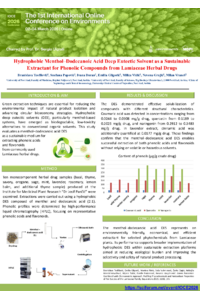
Green extraction techniques are essential for reducing the environmental impact of natural product isolation and advancing circular bioeconomy strategies. Hydrophobic deep eutectic solvents (DESs), particularly menthol-based systems, have emerged as biodegradable, low-toxicity alternatives to conventional organic solvents. This study evaluates a menthol–dodecanoic acid DES as a sustainable medium for extracting phenolic acids and flavonoids from commonly used Lamiaceae herbal drugs.
Methods:
Ten monocomponent herbal drug samples (basil, thyme, savory, oregano, sage, mint, lavender, rosemary, lemon balm, and an additional thyme sample) produced at the Institute for Medicinal Plant Research “Dr Josif Pančić” were examined. Extractions were carried out using a hydrophobic DES composed of menthol and dodecanoic acid (2:1). Phenolic profiles were determined by high-performance liquid chromatography (HPLC), focusing on representative phenolic acids and flavonoids.
Results:
The DES demonstrated effective solubilization of compounds with different structural characteristics. Coumaric acid was detected in concentrations ranging from 0.0244 to 0.0308 mg/g drug, quercetin from 0.1189 to 0.2025 mg/g drug, and naringenin from 0.2912 to 0.3483 mg/g drug. In lavender extract, cinnamic acid was additionally quantified at 0.0177 mg/g drug. These findings confirm that the menthol–dodecanoic acid DES enables successful extraction of both phenolic acids and flavonoids without relying on volatile or hazardous solvents.
Conclusions:
The menthol–dodecanoic acid DES represents an environmentally friendly, economical, and efficient extractant for selected phytochemicals from Lamiaceae plants. Its performance supports broader implementation of hydrophobic DES within sustainable extraction platforms aimed at reducing ecological burden and improving the selectivity and safety of natural product processing.
Keywords
Deep eutectic solvents (DES)
Green extraction
Natural product isolation
Lamiaceae herbal drugs
Renewable solvent systems.
Poster
Teofilović et al. IOCE 2026 Poster.pdf
Trace Metal Bioaccumulation and Redox Imbalance in Mytilus galloprovincialis from the Gulf of Pozzuoli (Italy)
Life-Cycle GHG of SAF in Real Flights: Empirical WTW Accounting and Reconciliation with TIM, DEFRA, and Base Empreinte