Event submissions
Published
This submission belongs to the session S2. Environmental Impact and Risk Assessment of the event The 1st International Online Conference on Environments
Published date
27 Feb, 2026
Academic Editor
'%3e%3cpath%20d='M12.6657%2010.9104C12.4185%2010.325%2012.0599%209.79327%2011.6097%209.34482C11.1609%208.89508%2010.6293%208.5365%2010.0442%208.28888C10.0389%208.28626%2010.0337%208.28495%2010.0285%208.28233C10.8446%207.69279%2011.3752%206.73249%2011.3752%205.64904C11.3752%203.8542%209.92103%202.39999%208.1262%202.39999C6.33136%202.39999%204.87715%203.8542%204.87715%205.64904C4.87715%206.73249%205.40774%207.69279%206.22393%208.28364C6.21869%208.28626%206.21345%208.28757%206.20821%208.29019C5.62129%208.5378%205.09463%208.89284%204.64265%209.34613C4.1929%209.79493%203.83432%2010.3266%203.58671%2010.9117C3.34345%2011.4845%203.21226%2012.0987%203.20023%2012.7209C3.19988%2012.7349%203.20233%2012.7488%203.20744%2012.7619C3.21255%2012.7749%203.22022%2012.7867%203.22998%2012.7968C3.23975%2012.8068%203.25142%2012.8147%203.26431%2012.8202C3.2772%2012.8256%203.29105%2012.8284%203.30504%2012.8284H4.09109C4.14874%2012.8284%204.19459%2012.7825%204.1959%2012.7262C4.2221%2011.7148%204.62823%2010.7676%205.34617%2010.0497C6.08899%209.30683%207.0755%208.89808%208.1262%208.89808C9.17689%208.89808%2010.1634%209.30683%2010.9062%2010.0497C11.6242%2010.7676%2012.0303%2011.7148%2012.0565%2012.7262C12.0578%2012.7838%2012.1037%2012.8284%2012.1613%2012.8284H12.9474C12.9613%2012.8284%2012.9752%2012.8256%2012.9881%2012.8202C13.001%2012.8147%2013.0126%2012.8068%2013.0224%2012.7968C13.0322%2012.7867%2013.0398%2012.7749%2013.0449%2012.7619C13.0501%2012.7488%2013.0525%2012.7349%2013.0522%2012.7209C13.0391%2012.0947%2012.9094%2011.4855%2012.6657%2010.9104ZM8.1262%207.9024C7.52486%207.9024%206.9589%207.6679%206.53312%207.24211C6.10733%206.81633%205.87283%206.25037%205.87283%205.64904C5.87283%205.0477%206.10733%204.48174%206.53312%204.05596C6.9589%203.63018%207.52486%203.39567%208.1262%203.39567C8.72753%203.39567%209.29349%203.63018%209.71927%204.05596C10.1451%204.48174%2010.3796%205.0477%2010.3796%205.64904C10.3796%206.25037%2010.1451%206.81633%209.71927%207.24211C9.29349%207.6679%208.72753%207.9024%208.1262%207.9024Z'%20fill='%235D1EE1'/%3e%3c/g%3e%3c/svg%3e) Gianniantonio Petruzzelli
Gianniantonio PetruzzelliCitation
Elisabete Muchagato Maurício, Patricia Branco, Anabela Cruces, Evaluating the Ecotoxicological Effects of Glyphosate on Soil Systems: Towards Sustainable Agroecosystems, in Proceedings of The 1st International Online Conference on Environments, 2 March–4 March 2026, MDPI: Basel, Switzerland
Share
Email
Facebook
Twitter
LinkedIn
Evaluating the Ecotoxicological Effects of Glyphosate on Soil Systems: Towards Sustainable Agroecosystems
'%3e%3cpath%20d='M12.6647%2010.9104C12.4176%2010.325%2012.0589%209.7933%2011.6088%209.34485C11.16%208.89511%2010.6283%208.53653%2010.0432%208.28891C10.038%208.28629%2010.0327%208.28498%2010.0275%208.28236C10.8437%207.69282%2011.3743%206.73252%2011.3743%205.64907C11.3743%203.85423%209.92005%202.40002%208.12522%202.40002C6.33038%202.40002%204.87618%203.85423%204.87618%205.64907C4.87618%206.73252%205.40677%207.69282%206.22296%208.28367C6.21772%208.28629%206.21248%208.2876%206.20724%208.29022C5.62031%208.53783%205.09365%208.89287%204.64167%209.34616C4.19192%209.79496%203.83334%2010.3266%203.58573%2010.9117C3.34247%2011.4846%203.21128%2012.0987%203.19925%2012.721C3.1989%2012.735%203.20135%2012.7489%203.20646%2012.7619C3.21157%2012.7749%203.21924%2012.7868%203.22901%2012.7968C3.23877%2012.8068%203.25045%2012.8148%203.26334%2012.8202C3.27623%2012.8256%203.29007%2012.8284%203.30406%2012.8284H4.09012C4.14776%2012.8284%204.19362%2012.7825%204.19493%2012.7262C4.22113%2011.7148%204.62726%2010.7676%205.34519%2010.0497C6.08802%209.30686%207.07452%208.89811%208.12522%208.89811C9.17592%208.89811%2010.1624%209.30686%2010.9052%2010.0497C11.6232%2010.7676%2012.0293%2011.7148%2012.0555%2012.7262C12.0568%2012.7839%2012.1027%2012.8284%2012.1603%2012.8284H12.9464C12.9604%2012.8284%2012.9742%2012.8256%2012.9871%2012.8202C13%2012.8148%2013.0117%2012.8068%2013.0214%2012.7968C13.0312%2012.7868%2013.0389%2012.7749%2013.044%2012.7619C13.0491%2012.7489%2013.0515%2012.735%2013.0512%2012.721C13.0381%2012.0947%2012.9084%2011.4856%2012.6647%2010.9104ZM8.12522%207.90243C7.52388%207.90243%206.95792%207.66793%206.53214%207.24215C6.10636%206.81636%205.87185%206.2504%205.87185%205.64907C5.87185%205.04773%206.10636%204.48177%206.53214%204.05599C6.95792%203.63021%207.52388%203.3957%208.12522%203.3957C8.72655%203.3957%209.29252%203.63021%209.7183%204.05599C10.1441%204.48177%2010.3786%205.04773%2010.3786%205.64907C10.3786%206.2504%2010.1441%206.81636%209.7183%207.24215C9.29252%207.66793%208.72655%207.90243%208.12522%207.90243Z'%20fill='%235D1EE1'/%3e%3c/g%3e%3c/svg%3e)
Elisabete Muchagato Maurício 1,2

Patricia Branco 1,3
Anabela Cruces 1,4
1. BIORG - Bioengineering and Sustainability Research Group, Faculty of Engineering, Lusófona University, Campo Grande 376, 1749-024, Lisbon, Portugal, Portugal
2. CBIOS – Research Center for Biosciences & Health Technologies, School of Health Sciences and Technologies, Lusófona University, Campo Grande 376, 1749-024, Lisbon, Portugal
3. Linking Landscape, Environment, Agriculture and Food (LEAF), TERRA Associated Laboratory, Higher Institute of Agronomy, University of Lisbon, Tapada da Ajuda, 1349-017 Lisbon, Portugal
4. IDL – Dom Luiz Institute (IDL) and Department of Geology (DG), Faculty of Sciences, University of Lisbon, Campo Grande, 1749-016 Lisbon, Portugal
Abstract
Glyphosate (C₃H₈NO₅P) is a broad-spectrum herbicide commonly used in agriculture to effectively control weeds in cereal, vineyard, and horticultural crops. However, excessive glyphosate application can negatively impact soil health by altering microbial diversity, disrupting nutrient cycling, and reducing fertility and biodiversity. Furthermore, prolonged exposure to glyphosate has been linked to potential health risks for humans, including cancer and endocrine disruption. The International Agency for Research on Cancer (IARC, 2015) classified glyphosate as "probably carcinogenic to humans" (Group 2A), underscoring the need for stricter regulations and environmentally responsible agricultural practices. This study aimed to evaluate the phytotoxicity of glyphosate on the germination of Raphanus sativus and Lepidium sativum seeds. This study contributes to our understanding of the environmental risks associated with increasing concentrations of this compound in agroecosystems. A triplicate bioassay was conducted using glyphosate concentrations of 3.6, 1.8, 0.9, 0.45, and 0.225 g/L. Twenty seeds of each species were evenly distributed in Petri dishes containing cotton soaked with the respective test solutions. After seven days, germinated seeds were counted, and median lethal concentrations (LC₅₀) were calculated. Statistical analyses were performed to evaluate the correlation between glyphosate concentration and germination inhibition. The results demonstrated a significant increase in germination inhibition between 1.8 and 3.6 g/L for both seed species. Turnip seeds were more sensitive than watercress seeds. A positive and significant correlation was found between glyphosate concentration and inhibition rate. The LC₅₀ values obtained were 2.18 g/L for Raphanus sativus and 1.43 g/L for Lepidium sativum. These results confirm that glyphosate impairs seed germination. The study emphasizes the need for continuous environmental monitoring and the adoption of sustainable soil management practices to mitigate glyphosate's ecological impact.
Keywords
Glyphosate
phytotoxicity
soil sustainability
seed germination
environmental risk
ecotoxicology.
Poster
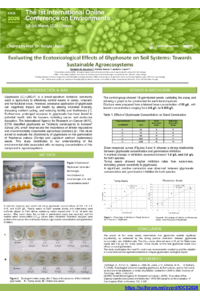
poster Glifosato congresso internacional 2026 (1).pdf
Green extraction of Satureja horvatii Šilić (Lamiaceae): Preliminary chemical analysis and antioxidant evaluation using natural deep eutectic solvents
Public Perceptions and Adaptive Capacity to Climate-Related Risk in Greece: Evidence from a Nationwide Dataset