Event submissions
Published
This submission belongs to the session S2. Environmental Impact and Risk Assessment of the event The 1st International Online Conference on Environments
Published date
27 Feb, 2026
Academic Editor
'%3e%3cpath%20d='M12.6657%2010.9104C12.4185%2010.325%2012.0599%209.79327%2011.6097%209.34482C11.1609%208.89508%2010.6293%208.5365%2010.0442%208.28888C10.0389%208.28626%2010.0337%208.28495%2010.0285%208.28233C10.8446%207.69279%2011.3752%206.73249%2011.3752%205.64904C11.3752%203.8542%209.92103%202.39999%208.1262%202.39999C6.33136%202.39999%204.87715%203.8542%204.87715%205.64904C4.87715%206.73249%205.40774%207.69279%206.22393%208.28364C6.21869%208.28626%206.21345%208.28757%206.20821%208.29019C5.62129%208.5378%205.09463%208.89284%204.64265%209.34613C4.1929%209.79493%203.83432%2010.3266%203.58671%2010.9117C3.34345%2011.4845%203.21226%2012.0987%203.20023%2012.7209C3.19988%2012.7349%203.20233%2012.7488%203.20744%2012.7619C3.21255%2012.7749%203.22022%2012.7867%203.22998%2012.7968C3.23975%2012.8068%203.25142%2012.8147%203.26431%2012.8202C3.2772%2012.8256%203.29105%2012.8284%203.30504%2012.8284H4.09109C4.14874%2012.8284%204.19459%2012.7825%204.1959%2012.7262C4.2221%2011.7148%204.62823%2010.7676%205.34617%2010.0497C6.08899%209.30683%207.0755%208.89808%208.1262%208.89808C9.17689%208.89808%2010.1634%209.30683%2010.9062%2010.0497C11.6242%2010.7676%2012.0303%2011.7148%2012.0565%2012.7262C12.0578%2012.7838%2012.1037%2012.8284%2012.1613%2012.8284H12.9474C12.9613%2012.8284%2012.9752%2012.8256%2012.9881%2012.8202C13.001%2012.8147%2013.0126%2012.8068%2013.0224%2012.7968C13.0322%2012.7867%2013.0398%2012.7749%2013.0449%2012.7619C13.0501%2012.7488%2013.0525%2012.7349%2013.0522%2012.7209C13.0391%2012.0947%2012.9094%2011.4855%2012.6657%2010.9104ZM8.1262%207.9024C7.52486%207.9024%206.9589%207.6679%206.53312%207.24211C6.10733%206.81633%205.87283%206.25037%205.87283%205.64904C5.87283%205.0477%206.10733%204.48174%206.53312%204.05596C6.9589%203.63018%207.52486%203.39567%208.1262%203.39567C8.72753%203.39567%209.29349%203.63018%209.71927%204.05596C10.1451%204.48174%2010.3796%205.0477%2010.3796%205.64904C10.3796%206.25037%2010.1451%206.81633%209.71927%207.24211C9.29349%207.6679%208.72753%207.9024%208.1262%207.9024Z'%20fill='%235D1EE1'/%3e%3c/g%3e%3c/svg%3e) Gianniantonio Petruzzelli
Gianniantonio PetruzzelliCitation
Tayebeh Lohraseb, Maria Teresa Sebastià Frasquet, Limitations of Project-Based Environmental Impact Assessment (EIA) and the Need for Cumulative Effects Assessment (CEA) in the Assaluyeh Coastal Industrial Zone, Iran, in Proceedings of The 1st International Online Conference on Environments, 2 March–4 March 2026, MDPI: Basel, Switzerland
Share
Email
Facebook
Twitter
LinkedIn
Limitations of Project-Based Environmental Impact Assessment (EIA) and the Need for Cumulative Effects Assessment (CEA) in the Assaluyeh Coastal Industrial Zone, Iran
'%3e%3cpath%20d='M12.6647%2010.9104C12.4176%2010.325%2012.0589%209.7933%2011.6088%209.34485C11.16%208.89511%2010.6283%208.53653%2010.0432%208.28891C10.038%208.28629%2010.0327%208.28498%2010.0275%208.28236C10.8437%207.69282%2011.3743%206.73252%2011.3743%205.64907C11.3743%203.85423%209.92005%202.40002%208.12522%202.40002C6.33038%202.40002%204.87618%203.85423%204.87618%205.64907C4.87618%206.73252%205.40677%207.69282%206.22296%208.28367C6.21772%208.28629%206.21248%208.2876%206.20724%208.29022C5.62031%208.53783%205.09365%208.89287%204.64167%209.34616C4.19192%209.79496%203.83334%2010.3266%203.58573%2010.9117C3.34247%2011.4846%203.21128%2012.0987%203.19925%2012.721C3.1989%2012.735%203.20135%2012.7489%203.20646%2012.7619C3.21157%2012.7749%203.21924%2012.7868%203.22901%2012.7968C3.23877%2012.8068%203.25045%2012.8148%203.26334%2012.8202C3.27623%2012.8256%203.29007%2012.8284%203.30406%2012.8284H4.09012C4.14776%2012.8284%204.19362%2012.7825%204.19493%2012.7262C4.22113%2011.7148%204.62726%2010.7676%205.34519%2010.0497C6.08802%209.30686%207.07452%208.89811%208.12522%208.89811C9.17592%208.89811%2010.1624%209.30686%2010.9052%2010.0497C11.6232%2010.7676%2012.0293%2011.7148%2012.0555%2012.7262C12.0568%2012.7839%2012.1027%2012.8284%2012.1603%2012.8284H12.9464C12.9604%2012.8284%2012.9742%2012.8256%2012.9871%2012.8202C13%2012.8148%2013.0117%2012.8068%2013.0214%2012.7968C13.0312%2012.7868%2013.0389%2012.7749%2013.044%2012.7619C13.0491%2012.7489%2013.0515%2012.735%2013.0512%2012.721C13.0381%2012.0947%2012.9084%2011.4856%2012.6647%2010.9104ZM8.12522%207.90243C7.52388%207.90243%206.95792%207.66793%206.53214%207.24215C6.10636%206.81636%205.87185%206.2504%205.87185%205.64907C5.87185%205.04773%206.10636%204.48177%206.53214%204.05599C6.95792%203.63021%207.52388%203.3957%208.12522%203.3957C8.72655%203.3957%209.29252%203.63021%209.7183%204.05599C10.1441%204.48177%2010.3786%205.04773%2010.3786%205.64907C10.3786%206.2504%2010.1441%206.81636%209.7183%207.24215C9.29252%207.66793%208.72655%207.90243%208.12522%207.90243Z'%20fill='%235D1EE1'/%3e%3c/g%3e%3c/svg%3e)
Tayebeh Lohraseb 1

Maria Teresa Sebastià Frasquet 2
1. Marine and Coastal Science and Technology, Universitat Politècnica de València, C/Paraninfo, 1, 46730 Grau de Gandia, Spain, Spain
2. International Action and Academic Coordination in the Area of Environment and Tourism / Universitat Politècnica de València, C/Paraninfo, 1, 46730 Grau de Gandia, Spain, Spain
Abstract
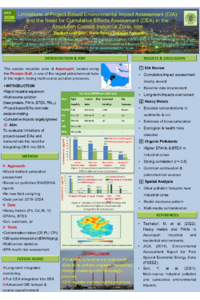
The Assaluyeh coastal industrial zone on the Persian Gulf hosts one of Iran’s largest clusters of oil, gas, and petrochemical facilities. Despite decades of project-level Environmental Impact Assessments (EIAs), the region continues to face severe environmental stress, raising important questions about the effectiveness of traditional assessment approaches. This study examines the core limitations of project-based EIA in Assaluyeh and highlights why a shift toward Cumulative Effects Assessment (CEA) is urgently needed. To explore this issue, we reviewed publicly available EIA and Environmental, Social, and Health Impact Assessment (ESHIA) reports, along with scientific publications from 2015 to 2024. Our analysis focused on whether cumulative impacts were acknowledged, the quality and clarity of the methods used, and the overall transparency of documentation. The findings reveal a consistent pattern; most reports limit their evaluations to individual project boundaries and either ignore cumulative impacts or address them only superficially. At the same time, field-based environmental studies draw a much clearer picture of the real situation on the ground. Multiple pollutants, including heavy metals (Pb, Cd, Ni, V), PAHs, BTEX compounds, and high levels of particulate matter, have accumulated across the region. These pollutants originate from numerous sources and interact in complex ways, creating environmental pressures that single-project EIAs are not equipped to capture. Together, these insights point to a crucial gap in current environmental governance. A regional CEA framework, embedded within a Strategic Environmental Assessment (SEA), would provide a more holistic view of industrial development and its long-term consequences. Such an approach can improve coordination among institutions, enhance environmental data sharing, and support more sustainable planning for Iran’s rapidly expanding coastal industrial zones. Overall, this study emphasizes that managing the environmental challenges of Assaluyeh requires moving beyond project-level assessments and adopting tools that can address the full scale of cumulative and synergistic impacts.
Keywords
Assaluyeh
CEA
cumulative impacts
EIA
environmental management
Iran
Petro-chemical industry
SEA
Poster
poster 6.pdf
Multivariate Analysis of Toxic Contaminants: A Data-Driven Approach to Evaluating Harmful pollutants Accumulated in fish species
Land Use Intensity, Power Density, and Energy Density of Photovoltaic Power Plants