Event submissions
Published
This submission belongs to the session 10. Submissions under other topics of Plant Protection of the event The 1st International Electronic Conference on Plant Protection
Published date
01 Mar, 2026
Academic Editor
'%3e%3cpath%20d='M12.6657%2010.9104C12.4185%2010.325%2012.0599%209.79327%2011.6097%209.34482C11.1609%208.89508%2010.6293%208.5365%2010.0442%208.28888C10.0389%208.28626%2010.0337%208.28495%2010.0285%208.28233C10.8446%207.69279%2011.3752%206.73249%2011.3752%205.64904C11.3752%203.8542%209.92103%202.39999%208.1262%202.39999C6.33136%202.39999%204.87715%203.8542%204.87715%205.64904C4.87715%206.73249%205.40774%207.69279%206.22393%208.28364C6.21869%208.28626%206.21345%208.28757%206.20821%208.29019C5.62129%208.5378%205.09463%208.89284%204.64265%209.34613C4.1929%209.79493%203.83432%2010.3266%203.58671%2010.9117C3.34345%2011.4845%203.21226%2012.0987%203.20023%2012.7209C3.19988%2012.7349%203.20233%2012.7488%203.20744%2012.7619C3.21255%2012.7749%203.22022%2012.7867%203.22998%2012.7968C3.23975%2012.8068%203.25142%2012.8147%203.26431%2012.8202C3.2772%2012.8256%203.29105%2012.8284%203.30504%2012.8284H4.09109C4.14874%2012.8284%204.19459%2012.7825%204.1959%2012.7262C4.2221%2011.7148%204.62823%2010.7676%205.34617%2010.0497C6.08899%209.30683%207.0755%208.89808%208.1262%208.89808C9.17689%208.89808%2010.1634%209.30683%2010.9062%2010.0497C11.6242%2010.7676%2012.0303%2011.7148%2012.0565%2012.7262C12.0578%2012.7838%2012.1037%2012.8284%2012.1613%2012.8284H12.9474C12.9613%2012.8284%2012.9752%2012.8256%2012.9881%2012.8202C13.001%2012.8147%2013.0126%2012.8068%2013.0224%2012.7968C13.0322%2012.7867%2013.0398%2012.7749%2013.0449%2012.7619C13.0501%2012.7488%2013.0525%2012.7349%2013.0522%2012.7209C13.0391%2012.0947%2012.9094%2011.4855%2012.6657%2010.9104ZM8.1262%207.9024C7.52486%207.9024%206.9589%207.6679%206.53312%207.24211C6.10733%206.81633%205.87283%206.25037%205.87283%205.64904C5.87283%205.0477%206.10733%204.48174%206.53312%204.05596C6.9589%203.63018%207.52486%203.39567%208.1262%203.39567C8.72753%203.39567%209.29349%203.63018%209.71927%204.05596C10.1451%204.48174%2010.3796%205.0477%2010.3796%205.64904C10.3796%206.25037%2010.1451%206.81633%209.71927%207.24211C9.29349%207.6679%208.72753%207.9024%208.1262%207.9024Z'%20fill='%235D1EE1'/%3e%3c/g%3e%3c/svg%3e) Clarisse Brígido
Clarisse BrígidoCitation
Babur Ali Akbar, Assessing Ridolfia segetum Aqueous Extract as a Plant-Based Bioherbicide: Growth and Seedling Responses of Sinapis alba, in Proceedings of The 1st International Electronic Conference on Plant Protection, 2 March–8 March 2026, MDPI: Basel, Switzerland
Share
Email
Facebook
Twitter
LinkedIn
Assessing Ridolfia segetum Aqueous Extract as a Plant-Based Bioherbicide: Growth and Seedling Responses of Sinapis alba
'%3e%3cpath%20d='M12.6647%2010.9104C12.4176%2010.325%2012.0589%209.7933%2011.6088%209.34485C11.16%208.89511%2010.6283%208.53653%2010.0432%208.28891C10.038%208.28629%2010.0327%208.28498%2010.0275%208.28236C10.8437%207.69282%2011.3743%206.73252%2011.3743%205.64907C11.3743%203.85423%209.92005%202.40002%208.12522%202.40002C6.33038%202.40002%204.87618%203.85423%204.87618%205.64907C4.87618%206.73252%205.40677%207.69282%206.22296%208.28367C6.21772%208.28629%206.21248%208.2876%206.20724%208.29022C5.62031%208.53783%205.09365%208.89287%204.64167%209.34616C4.19192%209.79496%203.83334%2010.3266%203.58573%2010.9117C3.34247%2011.4846%203.21128%2012.0987%203.19925%2012.721C3.1989%2012.735%203.20135%2012.7489%203.20646%2012.7619C3.21157%2012.7749%203.21924%2012.7868%203.22901%2012.7968C3.23877%2012.8068%203.25045%2012.8148%203.26334%2012.8202C3.27623%2012.8256%203.29007%2012.8284%203.30406%2012.8284H4.09012C4.14776%2012.8284%204.19362%2012.7825%204.19493%2012.7262C4.22113%2011.7148%204.62726%2010.7676%205.34519%2010.0497C6.08802%209.30686%207.07452%208.89811%208.12522%208.89811C9.17592%208.89811%2010.1624%209.30686%2010.9052%2010.0497C11.6232%2010.7676%2012.0293%2011.7148%2012.0555%2012.7262C12.0568%2012.7839%2012.1027%2012.8284%2012.1603%2012.8284H12.9464C12.9604%2012.8284%2012.9742%2012.8256%2012.9871%2012.8202C13%2012.8148%2013.0117%2012.8068%2013.0214%2012.7968C13.0312%2012.7868%2013.0389%2012.7749%2013.044%2012.7619C13.0491%2012.7489%2013.0515%2012.735%2013.0512%2012.721C13.0381%2012.0947%2012.9084%2011.4856%2012.6647%2010.9104ZM8.12522%207.90243C7.52388%207.90243%206.95792%207.66793%206.53214%207.24215C6.10636%206.81636%205.87185%206.2504%205.87185%205.64907C5.87185%205.04773%206.10636%204.48177%206.53214%204.05599C6.95792%203.63021%207.52388%203.3957%208.12522%203.3957C8.72655%203.3957%209.29252%203.63021%209.7183%204.05599C10.1441%204.48177%2010.3786%205.04773%2010.3786%205.64907C10.3786%206.2504%2010.1441%206.81636%209.7183%207.24215C9.29252%207.66793%208.72655%207.90243%208.12522%207.90243Z'%20fill='%235D1EE1'/%3e%3c/g%3e%3c/svg%3e)
Babur Ali Akbar 1
1. Centre of Agricultural Biochemistry and Biotechnology, faculty of Agriculture, University of Agriculture Faisalabad, Faisalabad, 64101 , Pakistan, Pakistan
Abstract
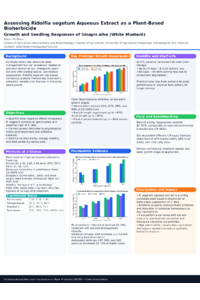
Synthetic herbicides remain the predominant management strategy for agricultural weeds, yet their widespread application has engendered environmental concerns and the emergence of resistant populations. The investigation of plant-derived allelopathic compounds offers a viable alternative for developing biodegradable and ecologically sustainable weed control agents. Ridolfia segetum (L.) Moris, arable weed belonging to the Apiaceae family, harbors diverse secondary metabolites with established phytotoxic properties. The phytotoxic efficacy of aqueous extracts derived from R. segetum tissues against Sinapis alba (white mustard), a prevalent cruciferous weed species problematic in cereal and legume cropping systems, was evaluated through systematic laboratory and greenhouse experiments. Fresh aerial parts of R. segetum were collected at the flowering stage and subjected to aqueous extraction at plant-to-water ratios of 1:10, 1:20, and 1:40 (w/v). The aqueous extraction methodology, encompassing various solvent concentrations and extraction temperatures (25°C, 50°C, and 80°C for 24, 48, and 72 hours), significantly influences the release and bioavailability of allelopathic compounds, including coumarins, volatile oils, and phenolic derivatives. Phytotoxic evaluations conducted across multiple growth stages reveal dose-dependent inhibitory effects on seed germination rates, radicle elongation, and seedling biomass accumulation in S. alba. At concentrations of 25%, 50%, 75%, and 100% (v/v), the extracts reduced seed germination by 23%, 47%, 68%, and 89% respectively compared to controls. Radicle length was suppressed by 31-92%, while shoot length decreased by 28-85% across the concentration gradient. Fresh biomass accumulation showed reductions of 35-94% relative to untreated seedlings. Mechanistic investigations indicate that R. segetum aqueous extracts suppress photosynthetic efficiency and disrupt oxidative stress homeostasis in target seedlings through elevated reactive oxygen species production and diminished antioxidant enzyme activities. Chlorophyll content decreased by 42-78%, while measurements of malondialdehyde levels increased by 2.3 to 4.8-fold, indicating lipid peroxidation. Activities of catalase, peroxidase, and superoxide dismutase were reduced by 34-71%, 29-66%, and 38-73% respectively at higher extract concentrations. Temporal assessments demonstrate that extract potency remains relatively stable over short-term storage periods (up to 15 days at 4°C with 8-12% activity loss), though degradation of bioactive components occurs under extended conditions, with approximately 45-60% reduction in phytotoxic activity after 60 days. Comparative analysis with existing bioherbicide formulations demonstrates competitive or superior suppression of S. alba growth at equivalent application rates, with R. segetum extracts achieving 82-91% weed suppression compared to 74-86% for commercial alternatives. Field-based assessments indicate variable efficacy under natural conditions, contingent upon soil edaphic properties, prevailing moisture regimes, and the developmental stage of target weeds. Plot trials across three soil types (sandy loam, clay loam, and silty clay) showed weed biomass reductions of 56%, 68%, and 71% respectively at 14 days after treatment. This work synthesize available evidence regarding optimal extraction protocols, identifies knowledge gaps concerning the identity and synergistic interactions of active phytotoxic compounds, and discusses the regulatory and practical considerations inherent to bioherbicide commercialization. Integration of R. segetum-derived allelopathic preparations into conservation agriculture systems and organic production frameworks could substantially reduce herbicide dependency whilst maintaining agronomic productivity. Future research priorities encompassing field-scale validation across diverse edaphoclimatic contexts, standardization of extraction methodologies, and characterization of phytotoxic mechanisms at the molecular level are essential for advancing this biotechnological approach toward practical agriculture implementation.
Keywords
Synthetic herbicides
plant-derived allelopathic compounds
white mustard
Comparative analysis
Field-based assessments
Poster
Ridolfia segetum bioherbicide poster.pdf
Genome-wide Identification and Characterization of Chitinase Genes in the Coffee Berry Borer (Hypothenemus hampei) and Its Potential as Molecular Targets for Pest Management
Multi-omics approach applied to the discovery of biopesticides from endophytic fungi