Event submissions
Published
This submission belongs to the session 10. Submissions under other topics of Plant Protection of the event The 1st International Electronic Conference on Plant Protection
Published date
01 Mar, 2026
Academic Editor
'%3e%3cpath%20d='M12.6657%2010.9104C12.4185%2010.325%2012.0599%209.79327%2011.6097%209.34482C11.1609%208.89508%2010.6293%208.5365%2010.0442%208.28888C10.0389%208.28626%2010.0337%208.28495%2010.0285%208.28233C10.8446%207.69279%2011.3752%206.73249%2011.3752%205.64904C11.3752%203.8542%209.92103%202.39999%208.1262%202.39999C6.33136%202.39999%204.87715%203.8542%204.87715%205.64904C4.87715%206.73249%205.40774%207.69279%206.22393%208.28364C6.21869%208.28626%206.21345%208.28757%206.20821%208.29019C5.62129%208.5378%205.09463%208.89284%204.64265%209.34613C4.1929%209.79493%203.83432%2010.3266%203.58671%2010.9117C3.34345%2011.4845%203.21226%2012.0987%203.20023%2012.7209C3.19988%2012.7349%203.20233%2012.7488%203.20744%2012.7619C3.21255%2012.7749%203.22022%2012.7867%203.22998%2012.7968C3.23975%2012.8068%203.25142%2012.8147%203.26431%2012.8202C3.2772%2012.8256%203.29105%2012.8284%203.30504%2012.8284H4.09109C4.14874%2012.8284%204.19459%2012.7825%204.1959%2012.7262C4.2221%2011.7148%204.62823%2010.7676%205.34617%2010.0497C6.08899%209.30683%207.0755%208.89808%208.1262%208.89808C9.17689%208.89808%2010.1634%209.30683%2010.9062%2010.0497C11.6242%2010.7676%2012.0303%2011.7148%2012.0565%2012.7262C12.0578%2012.7838%2012.1037%2012.8284%2012.1613%2012.8284H12.9474C12.9613%2012.8284%2012.9752%2012.8256%2012.9881%2012.8202C13.001%2012.8147%2013.0126%2012.8068%2013.0224%2012.7968C13.0322%2012.7867%2013.0398%2012.7749%2013.0449%2012.7619C13.0501%2012.7488%2013.0525%2012.7349%2013.0522%2012.7209C13.0391%2012.0947%2012.9094%2011.4855%2012.6657%2010.9104ZM8.1262%207.9024C7.52486%207.9024%206.9589%207.6679%206.53312%207.24211C6.10733%206.81633%205.87283%206.25037%205.87283%205.64904C5.87283%205.0477%206.10733%204.48174%206.53312%204.05596C6.9589%203.63018%207.52486%203.39567%208.1262%203.39567C8.72753%203.39567%209.29349%203.63018%209.71927%204.05596C10.1451%204.48174%2010.3796%205.0477%2010.3796%205.64904C10.3796%206.25037%2010.1451%206.81633%209.71927%207.24211C9.29349%207.6679%208.72753%207.9024%208.1262%207.9024Z'%20fill='%235D1EE1'/%3e%3c/g%3e%3c/svg%3e) Jorge M. S. Faria
Jorge M. S. FariaCitation
Babur Ali Akbar, Insects’ Frass as a nematicidal tool against Meloidogyne incognita, in Proceedings of The 1st International Electronic Conference on Plant Protection, 2 March–8 March 2026, MDPI: Basel, Switzerland
Share
Email
Facebook
Twitter
LinkedIn
Insects’ Frass as a nematicidal tool against Meloidogyne incognita
'%3e%3cpath%20d='M12.6647%2010.9104C12.4176%2010.325%2012.0589%209.7933%2011.6088%209.34485C11.16%208.89511%2010.6283%208.53653%2010.0432%208.28891C10.038%208.28629%2010.0327%208.28498%2010.0275%208.28236C10.8437%207.69282%2011.3743%206.73252%2011.3743%205.64907C11.3743%203.85423%209.92005%202.40002%208.12522%202.40002C6.33038%202.40002%204.87618%203.85423%204.87618%205.64907C4.87618%206.73252%205.40677%207.69282%206.22296%208.28367C6.21772%208.28629%206.21248%208.2876%206.20724%208.29022C5.62031%208.53783%205.09365%208.89287%204.64167%209.34616C4.19192%209.79496%203.83334%2010.3266%203.58573%2010.9117C3.34247%2011.4846%203.21128%2012.0987%203.19925%2012.721C3.1989%2012.735%203.20135%2012.7489%203.20646%2012.7619C3.21157%2012.7749%203.21924%2012.7868%203.22901%2012.7968C3.23877%2012.8068%203.25045%2012.8148%203.26334%2012.8202C3.27623%2012.8256%203.29007%2012.8284%203.30406%2012.8284H4.09012C4.14776%2012.8284%204.19362%2012.7825%204.19493%2012.7262C4.22113%2011.7148%204.62726%2010.7676%205.34519%2010.0497C6.08802%209.30686%207.07452%208.89811%208.12522%208.89811C9.17592%208.89811%2010.1624%209.30686%2010.9052%2010.0497C11.6232%2010.7676%2012.0293%2011.7148%2012.0555%2012.7262C12.0568%2012.7839%2012.1027%2012.8284%2012.1603%2012.8284H12.9464C12.9604%2012.8284%2012.9742%2012.8256%2012.9871%2012.8202C13%2012.8148%2013.0117%2012.8068%2013.0214%2012.7968C13.0312%2012.7868%2013.0389%2012.7749%2013.044%2012.7619C13.0491%2012.7489%2013.0515%2012.735%2013.0512%2012.721C13.0381%2012.0947%2012.9084%2011.4856%2012.6647%2010.9104ZM8.12522%207.90243C7.52388%207.90243%206.95792%207.66793%206.53214%207.24215C6.10636%206.81636%205.87185%206.2504%205.87185%205.64907C5.87185%205.04773%206.10636%204.48177%206.53214%204.05599C6.95792%203.63021%207.52388%203.3957%208.12522%203.3957C8.72655%203.3957%209.29252%203.63021%209.7183%204.05599C10.1441%204.48177%2010.3786%205.04773%2010.3786%205.64907C10.3786%206.2504%2010.1441%206.81636%209.7183%207.24215C9.29252%207.66793%208.72655%207.90243%208.12522%207.90243Z'%20fill='%235D1EE1'/%3e%3c/g%3e%3c/svg%3e)
Babur Ali Akbar 1
1. Centre of Agricultural Biochemistry and Biotechnology, faculty of Agriculture, University of Agriculture Faisalabad, Faisalabad, 64101 , Pakistan, Pakistan
Abstract
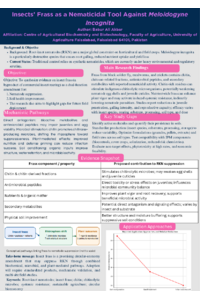
Root-knot nematodes represent a threat to global agricultural productivity, with Meloidogyne incognita being the most prevalent and destructive species affecting horticultural and field crops. Conventional nematode management has predominantly relied on synthetic nematicides, which have fallen under increasing regulatory scrutiny due to environmental persistence, non-target toxicity, and potential carcinogenic properties. The imperative for sustainable alternatives has intensified research into biologically derived control agents and organic amendments. Insect frass, a byproduct of industrial insect farming, has emerged as a promising candidate for nematode suppression, though comprehensive evaluations of its mechanisms and efficacy remain limited. This abstract synthesizes current knowledge regarding the nematicidal potential of insect frass against M. incognita, examining both direct antagonistic effects and indirect soil health improvements that contribute to nematode management. This summary indicates that frass from commercially reared insects such as black soldier fly, mealworms, and crickets contains bioactive compounds including chitin, chitosan derivatives, antimicrobial peptides, and diverse secondary metabolites that exhibit nematicidal properties. The chitinous components appear particularly relevant, as they stimulate indigenous chitinolytic microorganisms capable of degrading nematode egg shells and juvenile cuticles. Furthermore, the nutrient-rich composition of frass enhances plant vigor and activates systemic resistance mechanisms, indirectly reducing nematode parasitism success. Studies employing various application methods soil incorporation, seed treatment, and foliar sprays have demonstrated reductions in nematode penetration, galling intensity, and reproductive capacity. However, efficacy varies considerably depending on insect species, rearing substrate, frass processing methods, and application rates. Study gaps exist in understanding the specific bioactive molecules responsible for nematicidal activity, optimal formulation strategies for field deployment, and potential interactions with existing integrated pest management practices. The temporal dynamics of frass decomposition and persistence of nematicidal effects in diverse soil types warrant further investigation. Environmental considerations, including impacts on beneficial soil organisms and potential phytotoxicity at excessive rates, require systematic evaluation. Economic analyses comparing frass-based approaches with conventional nematicides remain scarce. This review summary highlights the multifaceted benefits of insect frass as both a nematode management tool and soil conditioner, positioning it within the broader context of sustainable agriculture and circular bioeconomy initiatives. Future research directions should prioritize standardization of production protocols, elucidation of mode of action, and development of commercially viable formulations to facilitate adoption in agricultural systems
Keywords
Root-knot nematodes
onventional nematode management
Insects’ Frass
beneficial soil organisms
sustainable agriculture
Poster
Babur Ali Akbar (26).pdf
Agricultural Exploitation of the Trichoderma hamatum-Brassica Crops Interaction as a Biotechnological Tool for Nutraceutical and Defensive Improvement
From Gene Discovery to Cultivar Development: Harnessing Genomic Tools and Advanced Breeding Approaches for Crop Enhancement