Event submissions
EventsThe 5th International Electronic Conference on Brain Sciences & 1st International Electronic Conference on Neurosciences
Published
This submission belongs to the session S4. Cognitive Neuroscience of the event The 5th International Electronic Conference on Brain Sciences & 1st International Electronic Conference on Neurosciences
Published date
04 Mar, 2026
Academic Editor
'%3e%3cpath%20d='M12.6657%2010.9104C12.4185%2010.325%2012.0599%209.79327%2011.6097%209.34482C11.1609%208.89508%2010.6293%208.5365%2010.0442%208.28888C10.0389%208.28626%2010.0337%208.28495%2010.0285%208.28233C10.8446%207.69279%2011.3752%206.73249%2011.3752%205.64904C11.3752%203.8542%209.92103%202.39999%208.1262%202.39999C6.33136%202.39999%204.87715%203.8542%204.87715%205.64904C4.87715%206.73249%205.40774%207.69279%206.22393%208.28364C6.21869%208.28626%206.21345%208.28757%206.20821%208.29019C5.62129%208.5378%205.09463%208.89284%204.64265%209.34613C4.1929%209.79493%203.83432%2010.3266%203.58671%2010.9117C3.34345%2011.4845%203.21226%2012.0987%203.20023%2012.7209C3.19988%2012.7349%203.20233%2012.7488%203.20744%2012.7619C3.21255%2012.7749%203.22022%2012.7867%203.22998%2012.7968C3.23975%2012.8068%203.25142%2012.8147%203.26431%2012.8202C3.2772%2012.8256%203.29105%2012.8284%203.30504%2012.8284H4.09109C4.14874%2012.8284%204.19459%2012.7825%204.1959%2012.7262C4.2221%2011.7148%204.62823%2010.7676%205.34617%2010.0497C6.08899%209.30683%207.0755%208.89808%208.1262%208.89808C9.17689%208.89808%2010.1634%209.30683%2010.9062%2010.0497C11.6242%2010.7676%2012.0303%2011.7148%2012.0565%2012.7262C12.0578%2012.7838%2012.1037%2012.8284%2012.1613%2012.8284H12.9474C12.9613%2012.8284%2012.9752%2012.8256%2012.9881%2012.8202C13.001%2012.8147%2013.0126%2012.8068%2013.0224%2012.7968C13.0322%2012.7867%2013.0398%2012.7749%2013.0449%2012.7619C13.0501%2012.7488%2013.0525%2012.7349%2013.0522%2012.7209C13.0391%2012.0947%2012.9094%2011.4855%2012.6657%2010.9104ZM8.1262%207.9024C7.52486%207.9024%206.9589%207.6679%206.53312%207.24211C6.10733%206.81633%205.87283%206.25037%205.87283%205.64904C5.87283%205.0477%206.10733%204.48174%206.53312%204.05596C6.9589%203.63018%207.52486%203.39567%208.1262%203.39567C8.72753%203.39567%209.29349%203.63018%209.71927%204.05596C10.1451%204.48174%2010.3796%205.0477%2010.3796%205.64904C10.3796%206.25037%2010.1451%206.81633%209.71927%207.24211C9.29349%207.6679%208.72753%207.9024%208.1262%207.9024Z'%20fill='%235D1EE1'/%3e%3c/g%3e%3c/svg%3e) Carla Masala
Carla MasalaCitation
Grigorii Vyacheslavovich Iskarevskii, Elizaveta Vinogradova, Anna Beknazarova, Victoria Kuvaeva, Dmitry Alexandrovich Onishchenko, Yan Robertovich Bravyy, Maxim Eduardovich Baltin, The impact of age and sports experience on balance control: physiological and cognitive insights, in Proceedings of The 5th International Electronic Conference on Brain Sciences & 1st International Electronic Conference on Neurosciences, 9 March–11 March 2026, MDPI: Basel, Switzerland
Share
Email
Facebook
Twitter
LinkedIn
The impact of age and sports experience on balance control: physiological and cognitive insights
'%3e%3cpath%20d='M12.6647%2010.9104C12.4176%2010.325%2012.0589%209.7933%2011.6088%209.34485C11.16%208.89511%2010.6283%208.53653%2010.0432%208.28891C10.038%208.28629%2010.0327%208.28498%2010.0275%208.28236C10.8437%207.69282%2011.3743%206.73252%2011.3743%205.64907C11.3743%203.85423%209.92005%202.40002%208.12522%202.40002C6.33038%202.40002%204.87618%203.85423%204.87618%205.64907C4.87618%206.73252%205.40677%207.69282%206.22296%208.28367C6.21772%208.28629%206.21248%208.2876%206.20724%208.29022C5.62031%208.53783%205.09365%208.89287%204.64167%209.34616C4.19192%209.79496%203.83334%2010.3266%203.58573%2010.9117C3.34247%2011.4846%203.21128%2012.0987%203.19925%2012.721C3.1989%2012.735%203.20135%2012.7489%203.20646%2012.7619C3.21157%2012.7749%203.21924%2012.7868%203.22901%2012.7968C3.23877%2012.8068%203.25045%2012.8148%203.26334%2012.8202C3.27623%2012.8256%203.29007%2012.8284%203.30406%2012.8284H4.09012C4.14776%2012.8284%204.19362%2012.7825%204.19493%2012.7262C4.22113%2011.7148%204.62726%2010.7676%205.34519%2010.0497C6.08802%209.30686%207.07452%208.89811%208.12522%208.89811C9.17592%208.89811%2010.1624%209.30686%2010.9052%2010.0497C11.6232%2010.7676%2012.0293%2011.7148%2012.0555%2012.7262C12.0568%2012.7839%2012.1027%2012.8284%2012.1603%2012.8284H12.9464C12.9604%2012.8284%2012.9742%2012.8256%2012.9871%2012.8202C13%2012.8148%2013.0117%2012.8068%2013.0214%2012.7968C13.0312%2012.7868%2013.0389%2012.7749%2013.044%2012.7619C13.0491%2012.7489%2013.0515%2012.735%2013.0512%2012.721C13.0381%2012.0947%2012.9084%2011.4856%2012.6647%2010.9104ZM8.12522%207.90243C7.52388%207.90243%206.95792%207.66793%206.53214%207.24215C6.10636%206.81636%205.87185%206.2504%205.87185%205.64907C5.87185%205.04773%206.10636%204.48177%206.53214%204.05599C6.95792%203.63021%207.52388%203.3957%208.12522%203.3957C8.72655%203.3957%209.29252%203.63021%209.7183%204.05599C10.1441%204.48177%2010.3786%205.04773%2010.3786%205.64907C10.3786%206.2504%2010.1441%206.81636%209.7183%207.24215C9.29252%207.66793%208.72655%207.90243%208.12522%207.90243Z'%20fill='%235D1EE1'/%3e%3c/g%3e%3c/svg%3e)
Grigorii Vyacheslavovich Iskarevskii 1
Elizaveta Vinogradova 1
Anna Beknazarova 1
Victoria Kuvaeva 1
Dmitry Alexandrovich Onishchenko 1
Yan Robertovich Bravyy 1
Maxim Eduardovich Baltin 1
1. Sport science department, Sirius University of Science and Technology, Sirius Federal Territory, Russia, Russia
Abstract
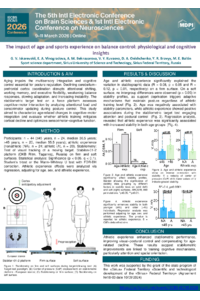
Introduction. Aging impairs the multisensory integration and cognitive control essential for posture regulation. Declining cerebellum–prefrontal cortex coordination disrupts attentional shifting, working memory, and executive flexibility, weakening balance responses, slowing adaptation, and increasing instability. The stabilometric target test on a force platform assesses cognitive–motor interaction by analyzing attentional load and sensorimotor updating during posture control. This study aimed to characterize age-related changes in cognitive–motor integration and evaluate whether athletic training mitigates cortical decline and optimizes sensorimotor–cognitive function.
Methods. Forty-four participants were divided by age (≤45 years, n = 24, median 36.5 years; >45 years, n = 20, median 55.5 years) and athletic experience (nonexperienced, n = 24; experienced, n = 20). All performed a stabilometric target test on the Stabilan-01-2 platform (OKB Ritm, Taganrog, Russia) on firm and soft surfaces, with stabilogram recording and frequency analysis. Statistical significance (p < 0.05, q < 0.1) was assessed using Student’s t-test or the Mann–Whitney U test with FDR-BH correction. Athletic experience effects were analyzed via regression, adjusting for age, sex, and training.
Results. Age and athletic experience significantly explained the variation in stabilographic data (p < 0.05 and p < 0.01, respectively) on a firm surface. Age was negatively associated with stability parameters (r < 0), while athletic experience showed positive associations (r > 0) during the stabilometric target test engaging attention and postural control. On a soft surface, no intergroup differences were observed, as support deprivation triggers adaptive mechanisms that maintain posture regardless of athletic training level. Regression analysis revealed that athletic experience was significantly associated with increased stability in both age groups.
Conclusion. Athletic experience enhanced stabilometric performance, improving visual–postural control and compensating for age-related decline. These results suggest stabilometric improvements are linked to training cognitive mechanisms, particularly attention and spatial orientation.
Keywords
Cognitive-motor integration
stability platform
postural regulation
aging and balance
sports training and balance
cortico-cerebellar network
Poster
sciforum-158551_Iskarevskii_G_V.pdf
Neuroprotective Effect of Centella Asiatica Extract on Experimentally Induced Brain Ischemia in Aged Rats
Modeling the blood–brain barrier under neuroinflammation using a BBB-on-a-Chip