Event submissions
Published
This submission belongs to the session S1. Mineral Geochemistry: Environmental Applications and Recent Advances of the event The 3rd International Online Conference on Mineral Science
Published date
06 Mar, 2026
Academic Editor
'%3e%3cpath%20d='M12.6657%2010.9104C12.4185%2010.325%2012.0599%209.79327%2011.6097%209.34482C11.1609%208.89508%2010.6293%208.5365%2010.0442%208.28888C10.0389%208.28626%2010.0337%208.28495%2010.0285%208.28233C10.8446%207.69279%2011.3752%206.73249%2011.3752%205.64904C11.3752%203.8542%209.92103%202.39999%208.1262%202.39999C6.33136%202.39999%204.87715%203.8542%204.87715%205.64904C4.87715%206.73249%205.40774%207.69279%206.22393%208.28364C6.21869%208.28626%206.21345%208.28757%206.20821%208.29019C5.62129%208.5378%205.09463%208.89284%204.64265%209.34613C4.1929%209.79493%203.83432%2010.3266%203.58671%2010.9117C3.34345%2011.4845%203.21226%2012.0987%203.20023%2012.7209C3.19988%2012.7349%203.20233%2012.7488%203.20744%2012.7619C3.21255%2012.7749%203.22022%2012.7867%203.22998%2012.7968C3.23975%2012.8068%203.25142%2012.8147%203.26431%2012.8202C3.2772%2012.8256%203.29105%2012.8284%203.30504%2012.8284H4.09109C4.14874%2012.8284%204.19459%2012.7825%204.1959%2012.7262C4.2221%2011.7148%204.62823%2010.7676%205.34617%2010.0497C6.08899%209.30683%207.0755%208.89808%208.1262%208.89808C9.17689%208.89808%2010.1634%209.30683%2010.9062%2010.0497C11.6242%2010.7676%2012.0303%2011.7148%2012.0565%2012.7262C12.0578%2012.7838%2012.1037%2012.8284%2012.1613%2012.8284H12.9474C12.9613%2012.8284%2012.9752%2012.8256%2012.9881%2012.8202C13.001%2012.8147%2013.0126%2012.8068%2013.0224%2012.7968C13.0322%2012.7867%2013.0398%2012.7749%2013.0449%2012.7619C13.0501%2012.7488%2013.0525%2012.7349%2013.0522%2012.7209C13.0391%2012.0947%2012.9094%2011.4855%2012.6657%2010.9104ZM8.1262%207.9024C7.52486%207.9024%206.9589%207.6679%206.53312%207.24211C6.10733%206.81633%205.87283%206.25037%205.87283%205.64904C5.87283%205.0477%206.10733%204.48174%206.53312%204.05596C6.9589%203.63018%207.52486%203.39567%208.1262%203.39567C8.72753%203.39567%209.29349%203.63018%209.71927%204.05596C10.1451%204.48174%2010.3796%205.0477%2010.3796%205.64904C10.3796%206.25037%2010.1451%206.81633%209.71927%207.24211C9.29349%207.6679%208.72753%207.9024%208.1262%207.9024Z'%20fill='%235D1EE1'/%3e%3c/g%3e%3c/svg%3e) Rafael M. Santos
Rafael M. SantosCitation
Matteo Alberghini, Giulio Galamini, Barbara Faccini, Giacomo Ferretti, SCALABLE AMMONIUM RECOVERY FROM LIVESTOCK AND MUNICIPAL DIGESTATES WITH ZEOLITIC-RICH TUFFS, in Proceedings of The 3rd International Online Conference on Mineral Science, 10 March–12 March 2026, MDPI: Basel, Switzerland
Share
Email
Facebook
Twitter
LinkedIn
SCALABLE AMMONIUM RECOVERY FROM LIVESTOCK AND MUNICIPAL DIGESTATES WITH ZEOLITIC-RICH TUFFS
'%3e%3cpath%20d='M12.6647%2010.9104C12.4176%2010.325%2012.0589%209.7933%2011.6088%209.34485C11.16%208.89511%2010.6283%208.53653%2010.0432%208.28891C10.038%208.28629%2010.0327%208.28498%2010.0275%208.28236C10.8437%207.69282%2011.3743%206.73252%2011.3743%205.64907C11.3743%203.85423%209.92005%202.40002%208.12522%202.40002C6.33038%202.40002%204.87618%203.85423%204.87618%205.64907C4.87618%206.73252%205.40677%207.69282%206.22296%208.28367C6.21772%208.28629%206.21248%208.2876%206.20724%208.29022C5.62031%208.53783%205.09365%208.89287%204.64167%209.34616C4.19192%209.79496%203.83334%2010.3266%203.58573%2010.9117C3.34247%2011.4846%203.21128%2012.0987%203.19925%2012.721C3.1989%2012.735%203.20135%2012.7489%203.20646%2012.7619C3.21157%2012.7749%203.21924%2012.7868%203.22901%2012.7968C3.23877%2012.8068%203.25045%2012.8148%203.26334%2012.8202C3.27623%2012.8256%203.29007%2012.8284%203.30406%2012.8284H4.09012C4.14776%2012.8284%204.19362%2012.7825%204.19493%2012.7262C4.22113%2011.7148%204.62726%2010.7676%205.34519%2010.0497C6.08802%209.30686%207.07452%208.89811%208.12522%208.89811C9.17592%208.89811%2010.1624%209.30686%2010.9052%2010.0497C11.6232%2010.7676%2012.0293%2011.7148%2012.0555%2012.7262C12.0568%2012.7839%2012.1027%2012.8284%2012.1603%2012.8284H12.9464C12.9604%2012.8284%2012.9742%2012.8256%2012.9871%2012.8202C13%2012.8148%2013.0117%2012.8068%2013.0214%2012.7968C13.0312%2012.7868%2013.0389%2012.7749%2013.044%2012.7619C13.0491%2012.7489%2013.0515%2012.735%2013.0512%2012.721C13.0381%2012.0947%2012.9084%2011.4856%2012.6647%2010.9104ZM8.12522%207.90243C7.52388%207.90243%206.95792%207.66793%206.53214%207.24215C6.10636%206.81636%205.87185%206.2504%205.87185%205.64907C5.87185%205.04773%206.10636%204.48177%206.53214%204.05599C6.95792%203.63021%207.52388%203.3957%208.12522%203.3957C8.72655%203.3957%209.29252%203.63021%209.7183%204.05599C10.1441%204.48177%2010.3786%205.04773%2010.3786%205.64907C10.3786%206.2504%2010.1441%206.81636%209.7183%207.24215C9.29252%207.66793%208.72655%207.90243%208.12522%207.90243Z'%20fill='%235D1EE1'/%3e%3c/g%3e%3c/svg%3e)
Matteo Alberghini 1
Giulio Galamini 2
Barbara Faccini 1

Giacomo Ferretti 3
1. Department of Environmental and Prevention Science, University of Ferrara, Via Luigi Borsari 46, 44121 Ferrara, Italy, Italy
2. Department of Chemical and Geological Sciences, University of Modena and Reggio Emilia, Via Giuseppe Campi 103, 41125, Modena, Italy, Italy
3. Department of Chemical, Pharmaceutical and Agricultural Sciences, University of Ferrara, Via Luigi Borsari 46, 44121 Ferrara, Italy, Italy
Abstract
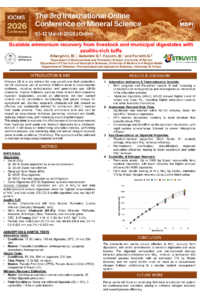
The circular recovery and reuse of nutrients from wastewater represent key strategies for achieving sustainability targets and the objectives of the EU Green Deal. In this study, the selective capture of ammonium (NH₄⁺) was investigated using two distinct zeolitic tuffs: one rich in chabazite and another enriched in both phillipsite and chabazite. This research aimed to assess their suitability for farm-scale applications by testing different anaerobic digestates, originating from swine, cattle, and municipal solid waste.
Adsorption isotherms and kinetic experiments were conducted to evaluate the influence of initial NH₄⁺ concentration, contact time, ionic competition (notably K⁺), total solids content, and pre-treatment conditions. Equilibrium data were best described by the Freundlich model, indicating a heterogeneous and multilayer adsorption process, while kinetic results fitted well with the pseudo-first-order and intraparticle diffusion models, highlighting ion exchange and diffusion as the predominant mechanisms. Under the same operating conditions, the chabazite-rich tuff exhibited higher ammonium uptake and faster adsorption kinetics compared to the phillipsite–chabazite tuff, reflecting differences in mineralogical composition and cation exchange capacity. NH₄⁺ removal efficiency decreased with increasing K⁺ concentration and solids content, whereas livestock digestates achieved the highest nitrogen recovery per gram of tuff due to their favorable composition and kinetics. Among the pre-treatments, centrifugation proved most effective, enhancing the accessibility of active exchange sites. A preliminary farm-scale batch test using microfiltered swine digestate at a 3% solid-to-liquid ratio confirmed operational feasibility, resulting in an estimated nitrogen recovery of 715 kg N per year. Overall, these results highlight the potential of zeolitic tuffs for promoting nutrient circularity in agriculture and provide insights for selecting materials to maximize ammonium recovery under diverse farm-scale scenarios.
Keywords
ammonium recovery
zeolitic tuffs
anaerobic digestates
farm-scale applications
wastewater reuse
Poster
Alberghini_Matteo_poster_sciforum-158421.pdf
Carbon sequestration potential of the mafic rocks from the Mindanao Eastern Pacific Cordillera, southern Philippines
A Computational Study on Geochemical Stability of Natural and Engineered Sesquioxide Nanominerals