Event submissions
Published
This submission belongs to the session S3. Nanominerals and Clays: Emerging Applications in Materials Science of the event The 3rd International Online Conference on Mineral Science
Published date
06 Mar, 2026
Academic Editor
'%3e%3cpath%20d='M12.6657%2010.9104C12.4185%2010.325%2012.0599%209.79327%2011.6097%209.34482C11.1609%208.89508%2010.6293%208.5365%2010.0442%208.28888C10.0389%208.28626%2010.0337%208.28495%2010.0285%208.28233C10.8446%207.69279%2011.3752%206.73249%2011.3752%205.64904C11.3752%203.8542%209.92103%202.39999%208.1262%202.39999C6.33136%202.39999%204.87715%203.8542%204.87715%205.64904C4.87715%206.73249%205.40774%207.69279%206.22393%208.28364C6.21869%208.28626%206.21345%208.28757%206.20821%208.29019C5.62129%208.5378%205.09463%208.89284%204.64265%209.34613C4.1929%209.79493%203.83432%2010.3266%203.58671%2010.9117C3.34345%2011.4845%203.21226%2012.0987%203.20023%2012.7209C3.19988%2012.7349%203.20233%2012.7488%203.20744%2012.7619C3.21255%2012.7749%203.22022%2012.7867%203.22998%2012.7968C3.23975%2012.8068%203.25142%2012.8147%203.26431%2012.8202C3.2772%2012.8256%203.29105%2012.8284%203.30504%2012.8284H4.09109C4.14874%2012.8284%204.19459%2012.7825%204.1959%2012.7262C4.2221%2011.7148%204.62823%2010.7676%205.34617%2010.0497C6.08899%209.30683%207.0755%208.89808%208.1262%208.89808C9.17689%208.89808%2010.1634%209.30683%2010.9062%2010.0497C11.6242%2010.7676%2012.0303%2011.7148%2012.0565%2012.7262C12.0578%2012.7838%2012.1037%2012.8284%2012.1613%2012.8284H12.9474C12.9613%2012.8284%2012.9752%2012.8256%2012.9881%2012.8202C13.001%2012.8147%2013.0126%2012.8068%2013.0224%2012.7968C13.0322%2012.7867%2013.0398%2012.7749%2013.0449%2012.7619C13.0501%2012.7488%2013.0525%2012.7349%2013.0522%2012.7209C13.0391%2012.0947%2012.9094%2011.4855%2012.6657%2010.9104ZM8.1262%207.9024C7.52486%207.9024%206.9589%207.6679%206.53312%207.24211C6.10733%206.81633%205.87283%206.25037%205.87283%205.64904C5.87283%205.0477%206.10733%204.48174%206.53312%204.05596C6.9589%203.63018%207.52486%203.39567%208.1262%203.39567C8.72753%203.39567%209.29349%203.63018%209.71927%204.05596C10.1451%204.48174%2010.3796%205.0477%2010.3796%205.64904C10.3796%206.25037%2010.1451%206.81633%209.71927%207.24211C9.29349%207.6679%208.72753%207.9024%208.1262%207.9024Z'%20fill='%235D1EE1'/%3e%3c/g%3e%3c/svg%3e) Andrey Kalinichev
Andrey KalinichevCitation
Md. Nurjaman Ridoy, Sabbir Hossain, Tahzib Ibrahim Protik, Sk. Tanjim Jaman Supto, A Computational Study on Geochemical Stability of Natural and Engineered Sesquioxide Nanominerals, in Proceedings of The 3rd International Online Conference on Mineral Science, 10 March–12 March 2026, MDPI: Basel, Switzerland
Share
Email
Facebook
Twitter
LinkedIn
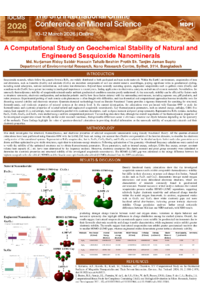
A Computational Study on Geochemical Stability of Natural and Engineered Sesquioxide Nanominerals

Md. Nurjaman Ridoy 1

Sabbir Hossain 1
'%3e%3cpath%20d='M12.6647%2010.9104C12.4176%2010.325%2012.0589%209.7933%2011.6088%209.34485C11.16%208.89511%2010.6283%208.53653%2010.0432%208.28891C10.038%208.28629%2010.0327%208.28498%2010.0275%208.28236C10.8437%207.69282%2011.3743%206.73252%2011.3743%205.64907C11.3743%203.85423%209.92005%202.40002%208.12522%202.40002C6.33038%202.40002%204.87618%203.85423%204.87618%205.64907C4.87618%206.73252%205.40677%207.69282%206.22296%208.28367C6.21772%208.28629%206.21248%208.2876%206.20724%208.29022C5.62031%208.53783%205.09365%208.89287%204.64167%209.34616C4.19192%209.79496%203.83334%2010.3266%203.58573%2010.9117C3.34247%2011.4846%203.21128%2012.0987%203.19925%2012.721C3.1989%2012.735%203.20135%2012.7489%203.20646%2012.7619C3.21157%2012.7749%203.21924%2012.7868%203.22901%2012.7968C3.23877%2012.8068%203.25045%2012.8148%203.26334%2012.8202C3.27623%2012.8256%203.29007%2012.8284%203.30406%2012.8284H4.09012C4.14776%2012.8284%204.19362%2012.7825%204.19493%2012.7262C4.22113%2011.7148%204.62726%2010.7676%205.34519%2010.0497C6.08802%209.30686%207.07452%208.89811%208.12522%208.89811C9.17592%208.89811%2010.1624%209.30686%2010.9052%2010.0497C11.6232%2010.7676%2012.0293%2011.7148%2012.0555%2012.7262C12.0568%2012.7839%2012.1027%2012.8284%2012.1603%2012.8284H12.9464C12.9604%2012.8284%2012.9742%2012.8256%2012.9871%2012.8202C13%2012.8148%2013.0117%2012.8068%2013.0214%2012.7968C13.0312%2012.7868%2013.0389%2012.7749%2013.044%2012.7619C13.0491%2012.7489%2013.0515%2012.735%2013.0512%2012.721C13.0381%2012.0947%2012.9084%2011.4856%2012.6647%2010.9104ZM8.12522%207.90243C7.52388%207.90243%206.95792%207.66793%206.53214%207.24215C6.10636%206.81636%205.87185%206.2504%205.87185%205.64907C5.87185%205.04773%206.10636%204.48177%206.53214%204.05599C6.95792%203.63021%207.52388%203.3957%208.12522%203.3957C8.72655%203.3957%209.29252%203.63021%209.7183%204.05599C10.1441%204.48177%2010.3786%205.04773%2010.3786%205.64907C10.3786%206.2504%2010.1441%206.81636%209.7183%207.24215C9.29252%207.66793%208.72655%207.90243%208.12522%207.90243Z'%20fill='%235D1EE1'/%3e%3c/g%3e%3c/svg%3e)
Tahzib Ibrahim Protik 1

Sk. Tanjim Jaman Supto 1
1. Department of Environmental Research, Nano Research Centre, Sylhet, 3114, Bangladesh, Bangladesh
Abstract
Sesquioxide minerals (R₂O₃) occur widely in natural systems, including Fe- and Al-based soil minerals such as hematite and corundum, and exist as technologically important engineered oxides such as Ga₂O₃, In₂O₃, and various rare-earth sesquioxides. Although these compounds are primarily recognized as highly thermodynamically stable and relevant in the environmental context, their nanoscale stability mechanisms in the presence of ambient geochemical conditions remain poorly understood. This study computationally evaluates the thermodynamic stability of representative natural and synthetic sesquioxide nanominerals to address this gap. Density functional theory (DFT) calculations were performed to obtain internal energy, enthalpy, Gibbs free energy, heat capacity (Cv), entropy, dipole moment, and point-group symmetry for selected R₂O₃ systems. For arsenolite-type As₂O₃, the verified values include an internal energy of −127691.670510234 eV, free energy of −127692.832381907 eV, Cv of 18.804 cal·mol⁻¹·K⁻¹, entropy of 91.852 cal·mol⁻¹·K⁻¹, a dipole moment of 5.2738 Debye, and Cs symmetry. Additional sesquioxides, including Fe₂O₃, Ga₂O₃, Sc₂O₃, Cr₂O₃, and others, were analyzed using the same computational protocol, with comparative trends observed across the dataset. The results indicate symmetry-dependent variations in electronic structure and dipole behavior even when their overall thermodynamic magnitudes remain comparable under standard conditions. These findings support the potential of quantum-chemical approaches for predicting nanoscale mineral stability in geochemical environments. Further work is needed to investigate interactions with aqueous ions and to explore stability variations across broader geochemical variables such as pH and redox conditions, to better link computational signatures with natural environmental behavior.
Keywords
nanominerals
density functional theory
gaussian 09w
geochemical stability
thermodynamic properties
environmental geochemistry
Poster
sciforum-161223.pdf
SCALABLE AMMONIUM RECOVERY FROM LIVESTOCK AND MUNICIPAL DIGESTATES WITH ZEOLITIC-RICH TUFFS
The chemical composition of ilmenite from different kimberlite pipes (south and north-east Yakutia)