Event submissions
Published
This submission belongs to the session S1. Digital Health Adoption and Innovation—A Vision for the Future of Healthcare of the event The 1st International Online Conference on Healthcare
Published date
20 Mar, 2026
Academic Editor
'%3e%3cpath%20d='M12.6657%2010.9104C12.4185%2010.325%2012.0599%209.79327%2011.6097%209.34482C11.1609%208.89508%2010.6293%208.5365%2010.0442%208.28888C10.0389%208.28626%2010.0337%208.28495%2010.0285%208.28233C10.8446%207.69279%2011.3752%206.73249%2011.3752%205.64904C11.3752%203.8542%209.92103%202.39999%208.1262%202.39999C6.33136%202.39999%204.87715%203.8542%204.87715%205.64904C4.87715%206.73249%205.40774%207.69279%206.22393%208.28364C6.21869%208.28626%206.21345%208.28757%206.20821%208.29019C5.62129%208.5378%205.09463%208.89284%204.64265%209.34613C4.1929%209.79493%203.83432%2010.3266%203.58671%2010.9117C3.34345%2011.4845%203.21226%2012.0987%203.20023%2012.7209C3.19988%2012.7349%203.20233%2012.7488%203.20744%2012.7619C3.21255%2012.7749%203.22022%2012.7867%203.22998%2012.7968C3.23975%2012.8068%203.25142%2012.8147%203.26431%2012.8202C3.2772%2012.8256%203.29105%2012.8284%203.30504%2012.8284H4.09109C4.14874%2012.8284%204.19459%2012.7825%204.1959%2012.7262C4.2221%2011.7148%204.62823%2010.7676%205.34617%2010.0497C6.08899%209.30683%207.0755%208.89808%208.1262%208.89808C9.17689%208.89808%2010.1634%209.30683%2010.9062%2010.0497C11.6242%2010.7676%2012.0303%2011.7148%2012.0565%2012.7262C12.0578%2012.7838%2012.1037%2012.8284%2012.1613%2012.8284H12.9474C12.9613%2012.8284%2012.9752%2012.8256%2012.9881%2012.8202C13.001%2012.8147%2013.0126%2012.8068%2013.0224%2012.7968C13.0322%2012.7867%2013.0398%2012.7749%2013.0449%2012.7619C13.0501%2012.7488%2013.0525%2012.7349%2013.0522%2012.7209C13.0391%2012.0947%2012.9094%2011.4855%2012.6657%2010.9104ZM8.1262%207.9024C7.52486%207.9024%206.9589%207.6679%206.53312%207.24211C6.10733%206.81633%205.87283%206.25037%205.87283%205.64904C5.87283%205.0477%206.10733%204.48174%206.53312%204.05596C6.9589%203.63018%207.52486%203.39567%208.1262%203.39567C8.72753%203.39567%209.29349%203.63018%209.71927%204.05596C10.1451%204.48174%2010.3796%205.0477%2010.3796%205.64904C10.3796%206.25037%2010.1451%206.81633%209.71927%207.24211C9.29349%207.6679%208.72753%207.9024%208.1262%207.9024Z'%20fill='%235D1EE1'/%3e%3c/g%3e%3c/svg%3e) Simona Tecco
Simona TeccoCitation
Cynthia White-Williams, Gulsah Koksalmis, Bari Hoffman, Aishwarya Joshi, Healthcare Professionals’ Intentions to Adopt Holoportation Technology, in Proceedings of The 1st International Online Conference on Healthcare, 25 March–26 March 2026, MDPI: Basel, Switzerland
Share
Email
Facebook
Twitter
LinkedIn
Healthcare Professionals’ Intentions to Adopt Holoportation Technology
'%3e%3cpath%20d='M12.6647%2010.9104C12.4176%2010.325%2012.0589%209.7933%2011.6088%209.34485C11.16%208.89511%2010.6283%208.53653%2010.0432%208.28891C10.038%208.28629%2010.0327%208.28498%2010.0275%208.28236C10.8437%207.69282%2011.3743%206.73252%2011.3743%205.64907C11.3743%203.85423%209.92005%202.40002%208.12522%202.40002C6.33038%202.40002%204.87618%203.85423%204.87618%205.64907C4.87618%206.73252%205.40677%207.69282%206.22296%208.28367C6.21772%208.28629%206.21248%208.2876%206.20724%208.29022C5.62031%208.53783%205.09365%208.89287%204.64167%209.34616C4.19192%209.79496%203.83334%2010.3266%203.58573%2010.9117C3.34247%2011.4846%203.21128%2012.0987%203.19925%2012.721C3.1989%2012.735%203.20135%2012.7489%203.20646%2012.7619C3.21157%2012.7749%203.21924%2012.7868%203.22901%2012.7968C3.23877%2012.8068%203.25045%2012.8148%203.26334%2012.8202C3.27623%2012.8256%203.29007%2012.8284%203.30406%2012.8284H4.09012C4.14776%2012.8284%204.19362%2012.7825%204.19493%2012.7262C4.22113%2011.7148%204.62726%2010.7676%205.34519%2010.0497C6.08802%209.30686%207.07452%208.89811%208.12522%208.89811C9.17592%208.89811%2010.1624%209.30686%2010.9052%2010.0497C11.6232%2010.7676%2012.0293%2011.7148%2012.0555%2012.7262C12.0568%2012.7839%2012.1027%2012.8284%2012.1603%2012.8284H12.9464C12.9604%2012.8284%2012.9742%2012.8256%2012.9871%2012.8202C13%2012.8148%2013.0117%2012.8068%2013.0214%2012.7968C13.0312%2012.7868%2013.0389%2012.7749%2013.044%2012.7619C13.0491%2012.7489%2013.0515%2012.735%2013.0512%2012.721C13.0381%2012.0947%2012.9084%2011.4856%2012.6647%2010.9104ZM8.12522%207.90243C7.52388%207.90243%206.95792%207.66793%206.53214%207.24215C6.10636%206.81636%205.87185%206.2504%205.87185%205.64907C5.87185%205.04773%206.10636%204.48177%206.53214%204.05599C6.95792%203.63021%207.52388%203.3957%208.12522%203.3957C8.72655%203.3957%209.29252%203.63021%209.7183%204.05599C10.1441%204.48177%2010.3786%205.04773%2010.3786%205.64907C10.3786%206.2504%2010.1441%206.81636%209.7183%207.24215C9.29252%207.66793%208.72655%207.90243%208.12522%207.90243Z'%20fill='%235D1EE1'/%3e%3c/g%3e%3c/svg%3e)
Cynthia White-Williams 1
Gulsah Koksalmis 1
Bari Hoffman 1
Aishwarya Joshi 1
1. School of Global Health Management and Informatics, University of Central Florida, Orlando, Florida, 32828, USA, USA
Abstract
Background:
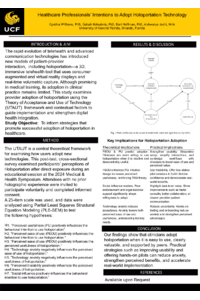
Holography offers a cutting-edge method for three-dimensional interaction between healthcare providers and patients. While its use in education and care delivery is growing, provider acceptance remains uncertain. This study investigates healthcare professionals’ intention to adopt holohealth technologies using the Unified Theory of Acceptance and Use of Technology (UTAUT)
Methods:
A cross-sectional survey was conducted following a presentation on Holoportation/Hologram tools at a healthcare providers’ conference. Participants completed a Qualtrics survey, and data were analyzed using SmartPLS 4 with partial least squares–structural equation modeling (PLS-SEM). The analysis assessed the measurement reliability and tested relationships within the structural model.
Results:
Results reveal that perceived ease of use (PEOU) is a key determinant of adoption, significantly predicting behavioral intention to use (BIU) (β = 0.414; p < 0.05) and perceived usefulness (PU) (β = 0.241; p < 0.05). This confirms that an intuitive, user-friendly design enhances both perceived utility and adoption likelihood. PU also significantly influences BIU (β = 0.243; p < 0.05), underscoring that professionals adopt holohealth when it improves efficiency or outcomes. Trialability has a positive effect on PU (β = 0.306; p < 0.05), indicating that hands-on exposure enhances perceived value. Social influence further drives adoption (β = 0.333; p < 0.05), reflecting the role of peer and organizational endorsement. Conversely, technology anxiety hinders adoption by reducing both PEOU (β = -0.644; p < 0.05) and PU (β = -0.472; p < 0.05). The structural model (R² = 0.718 for BIU) explains over 70% of the variance in adoption.
Conclusion:
This study provides empirical support for a comprehensive model of holohealth adoption. Key factors such as intuitive design, perceived benefits, peer support, and hands-on experience promote adoption, while anxiety about technology presents a barrier. These insights can guide implementation strategies that foster confidence and usability among healthcare professionals.
Keywords
Telehealth
Holoportation
Technology Acceptance Model
Poster
ICOH_cw3.4.pdf
Psychological Stress Mediates the Relationship Between Personality Characteristics and Eye-Blink Rate
Digital Health Strategies for Florida’s Emerging Chronic Disease Burden