Event submissions
Published
This submission belongs to the session S2. Patient-Centered Care—Optimizing Care Pathways through Engagement and Outcome Measurement of the event The 1st International Online Conference on Healthcare
Published date
20 Mar, 2026
Academic Editor
'%3e%3cpath%20d='M12.6657%2010.9104C12.4185%2010.325%2012.0599%209.79327%2011.6097%209.34482C11.1609%208.89508%2010.6293%208.5365%2010.0442%208.28888C10.0389%208.28626%2010.0337%208.28495%2010.0285%208.28233C10.8446%207.69279%2011.3752%206.73249%2011.3752%205.64904C11.3752%203.8542%209.92103%202.39999%208.1262%202.39999C6.33136%202.39999%204.87715%203.8542%204.87715%205.64904C4.87715%206.73249%205.40774%207.69279%206.22393%208.28364C6.21869%208.28626%206.21345%208.28757%206.20821%208.29019C5.62129%208.5378%205.09463%208.89284%204.64265%209.34613C4.1929%209.79493%203.83432%2010.3266%203.58671%2010.9117C3.34345%2011.4845%203.21226%2012.0987%203.20023%2012.7209C3.19988%2012.7349%203.20233%2012.7488%203.20744%2012.7619C3.21255%2012.7749%203.22022%2012.7867%203.22998%2012.7968C3.23975%2012.8068%203.25142%2012.8147%203.26431%2012.8202C3.2772%2012.8256%203.29105%2012.8284%203.30504%2012.8284H4.09109C4.14874%2012.8284%204.19459%2012.7825%204.1959%2012.7262C4.2221%2011.7148%204.62823%2010.7676%205.34617%2010.0497C6.08899%209.30683%207.0755%208.89808%208.1262%208.89808C9.17689%208.89808%2010.1634%209.30683%2010.9062%2010.0497C11.6242%2010.7676%2012.0303%2011.7148%2012.0565%2012.7262C12.0578%2012.7838%2012.1037%2012.8284%2012.1613%2012.8284H12.9474C12.9613%2012.8284%2012.9752%2012.8256%2012.9881%2012.8202C13.001%2012.8147%2013.0126%2012.8068%2013.0224%2012.7968C13.0322%2012.7867%2013.0398%2012.7749%2013.0449%2012.7619C13.0501%2012.7488%2013.0525%2012.7349%2013.0522%2012.7209C13.0391%2012.0947%2012.9094%2011.4855%2012.6657%2010.9104ZM8.1262%207.9024C7.52486%207.9024%206.9589%207.6679%206.53312%207.24211C6.10733%206.81633%205.87283%206.25037%205.87283%205.64904C5.87283%205.0477%206.10733%204.48174%206.53312%204.05596C6.9589%203.63018%207.52486%203.39567%208.1262%203.39567C8.72753%203.39567%209.29349%203.63018%209.71927%204.05596C10.1451%204.48174%2010.3796%205.0477%2010.3796%205.64904C10.3796%206.25037%2010.1451%206.81633%209.71927%207.24211C9.29349%207.6679%208.72753%207.9024%208.1262%207.9024Z'%20fill='%235D1EE1'/%3e%3c/g%3e%3c/svg%3e) Lorraine Evangelista
Lorraine EvangelistaCitation
Joshua Khorsandi, Michael Kahen, Brian Mansoury, Justin Kahen, Aria Damavandi, Moez Khorsandi, Co-Designed Digital Health Interventions for Underserved Populations: A Systematic Review of Adoption, Engagement, and Clinical Outcomes, in Proceedings of The 1st International Online Conference on Healthcare, 25 March–26 March 2026, MDPI: Basel, Switzerland
Share
Email
Facebook
Twitter
LinkedIn
Co-Designed Digital Health Interventions for Underserved Populations: A Systematic Review of Adoption, Engagement, and Clinical Outcomes
'%3e%3cpath%20d='M12.6647%2010.9104C12.4176%2010.325%2012.0589%209.7933%2011.6088%209.34485C11.16%208.89511%2010.6283%208.53653%2010.0432%208.28891C10.038%208.28629%2010.0327%208.28498%2010.0275%208.28236C10.8437%207.69282%2011.3743%206.73252%2011.3743%205.64907C11.3743%203.85423%209.92005%202.40002%208.12522%202.40002C6.33038%202.40002%204.87618%203.85423%204.87618%205.64907C4.87618%206.73252%205.40677%207.69282%206.22296%208.28367C6.21772%208.28629%206.21248%208.2876%206.20724%208.29022C5.62031%208.53783%205.09365%208.89287%204.64167%209.34616C4.19192%209.79496%203.83334%2010.3266%203.58573%2010.9117C3.34247%2011.4846%203.21128%2012.0987%203.19925%2012.721C3.1989%2012.735%203.20135%2012.7489%203.20646%2012.7619C3.21157%2012.7749%203.21924%2012.7868%203.22901%2012.7968C3.23877%2012.8068%203.25045%2012.8148%203.26334%2012.8202C3.27623%2012.8256%203.29007%2012.8284%203.30406%2012.8284H4.09012C4.14776%2012.8284%204.19362%2012.7825%204.19493%2012.7262C4.22113%2011.7148%204.62726%2010.7676%205.34519%2010.0497C6.08802%209.30686%207.07452%208.89811%208.12522%208.89811C9.17592%208.89811%2010.1624%209.30686%2010.9052%2010.0497C11.6232%2010.7676%2012.0293%2011.7148%2012.0555%2012.7262C12.0568%2012.7839%2012.1027%2012.8284%2012.1603%2012.8284H12.9464C12.9604%2012.8284%2012.9742%2012.8256%2012.9871%2012.8202C13%2012.8148%2013.0117%2012.8068%2013.0214%2012.7968C13.0312%2012.7868%2013.0389%2012.7749%2013.044%2012.7619C13.0491%2012.7489%2013.0515%2012.735%2013.0512%2012.721C13.0381%2012.0947%2012.9084%2011.4856%2012.6647%2010.9104ZM8.12522%207.90243C7.52388%207.90243%206.95792%207.66793%206.53214%207.24215C6.10636%206.81636%205.87185%206.2504%205.87185%205.64907C5.87185%205.04773%206.10636%204.48177%206.53214%204.05599C6.95792%203.63021%207.52388%203.3957%208.12522%203.3957C8.72655%203.3957%209.29252%203.63021%209.7183%204.05599C10.1441%204.48177%2010.3786%205.04773%2010.3786%205.64907C10.3786%206.2504%2010.1441%206.81636%209.7183%207.24215C9.29252%207.66793%208.72655%207.90243%208.12522%207.90243Z'%20fill='%235D1EE1'/%3e%3c/g%3e%3c/svg%3e)
Joshua Khorsandi 1
Michael Kahen 2
Brian Mansoury 2
Justin Kahen 2
Aria Damavandi 2
Moez Khorsandi 3
1. Kirk Kerkorian School of Medicine, University of Nevada, Las Vegas, Las Vegas, NV 89106, USA, USA
2. Department of Life Sciences, University of California Los Angeles, CA 90095, USA., USA
3. Clinical Professor of Surgery, Western University of Health Sciences, CA 91766, USA., USA
Abstract
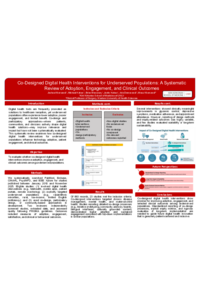
Introduction: Digital health tools are frequently promoted as solutions to healthcare inequities, yet underserved populations often experience lower adoption, poorer engagement, and limited benefit. Co-design and participatory approaches—where patients, communities, and clinicians actively shape digital health solutions—may improve relevance and impact but have not been systematically evaluated. This systematic review examines how co-designed digital health interventions for underserved populations influence technology adoption, patient engagement, and clinical outcomes.
Methods: We systematically searched PubMed, Embase, CINAHL, PsycINFO, and IEEE Xplore for studies published between January 2010 and November 2025. Eligible studies (1) involved digital health interventions (e.g., telehealth, mobile apps, patient portals, remote monitoring); (2) explicitly targeted underserved populations (e.g., racial/ethnic minorities, rural, low-income, limited English proficiency); and (3) used co-design, participatory design, or community-based approaches in development. Two reviewers independently screened studies, extracted data, and assessed quality following PRISMA guidelines. Outcomes included measures of adoption, engagement, satisfaction, and clinical or behavioral outcomes.
Results: Of 863 records, 23 studies met the inclusion criteria. Co-designed interventions most frequently targeted chronic disease management, mental health, and maternal–child health. Studies reporting detailed co-design processes (e.g., iterative prototyping, community advisory boards, bilingual interfaces, culturally grounded content) demonstrated higher adoption and sustained engagement compared with top–down implementations in similar populations. Several interventions showed clinically meaningful improvements in glycemic control, depressive symptoms, medication adherence, and appointment attendance. However, the reporting of design methods and equity-related outcomes was highly variable, and few studies evaluated scalability or long-term sustainability.
Conclusions: Co-designed digital health interventions show promise for improving adoption, engagement, and selected clinical outcomes among underserved populations. Standardized reporting of co-design processes, explicit equity metrics, and rigorous evaluation of long-term implementation are needed to guide future digital health innovation that is genuinely patient-centered and inclusive.
Keywords
digital health
underserved populations
health equity
patient engagement
community-based design
culturally tailored interventions
Poster
Khorsandi_Eposter.pdf
Quality of Work Life Among nurses in Tunisian University Hospitals: A Cross-Sectional Study
Video Laryngeal Mask Airways for Airway Management: A Scoping Review