Event submissions
Published
This submission belongs to the session S2. Patient-Centered Care—Optimizing Care Pathways through Engagement and Outcome Measurement of the event The 1st International Online Conference on Healthcare
Published date
20 Mar, 2026
Academic Editor
'%3e%3cpath%20d='M12.6657%2010.9104C12.4185%2010.325%2012.0599%209.79327%2011.6097%209.34482C11.1609%208.89508%2010.6293%208.5365%2010.0442%208.28888C10.0389%208.28626%2010.0337%208.28495%2010.0285%208.28233C10.8446%207.69279%2011.3752%206.73249%2011.3752%205.64904C11.3752%203.8542%209.92103%202.39999%208.1262%202.39999C6.33136%202.39999%204.87715%203.8542%204.87715%205.64904C4.87715%206.73249%205.40774%207.69279%206.22393%208.28364C6.21869%208.28626%206.21345%208.28757%206.20821%208.29019C5.62129%208.5378%205.09463%208.89284%204.64265%209.34613C4.1929%209.79493%203.83432%2010.3266%203.58671%2010.9117C3.34345%2011.4845%203.21226%2012.0987%203.20023%2012.7209C3.19988%2012.7349%203.20233%2012.7488%203.20744%2012.7619C3.21255%2012.7749%203.22022%2012.7867%203.22998%2012.7968C3.23975%2012.8068%203.25142%2012.8147%203.26431%2012.8202C3.2772%2012.8256%203.29105%2012.8284%203.30504%2012.8284H4.09109C4.14874%2012.8284%204.19459%2012.7825%204.1959%2012.7262C4.2221%2011.7148%204.62823%2010.7676%205.34617%2010.0497C6.08899%209.30683%207.0755%208.89808%208.1262%208.89808C9.17689%208.89808%2010.1634%209.30683%2010.9062%2010.0497C11.6242%2010.7676%2012.0303%2011.7148%2012.0565%2012.7262C12.0578%2012.7838%2012.1037%2012.8284%2012.1613%2012.8284H12.9474C12.9613%2012.8284%2012.9752%2012.8256%2012.9881%2012.8202C13.001%2012.8147%2013.0126%2012.8068%2013.0224%2012.7968C13.0322%2012.7867%2013.0398%2012.7749%2013.0449%2012.7619C13.0501%2012.7488%2013.0525%2012.7349%2013.0522%2012.7209C13.0391%2012.0947%2012.9094%2011.4855%2012.6657%2010.9104ZM8.1262%207.9024C7.52486%207.9024%206.9589%207.6679%206.53312%207.24211C6.10733%206.81633%205.87283%206.25037%205.87283%205.64904C5.87283%205.0477%206.10733%204.48174%206.53312%204.05596C6.9589%203.63018%207.52486%203.39567%208.1262%203.39567C8.72753%203.39567%209.29349%203.63018%209.71927%204.05596C10.1451%204.48174%2010.3796%205.0477%2010.3796%205.64904C10.3796%206.25037%2010.1451%206.81633%209.71927%207.24211C9.29349%207.6679%208.72753%207.9024%208.1262%207.9024Z'%20fill='%235D1EE1'/%3e%3c/g%3e%3c/svg%3e) Lorraine Evangelista
Lorraine EvangelistaCitation
Joshua Khorsandi, Aria Damavandi, Michael Kahen, Brian Mansoury, Justin Kahen, Moez Khorsandi, Adaptive Personalization in Digital Therapeutics: A Systematic Review of Real-Time Patient-Centered Tailoring Mechanisms and Their Clinical Outcomes, in Proceedings of The 1st International Online Conference on Healthcare, 25 March–26 March 2026, MDPI: Basel, Switzerland
Share
Email
Facebook
Twitter
LinkedIn
Adaptive Personalization in Digital Therapeutics: A Systematic Review of Real-Time Patient-Centered Tailoring Mechanisms and Their Clinical Outcomes
'%3e%3cpath%20d='M12.6647%2010.9104C12.4176%2010.325%2012.0589%209.7933%2011.6088%209.34485C11.16%208.89511%2010.6283%208.53653%2010.0432%208.28891C10.038%208.28629%2010.0327%208.28498%2010.0275%208.28236C10.8437%207.69282%2011.3743%206.73252%2011.3743%205.64907C11.3743%203.85423%209.92005%202.40002%208.12522%202.40002C6.33038%202.40002%204.87618%203.85423%204.87618%205.64907C4.87618%206.73252%205.40677%207.69282%206.22296%208.28367C6.21772%208.28629%206.21248%208.2876%206.20724%208.29022C5.62031%208.53783%205.09365%208.89287%204.64167%209.34616C4.19192%209.79496%203.83334%2010.3266%203.58573%2010.9117C3.34247%2011.4846%203.21128%2012.0987%203.19925%2012.721C3.1989%2012.735%203.20135%2012.7489%203.20646%2012.7619C3.21157%2012.7749%203.21924%2012.7868%203.22901%2012.7968C3.23877%2012.8068%203.25045%2012.8148%203.26334%2012.8202C3.27623%2012.8256%203.29007%2012.8284%203.30406%2012.8284H4.09012C4.14776%2012.8284%204.19362%2012.7825%204.19493%2012.7262C4.22113%2011.7148%204.62726%2010.7676%205.34519%2010.0497C6.08802%209.30686%207.07452%208.89811%208.12522%208.89811C9.17592%208.89811%2010.1624%209.30686%2010.9052%2010.0497C11.6232%2010.7676%2012.0293%2011.7148%2012.0555%2012.7262C12.0568%2012.7839%2012.1027%2012.8284%2012.1603%2012.8284H12.9464C12.9604%2012.8284%2012.9742%2012.8256%2012.9871%2012.8202C13%2012.8148%2013.0117%2012.8068%2013.0214%2012.7968C13.0312%2012.7868%2013.0389%2012.7749%2013.044%2012.7619C13.0491%2012.7489%2013.0515%2012.735%2013.0512%2012.721C13.0381%2012.0947%2012.9084%2011.4856%2012.6647%2010.9104ZM8.12522%207.90243C7.52388%207.90243%206.95792%207.66793%206.53214%207.24215C6.10636%206.81636%205.87185%206.2504%205.87185%205.64907C5.87185%205.04773%206.10636%204.48177%206.53214%204.05599C6.95792%203.63021%207.52388%203.3957%208.12522%203.3957C8.72655%203.3957%209.29252%203.63021%209.7183%204.05599C10.1441%204.48177%2010.3786%205.04773%2010.3786%205.64907C10.3786%206.2504%2010.1441%206.81636%209.7183%207.24215C9.29252%207.66793%208.72655%207.90243%208.12522%207.90243Z'%20fill='%235D1EE1'/%3e%3c/g%3e%3c/svg%3e)
Joshua Khorsandi 1
Aria Damavandi 2
Michael Kahen 2
Brian Mansoury 2
Justin Kahen 2
Moez Khorsandi 3
1. Kirk Kerkorian School of Medicine, University of Nevada, Las Vegas, Las Vegas, NV 89106, USA, USA
2. Department of Life Sciences, University of California Los Angeles, CA 90095, USA., USA
3. Clinical Professor of Surgery, Western University of Health Sciences, CA 91766, USA., USA
Abstract
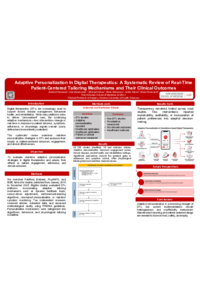
Introduction: Digital therapeutics (DTxs) are increasingly used to support chronic disease management, behavioral health, and rehabilitation. While many platforms claim to deliver “personalized” care, the underlying adaptive mechanisms—how interventions change in real time in response to patient behavior, symptoms, adherence, or physiologic signals—remain poorly defined and inconsistently evaluated. This systematic review examines real-time personalization strategies in DTxs and assesses their impact on patient-centered outcomes, engagement, and clinical effectiveness.
Methods: We searched PubMed, Embase, PsycINFO, and IEEE Xplore for studies published from January 2015 to November 2025. Eligible studies evaluated DTx platforms incorporating adaptive tailoring mechanisms such as dynamic feedback loops, sensor-driven adjustments, reinforcement learning algorithms, rule-based personalization, or real-time symptom monitoring. Two independent reviewers screened articles, extracted data, and assessed methodological quality using PRISMA guidelines. Personalization mechanisms were categorized into algorithmic, behavioral, and physiological tailoring modalities.
Results: Out of 303 potential studies, 19 articles met the inclusion criteria. Adaptive personalization significantly improved patient engagement across chronic disease management, mental health, and physical rehabilitation domains. Algorithmic personalization (e.g., reinforcement-learning recommendations, automated therapy dose adjustments) produced the largest gains in adherence and symptom control, while physiological tailoring using wearables improved real-time detection of deterioration. However, transparency regarding how personalization decisions were made was limited in most studies. Few interventions incorporated patient preferences or shared decision-making into their adaptive logic, and only 37% provided auditability or explainability features.
Conclusions: Personalization is often cited as a core strength of digital therapeutics, yet current implementations vary widely and are insufficiently transparent. Evidence suggests that real-time adaptive tailoring enhances engagement and clinical outcomes, but patient-centered co-design, explainability, and standardized reporting of personalization mechanisms are urgently needed for safe, equitable, and trustworthy DTx deployment.
Keywords
digital therapeutics
adaptive personalization
real-time tailoring
reinforcement learning
sensor-driven monitoring
patient engagement
Poster
Kahen M Poster.pdf
Video Laryngeal Mask Airways for Airway Management: A Scoping Review
Development and implementation of a structured emergency nursing triage training program