Event submissions
Published
This submission belongs to the session S5. Generative AI in Clinical Practice—Evidence-Based Evaluation of Diagnostic and Therapeutic Applications of the event The 1st International Online Conference on Healthcare
Published date
20 Mar, 2026
Academic Editor
'%3e%3cpath%20d='M12.6657%2010.9104C12.4185%2010.325%2012.0599%209.79327%2011.6097%209.34482C11.1609%208.89508%2010.6293%208.5365%2010.0442%208.28888C10.0389%208.28626%2010.0337%208.28495%2010.0285%208.28233C10.8446%207.69279%2011.3752%206.73249%2011.3752%205.64904C11.3752%203.8542%209.92103%202.39999%208.1262%202.39999C6.33136%202.39999%204.87715%203.8542%204.87715%205.64904C4.87715%206.73249%205.40774%207.69279%206.22393%208.28364C6.21869%208.28626%206.21345%208.28757%206.20821%208.29019C5.62129%208.5378%205.09463%208.89284%204.64265%209.34613C4.1929%209.79493%203.83432%2010.3266%203.58671%2010.9117C3.34345%2011.4845%203.21226%2012.0987%203.20023%2012.7209C3.19988%2012.7349%203.20233%2012.7488%203.20744%2012.7619C3.21255%2012.7749%203.22022%2012.7867%203.22998%2012.7968C3.23975%2012.8068%203.25142%2012.8147%203.26431%2012.8202C3.2772%2012.8256%203.29105%2012.8284%203.30504%2012.8284H4.09109C4.14874%2012.8284%204.19459%2012.7825%204.1959%2012.7262C4.2221%2011.7148%204.62823%2010.7676%205.34617%2010.0497C6.08899%209.30683%207.0755%208.89808%208.1262%208.89808C9.17689%208.89808%2010.1634%209.30683%2010.9062%2010.0497C11.6242%2010.7676%2012.0303%2011.7148%2012.0565%2012.7262C12.0578%2012.7838%2012.1037%2012.8284%2012.1613%2012.8284H12.9474C12.9613%2012.8284%2012.9752%2012.8256%2012.9881%2012.8202C13.001%2012.8147%2013.0126%2012.8068%2013.0224%2012.7968C13.0322%2012.7867%2013.0398%2012.7749%2013.0449%2012.7619C13.0501%2012.7488%2013.0525%2012.7349%2013.0522%2012.7209C13.0391%2012.0947%2012.9094%2011.4855%2012.6657%2010.9104ZM8.1262%207.9024C7.52486%207.9024%206.9589%207.6679%206.53312%207.24211C6.10733%206.81633%205.87283%206.25037%205.87283%205.64904C5.87283%205.0477%206.10733%204.48174%206.53312%204.05596C6.9589%203.63018%207.52486%203.39567%208.1262%203.39567C8.72753%203.39567%209.29349%203.63018%209.71927%204.05596C10.1451%204.48174%2010.3796%205.0477%2010.3796%205.64904C10.3796%206.25037%2010.1451%206.81633%209.71927%207.24211C9.29349%207.6679%208.72753%207.9024%208.1262%207.9024Z'%20fill='%235D1EE1'/%3e%3c/g%3e%3c/svg%3e) Lorraine Evangelista
Lorraine EvangelistaCitation
Joshua Khorsandi, Brian Mansoury, Justin Kahen, Aria Damavandi, Michael Kahen, Moez Khorsandi, Safety, Bias, and Hallucination Mitigation in Clinical Applications of Generative Artificial Intelligence: A Systematic Review of Current Evidence, in Proceedings of The 1st International Online Conference on Healthcare, 25 March–26 March 2026, MDPI: Basel, Switzerland
Share
Email
Facebook
Twitter
LinkedIn
Safety, Bias, and Hallucination Mitigation in Clinical Applications of Generative Artificial Intelligence: A Systematic Review of Current Evidence
'%3e%3cpath%20d='M12.6647%2010.9104C12.4176%2010.325%2012.0589%209.7933%2011.6088%209.34485C11.16%208.89511%2010.6283%208.53653%2010.0432%208.28891C10.038%208.28629%2010.0327%208.28498%2010.0275%208.28236C10.8437%207.69282%2011.3743%206.73252%2011.3743%205.64907C11.3743%203.85423%209.92005%202.40002%208.12522%202.40002C6.33038%202.40002%204.87618%203.85423%204.87618%205.64907C4.87618%206.73252%205.40677%207.69282%206.22296%208.28367C6.21772%208.28629%206.21248%208.2876%206.20724%208.29022C5.62031%208.53783%205.09365%208.89287%204.64167%209.34616C4.19192%209.79496%203.83334%2010.3266%203.58573%2010.9117C3.34247%2011.4846%203.21128%2012.0987%203.19925%2012.721C3.1989%2012.735%203.20135%2012.7489%203.20646%2012.7619C3.21157%2012.7749%203.21924%2012.7868%203.22901%2012.7968C3.23877%2012.8068%203.25045%2012.8148%203.26334%2012.8202C3.27623%2012.8256%203.29007%2012.8284%203.30406%2012.8284H4.09012C4.14776%2012.8284%204.19362%2012.7825%204.19493%2012.7262C4.22113%2011.7148%204.62726%2010.7676%205.34519%2010.0497C6.08802%209.30686%207.07452%208.89811%208.12522%208.89811C9.17592%208.89811%2010.1624%209.30686%2010.9052%2010.0497C11.6232%2010.7676%2012.0293%2011.7148%2012.0555%2012.7262C12.0568%2012.7839%2012.1027%2012.8284%2012.1603%2012.8284H12.9464C12.9604%2012.8284%2012.9742%2012.8256%2012.9871%2012.8202C13%2012.8148%2013.0117%2012.8068%2013.0214%2012.7968C13.0312%2012.7868%2013.0389%2012.7749%2013.044%2012.7619C13.0491%2012.7489%2013.0515%2012.735%2013.0512%2012.721C13.0381%2012.0947%2012.9084%2011.4856%2012.6647%2010.9104ZM8.12522%207.90243C7.52388%207.90243%206.95792%207.66793%206.53214%207.24215C6.10636%206.81636%205.87185%206.2504%205.87185%205.64907C5.87185%205.04773%206.10636%204.48177%206.53214%204.05599C6.95792%203.63021%207.52388%203.3957%208.12522%203.3957C8.72655%203.3957%209.29252%203.63021%209.7183%204.05599C10.1441%204.48177%2010.3786%205.04773%2010.3786%205.64907C10.3786%206.2504%2010.1441%206.81636%209.7183%207.24215C9.29252%207.66793%208.72655%207.90243%208.12522%207.90243Z'%20fill='%235D1EE1'/%3e%3c/g%3e%3c/svg%3e)
Joshua Khorsandi 1
Brian Mansoury 2
Justin Kahen 2
Aria Damavandi 2
Michael Kahen 2
Moez Khorsandi 3
1. Kirk Kerkorian School of Medicine, University of Nevada Las Vegas, NV 89106, USA., USA
2. Department of Life Sciences, University of California Los Angeles, CA 90095, USA., USA
3. Clinical Professor of Surgery, Western University of Health Sciences, CA 91766, USA., USA
Abstract
INTRODUCTION: Generative Artificial Intelligence (GenAI) models are rapidly transitioning from prototype tools to active participants in clinical workflows. Despite their promise in documentation, triage, and diagnostic reasoning, concerns regarding hallucinations, biased outputs, and unreliable reasoning remain a major barrier to safe clinical adoption. This systematic review synthesizes the current evidence on safety risks associated with GenAI in medicine and evaluates the effectiveness of emerging mitigation strategies.
METHODS: A systematic search of PubMed, Scopus, Web of Science, and IEEE Xplore was conducted for studies published between January 2015 and October 2025. Eligible studies empirically evaluated the clinical use, safety, or mitigation strategies for hallucinations or biased outputs in GenAI models. Two independent reviewers screened articles, extracted data, and assessed methodological quality using the PRISMA guidelines. Mitigation strategies were categorized into model-level, workflow-level, and human-in-the-loop interventions.
RESULTS: Across recent evaluations of AI models in healthcare, hallucination and omission rates vary widely by task. In one large clinical summarization study involving 12,999 clinician-annotated sentences, AI systems produced hallucinations in 1.47% of sentences and omissions in 3.45%, with structured prompting reducing major errors substantially. Other evaluations of clinical case vignettes have reported hallucination rates ranging from 50% to over 80%, with prompt-based mitigation lowering rates from 66% to 44%. Bias has also been documented across domains; for example, approximately 40% of radiology-reporting studies identified hallucinations or misdiagnosis events, and broader reviews note performance disparities linked to race and gender. Effective mitigation strategies across studies include grounding outputs in verified clinical sources, retrieval-augmented generation, structured prompts, and explicit uncertainty expression review to prevent error propagation in clinical documentation and decision support.
CONCLUSIONS: The current evidence demonstrates that hallucinations and biased outputs remain substantial risks in GenAI-supported clinical practice, but several emerging mitigation approaches show promise for improving reliability. Standardized evaluation frameworks and transparent reporting of model uncertainty are needed to support safe integration of GenAI into healthcare.
Keywords
Generative AI
clinical safety
algorithmic bias
mitigation strategies
clinical decision support
Poster
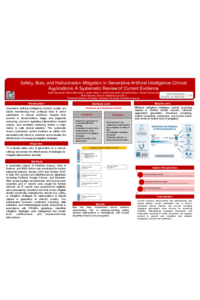
Khorsandi_Eposter.pdf
From Accuracy to Equity: Addressing Hallucination Risks and Bias in AI-Driven Clinical Decision Support Systems
ADVANCEMENTS IN PREDICTING DIABETES BIOMARKERS: A MACHINE LEARNING EPIGENETIC APPROACH