Event submissions
Published
This submission belongs to the session S5. Generative AI in Clinical Practice—Evidence-Based Evaluation of Diagnostic and Therapeutic Applications of the event The 1st International Online Conference on Healthcare
Published date
20 Mar, 2026
Academic Editor
'%3e%3cpath%20d='M12.6657%2010.9104C12.4185%2010.325%2012.0599%209.79327%2011.6097%209.34482C11.1609%208.89508%2010.6293%208.5365%2010.0442%208.28888C10.0389%208.28626%2010.0337%208.28495%2010.0285%208.28233C10.8446%207.69279%2011.3752%206.73249%2011.3752%205.64904C11.3752%203.8542%209.92103%202.39999%208.1262%202.39999C6.33136%202.39999%204.87715%203.8542%204.87715%205.64904C4.87715%206.73249%205.40774%207.69279%206.22393%208.28364C6.21869%208.28626%206.21345%208.28757%206.20821%208.29019C5.62129%208.5378%205.09463%208.89284%204.64265%209.34613C4.1929%209.79493%203.83432%2010.3266%203.58671%2010.9117C3.34345%2011.4845%203.21226%2012.0987%203.20023%2012.7209C3.19988%2012.7349%203.20233%2012.7488%203.20744%2012.7619C3.21255%2012.7749%203.22022%2012.7867%203.22998%2012.7968C3.23975%2012.8068%203.25142%2012.8147%203.26431%2012.8202C3.2772%2012.8256%203.29105%2012.8284%203.30504%2012.8284H4.09109C4.14874%2012.8284%204.19459%2012.7825%204.1959%2012.7262C4.2221%2011.7148%204.62823%2010.7676%205.34617%2010.0497C6.08899%209.30683%207.0755%208.89808%208.1262%208.89808C9.17689%208.89808%2010.1634%209.30683%2010.9062%2010.0497C11.6242%2010.7676%2012.0303%2011.7148%2012.0565%2012.7262C12.0578%2012.7838%2012.1037%2012.8284%2012.1613%2012.8284H12.9474C12.9613%2012.8284%2012.9752%2012.8256%2012.9881%2012.8202C13.001%2012.8147%2013.0126%2012.8068%2013.0224%2012.7968C13.0322%2012.7867%2013.0398%2012.7749%2013.0449%2012.7619C13.0501%2012.7488%2013.0525%2012.7349%2013.0522%2012.7209C13.0391%2012.0947%2012.9094%2011.4855%2012.6657%2010.9104ZM8.1262%207.9024C7.52486%207.9024%206.9589%207.6679%206.53312%207.24211C6.10733%206.81633%205.87283%206.25037%205.87283%205.64904C5.87283%205.0477%206.10733%204.48174%206.53312%204.05596C6.9589%203.63018%207.52486%203.39567%208.1262%203.39567C8.72753%203.39567%209.29349%203.63018%209.71927%204.05596C10.1451%204.48174%2010.3796%205.0477%2010.3796%205.64904C10.3796%206.25037%2010.1451%206.81633%209.71927%207.24211C9.29349%207.6679%208.72753%207.9024%208.1262%207.9024Z'%20fill='%235D1EE1'/%3e%3c/g%3e%3c/svg%3e) Lorraine Evangelista
Lorraine EvangelistaCitation
Reena Ughreja, From Accuracy to Equity: Addressing Hallucination Risks and Bias in AI-Driven Clinical Decision Support Systems, in Proceedings of The 1st International Online Conference on Healthcare, 25 March–26 March 2026, MDPI: Basel, Switzerland
Share
Email
Facebook
Twitter
LinkedIn
From Accuracy to Equity: Addressing Hallucination Risks and Bias in AI-Driven Clinical Decision Support Systems
'%3e%3cpath%20d='M12.6647%2010.9104C12.4176%2010.325%2012.0589%209.7933%2011.6088%209.34485C11.16%208.89511%2010.6283%208.53653%2010.0432%208.28891C10.038%208.28629%2010.0327%208.28498%2010.0275%208.28236C10.8437%207.69282%2011.3743%206.73252%2011.3743%205.64907C11.3743%203.85423%209.92005%202.40002%208.12522%202.40002C6.33038%202.40002%204.87618%203.85423%204.87618%205.64907C4.87618%206.73252%205.40677%207.69282%206.22296%208.28367C6.21772%208.28629%206.21248%208.2876%206.20724%208.29022C5.62031%208.53783%205.09365%208.89287%204.64167%209.34616C4.19192%209.79496%203.83334%2010.3266%203.58573%2010.9117C3.34247%2011.4846%203.21128%2012.0987%203.19925%2012.721C3.1989%2012.735%203.20135%2012.7489%203.20646%2012.7619C3.21157%2012.7749%203.21924%2012.7868%203.22901%2012.7968C3.23877%2012.8068%203.25045%2012.8148%203.26334%2012.8202C3.27623%2012.8256%203.29007%2012.8284%203.30406%2012.8284H4.09012C4.14776%2012.8284%204.19362%2012.7825%204.19493%2012.7262C4.22113%2011.7148%204.62726%2010.7676%205.34519%2010.0497C6.08802%209.30686%207.07452%208.89811%208.12522%208.89811C9.17592%208.89811%2010.1624%209.30686%2010.9052%2010.0497C11.6232%2010.7676%2012.0293%2011.7148%2012.0555%2012.7262C12.0568%2012.7839%2012.1027%2012.8284%2012.1603%2012.8284H12.9464C12.9604%2012.8284%2012.9742%2012.8256%2012.9871%2012.8202C13%2012.8148%2013.0117%2012.8068%2013.0214%2012.7968C13.0312%2012.7868%2013.0389%2012.7749%2013.044%2012.7619C13.0491%2012.7489%2013.0515%2012.735%2013.0512%2012.721C13.0381%2012.0947%2012.9084%2011.4856%2012.6647%2010.9104ZM8.12522%207.90243C7.52388%207.90243%206.95792%207.66793%206.53214%207.24215C6.10636%206.81636%205.87185%206.2504%205.87185%205.64907C5.87185%205.04773%206.10636%204.48177%206.53214%204.05599C6.95792%203.63021%207.52388%203.3957%208.12522%203.3957C8.72655%203.3957%209.29252%203.63021%209.7183%204.05599C10.1441%204.48177%2010.3786%205.04773%2010.3786%205.64907C10.3786%206.2504%2010.1441%206.81636%209.7183%207.24215C9.29252%207.66793%208.72655%207.90243%208.12522%207.90243Z'%20fill='%235D1EE1'/%3e%3c/g%3e%3c/svg%3e)
Reena Ughreja 1
1. School of Pharmaceutical Sciences, Faculty of Health Sciences, Atmiya University, Rajkot 360005, India, India
Abstract
Introduction:
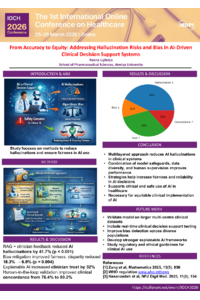
Incorporating the use of artificial intelligence (AI) in clinical decision support systems has been shown to improve the diagnostic accuracy and efficiency of workflow. However, AI hallucinations, which are defined as the production of factual or verifiably false outputs, and long-term bias, which compromises fairness between demographic groups, are also highly significant barriers to safe clinical use. The current study explores systematic measures to reduce AI hallucinations and bias and increase justice in clinical AI implementation.
Methods:
A mixed-methods experimental design was employed using a benchmark dataset of 2,000 de-identified electronic health records stratified by gender, age, and socioeconomic status. Model-level interventions included (i) retrieval-augmented generation (RAG) using curated clinical knowledge bases; (ii) uncertainty calibration via probabilistic confidence scoring; and (iii) reinforcement learning with clinician feedback (RLHF). Data-level interventions comprised dataset diversification, subgroup-wise bias auditing, and stratified resampling to correct demographic imbalance. Governance-level measures included post hoc explainability using SHAP-based feature attribution and structured human-in-the-loop (HITL) validation by board-certified clinicians. Quantitative evaluation involved hallucination rate measurement, predictive parity and demographic disparity analysis, and clinical concordance scoring against expert-validated ground truth. Statistical significance was assessed using paired t-tests and chi-square tests, with p < 0.05 considered significant.
Results:
RAG use in combination with clinician-directed feedback decreased the occurrence of hallucinations by 41.7 % compared to baseline models (p<0.001). The predictive parity of bias mitigation methods improved in demographic subgroups, reducing outcome disparity by 18.3 to 6.9 % (p= 0.004). Explainable AI increased clinician trust scores by 32 %, and human-in-the-loop validation increased clinical concordance by 76.4 % to 89.2 %.
Conclusion:
These results support the idea that the implementation of a multilayered approach, combining both technical protective measures, a variety of data management, and patient supervision, significantly decreases AI hallucinations and enhances the level of fairness in clinical practice. These strategies are necessary in ensuring ethical, reliable, and equitable application of AI in healthcare settings.
Keywords
Clinical Decision Support Systems
AI Hallucinations
Algorithmic Bias and Fairness
Explainable Artificial Intelligence
Oral Presentation
Poster_Reena.pptx
Poster
GenerativeAIinClinicalPractice_Evidence_BasedEvaluationofDiagnosticandTherapeuticApplications_29964_From_Accuracy_to_Equity_Addre_powerpoint.pdf
Deep Learning and Multimodal Approaches for Automated Pain Intensity Estimation in Infants: An Evidence-Based Clinical Evaluation
Safety, Bias, and Hallucination Mitigation in Clinical Applications of Generative Artificial Intelligence: A Systematic Review of Current Evidence