Event submissions
Published
This submission belongs to the session S2. Patient-Centered Care—Optimizing Care Pathways through Engagement and Outcome Measurement of the event The 1st International Online Conference on Healthcare
Published date
20 Mar, 2026
Academic Editor
'%3e%3cpath%20d='M12.6657%2010.9104C12.4185%2010.325%2012.0599%209.79327%2011.6097%209.34482C11.1609%208.89508%2010.6293%208.5365%2010.0442%208.28888C10.0389%208.28626%2010.0337%208.28495%2010.0285%208.28233C10.8446%207.69279%2011.3752%206.73249%2011.3752%205.64904C11.3752%203.8542%209.92103%202.39999%208.1262%202.39999C6.33136%202.39999%204.87715%203.8542%204.87715%205.64904C4.87715%206.73249%205.40774%207.69279%206.22393%208.28364C6.21869%208.28626%206.21345%208.28757%206.20821%208.29019C5.62129%208.5378%205.09463%208.89284%204.64265%209.34613C4.1929%209.79493%203.83432%2010.3266%203.58671%2010.9117C3.34345%2011.4845%203.21226%2012.0987%203.20023%2012.7209C3.19988%2012.7349%203.20233%2012.7488%203.20744%2012.7619C3.21255%2012.7749%203.22022%2012.7867%203.22998%2012.7968C3.23975%2012.8068%203.25142%2012.8147%203.26431%2012.8202C3.2772%2012.8256%203.29105%2012.8284%203.30504%2012.8284H4.09109C4.14874%2012.8284%204.19459%2012.7825%204.1959%2012.7262C4.2221%2011.7148%204.62823%2010.7676%205.34617%2010.0497C6.08899%209.30683%207.0755%208.89808%208.1262%208.89808C9.17689%208.89808%2010.1634%209.30683%2010.9062%2010.0497C11.6242%2010.7676%2012.0303%2011.7148%2012.0565%2012.7262C12.0578%2012.7838%2012.1037%2012.8284%2012.1613%2012.8284H12.9474C12.9613%2012.8284%2012.9752%2012.8256%2012.9881%2012.8202C13.001%2012.8147%2013.0126%2012.8068%2013.0224%2012.7968C13.0322%2012.7867%2013.0398%2012.7749%2013.0449%2012.7619C13.0501%2012.7488%2013.0525%2012.7349%2013.0522%2012.7209C13.0391%2012.0947%2012.9094%2011.4855%2012.6657%2010.9104ZM8.1262%207.9024C7.52486%207.9024%206.9589%207.6679%206.53312%207.24211C6.10733%206.81633%205.87283%206.25037%205.87283%205.64904C5.87283%205.0477%206.10733%204.48174%206.53312%204.05596C6.9589%203.63018%207.52486%203.39567%208.1262%203.39567C8.72753%203.39567%209.29349%203.63018%209.71927%204.05596C10.1451%204.48174%2010.3796%205.0477%2010.3796%205.64904C10.3796%206.25037%2010.1451%206.81633%209.71927%207.24211C9.29349%207.6679%208.72753%207.9024%208.1262%207.9024Z'%20fill='%235D1EE1'/%3e%3c/g%3e%3c/svg%3e) Lorraine S. Evangelista
Lorraine S. EvangelistaCitation
King-Pong YU, Kim-Ming Tsoi, Chi-Chau Chan, Hei Ho, Ka-Leung Chan, Wai-Ling Ma, Validity and Reliability of The HandCube: A Novel Multi-Camera Computer Vision System for Automated, Objective Assessment of Finger Kinematics in Rehabilitation, in Proceedings of The 1st International Online Conference on Healthcare, 25 March–26 March 2026, MDPI: Basel, Switzerland
Share
Email
Facebook
Twitter
LinkedIn
Validity and Reliability of The HandCube: A Novel Multi-Camera Computer Vision System for Automated, Objective Assessment of Finger Kinematics in Rehabilitation
'%3e%3cpath%20d='M12.6647%2010.9104C12.4176%2010.325%2012.0589%209.7933%2011.6088%209.34485C11.16%208.89511%2010.6283%208.53653%2010.0432%208.28891C10.038%208.28629%2010.0327%208.28498%2010.0275%208.28236C10.8437%207.69282%2011.3743%206.73252%2011.3743%205.64907C11.3743%203.85423%209.92005%202.40002%208.12522%202.40002C6.33038%202.40002%204.87618%203.85423%204.87618%205.64907C4.87618%206.73252%205.40677%207.69282%206.22296%208.28367C6.21772%208.28629%206.21248%208.2876%206.20724%208.29022C5.62031%208.53783%205.09365%208.89287%204.64167%209.34616C4.19192%209.79496%203.83334%2010.3266%203.58573%2010.9117C3.34247%2011.4846%203.21128%2012.0987%203.19925%2012.721C3.1989%2012.735%203.20135%2012.7489%203.20646%2012.7619C3.21157%2012.7749%203.21924%2012.7868%203.22901%2012.7968C3.23877%2012.8068%203.25045%2012.8148%203.26334%2012.8202C3.27623%2012.8256%203.29007%2012.8284%203.30406%2012.8284H4.09012C4.14776%2012.8284%204.19362%2012.7825%204.19493%2012.7262C4.22113%2011.7148%204.62726%2010.7676%205.34519%2010.0497C6.08802%209.30686%207.07452%208.89811%208.12522%208.89811C9.17592%208.89811%2010.1624%209.30686%2010.9052%2010.0497C11.6232%2010.7676%2012.0293%2011.7148%2012.0555%2012.7262C12.0568%2012.7839%2012.1027%2012.8284%2012.1603%2012.8284H12.9464C12.9604%2012.8284%2012.9742%2012.8256%2012.9871%2012.8202C13%2012.8148%2013.0117%2012.8068%2013.0214%2012.7968C13.0312%2012.7868%2013.0389%2012.7749%2013.044%2012.7619C13.0491%2012.7489%2013.0515%2012.735%2013.0512%2012.721C13.0381%2012.0947%2012.9084%2011.4856%2012.6647%2010.9104ZM8.12522%207.90243C7.52388%207.90243%206.95792%207.66793%206.53214%207.24215C6.10636%206.81636%205.87185%206.2504%205.87185%205.64907C5.87185%205.04773%206.10636%204.48177%206.53214%204.05599C6.95792%203.63021%207.52388%203.3957%208.12522%203.3957C8.72655%203.3957%209.29252%203.63021%209.7183%204.05599C10.1441%204.48177%2010.3786%205.04773%2010.3786%205.64907C10.3786%206.2504%2010.1441%206.81636%209.7183%207.24215C9.29252%207.66793%208.72655%207.90243%208.12522%207.90243Z'%20fill='%235D1EE1'/%3e%3c/g%3e%3c/svg%3e)
Kim-Ming Tsoi 1
King-Pong YU 1
Chi-Chau Chan 1
Hei Ho 1
Ka-Leung Chan 1
Wai-Ling Ma 1
1. Community Rehabilitation Service Support Center (CRSSC), Hospital Authority, Hong Kong, China, Hong Kong
Abstract
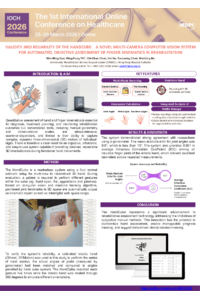
Quantitative assessment of hand and finger kinematics is essential for diagnosis, treatment planning, and monitoring rehabilitation outcomes but conventional tools, including manual goniometry and observational scales, are labour-intensive, examiner-dependent, and limited in their ability to capture complex, dynamic three-dimensional (3D) motion of individual digits. There is therefore a clear need for an objective, affordable, and easy-to-use system capable of providing detailed, repeatable 3D kinematic data during functional hand movements.
The HandCube is a markerless system using a four-webcam multi-view setup to reconstruct a 3D hand. During evaluation, a patient is required to perform different gestures within the cube (eg. hand open, fist, oppositions and pinches). Based on computer vision and a machine learning algorithm, prominent joint landmarks in 3D space are automatically output as a kinematic report and aninterdigital web space range.
To verify the system's reliability, a calibrated robotic hand (OHand, OYMotion) was used in this study to perform the series of hand motions, and the actual angles of joints (measured by goniometer) were matched and compared to angles provided by the HandCube system. The HandCube recorded each gesture five times while the robotic hand was rotated 360 degrees to simulate different orientations. The system demonstrated strong agreement with researchers using a goniometer. The mean absolute error for joint angles was 9.6°, which is less than 10°. The system also provides 0.951 in average Intraclass Correlation Coefficient (ICC) among all movable finger joints of the robotic hand, which showed excellent test–retest reliability across repeated measurements.
The HandCube represents a significant advancement in rehabilitative assessment technology addressing the limitations of subjective manual methods. This innovation has the potential to standardize hand assessment, enable manageable progress tracking, and support data-driven clinical decision-making.
Keywords
Rehabilitation
Computer Vision
A.I.
Markerless
Finger Joint
Poster
Patient_CenteredCare_OptimizingCarePathwaysthroughEngagementandOutcomeMeasurement_29996_Validity_and_Reliability_of_Th_slides.pdf
Entrepreneurial Competency in Nursing: A Concept Analysis
Patient-centered communication and psychological well-being among patients with chronic medical conditions