Event submissions
Published
This submission belongs to the session S2. Patient-Centered Care—Optimizing Care Pathways through Engagement and Outcome Measurement of the event The 1st International Online Conference on Healthcare
Published date
20 Mar, 2026
Academic Editor
'%3e%3cpath%20d='M12.6657%2010.9104C12.4185%2010.325%2012.0599%209.79327%2011.6097%209.34482C11.1609%208.89508%2010.6293%208.5365%2010.0442%208.28888C10.0389%208.28626%2010.0337%208.28495%2010.0285%208.28233C10.8446%207.69279%2011.3752%206.73249%2011.3752%205.64904C11.3752%203.8542%209.92103%202.39999%208.1262%202.39999C6.33136%202.39999%204.87715%203.8542%204.87715%205.64904C4.87715%206.73249%205.40774%207.69279%206.22393%208.28364C6.21869%208.28626%206.21345%208.28757%206.20821%208.29019C5.62129%208.5378%205.09463%208.89284%204.64265%209.34613C4.1929%209.79493%203.83432%2010.3266%203.58671%2010.9117C3.34345%2011.4845%203.21226%2012.0987%203.20023%2012.7209C3.19988%2012.7349%203.20233%2012.7488%203.20744%2012.7619C3.21255%2012.7749%203.22022%2012.7867%203.22998%2012.7968C3.23975%2012.8068%203.25142%2012.8147%203.26431%2012.8202C3.2772%2012.8256%203.29105%2012.8284%203.30504%2012.8284H4.09109C4.14874%2012.8284%204.19459%2012.7825%204.1959%2012.7262C4.2221%2011.7148%204.62823%2010.7676%205.34617%2010.0497C6.08899%209.30683%207.0755%208.89808%208.1262%208.89808C9.17689%208.89808%2010.1634%209.30683%2010.9062%2010.0497C11.6242%2010.7676%2012.0303%2011.7148%2012.0565%2012.7262C12.0578%2012.7838%2012.1037%2012.8284%2012.1613%2012.8284H12.9474C12.9613%2012.8284%2012.9752%2012.8256%2012.9881%2012.8202C13.001%2012.8147%2013.0126%2012.8068%2013.0224%2012.7968C13.0322%2012.7867%2013.0398%2012.7749%2013.0449%2012.7619C13.0501%2012.7488%2013.0525%2012.7349%2013.0522%2012.7209C13.0391%2012.0947%2012.9094%2011.4855%2012.6657%2010.9104ZM8.1262%207.9024C7.52486%207.9024%206.9589%207.6679%206.53312%207.24211C6.10733%206.81633%205.87283%206.25037%205.87283%205.64904C5.87283%205.0477%206.10733%204.48174%206.53312%204.05596C6.9589%203.63018%207.52486%203.39567%208.1262%203.39567C8.72753%203.39567%209.29349%203.63018%209.71927%204.05596C10.1451%204.48174%2010.3796%205.0477%2010.3796%205.64904C10.3796%206.25037%2010.1451%206.81633%209.71927%207.24211C9.29349%207.6679%208.72753%207.9024%208.1262%207.9024Z'%20fill='%235D1EE1'/%3e%3c/g%3e%3c/svg%3e) Lorraine Evangelista
Lorraine EvangelistaCitation
Asos Mahmood, Nikhil Ahuja, Satish Kedia, Coree Entwistle, Patient-centered communication and psychological well-being among patients with chronic medical conditions, in Proceedings of The 1st International Online Conference on Healthcare, 25 March–26 March 2026, MDPI: Basel, Switzerland
Share
Email
Facebook
Twitter
LinkedIn
Patient-centered communication and psychological well-being among patients with chronic medical conditions
'%3e%3cpath%20d='M12.6647%2010.9104C12.4176%2010.325%2012.0589%209.7933%2011.6088%209.34485C11.16%208.89511%2010.6283%208.53653%2010.0432%208.28891C10.038%208.28629%2010.0327%208.28498%2010.0275%208.28236C10.8437%207.69282%2011.3743%206.73252%2011.3743%205.64907C11.3743%203.85423%209.92005%202.40002%208.12522%202.40002C6.33038%202.40002%204.87618%203.85423%204.87618%205.64907C4.87618%206.73252%205.40677%207.69282%206.22296%208.28367C6.21772%208.28629%206.21248%208.2876%206.20724%208.29022C5.62031%208.53783%205.09365%208.89287%204.64167%209.34616C4.19192%209.79496%203.83334%2010.3266%203.58573%2010.9117C3.34247%2011.4846%203.21128%2012.0987%203.19925%2012.721C3.1989%2012.735%203.20135%2012.7489%203.20646%2012.7619C3.21157%2012.7749%203.21924%2012.7868%203.22901%2012.7968C3.23877%2012.8068%203.25045%2012.8148%203.26334%2012.8202C3.27623%2012.8256%203.29007%2012.8284%203.30406%2012.8284H4.09012C4.14776%2012.8284%204.19362%2012.7825%204.19493%2012.7262C4.22113%2011.7148%204.62726%2010.7676%205.34519%2010.0497C6.08802%209.30686%207.07452%208.89811%208.12522%208.89811C9.17592%208.89811%2010.1624%209.30686%2010.9052%2010.0497C11.6232%2010.7676%2012.0293%2011.7148%2012.0555%2012.7262C12.0568%2012.7839%2012.1027%2012.8284%2012.1603%2012.8284H12.9464C12.9604%2012.8284%2012.9742%2012.8256%2012.9871%2012.8202C13%2012.8148%2013.0117%2012.8068%2013.0214%2012.7968C13.0312%2012.7868%2013.0389%2012.7749%2013.044%2012.7619C13.0491%2012.7489%2013.0515%2012.735%2013.0512%2012.721C13.0381%2012.0947%2012.9084%2011.4856%2012.6647%2010.9104ZM8.12522%207.90243C7.52388%207.90243%206.95792%207.66793%206.53214%207.24215C6.10636%206.81636%205.87185%206.2504%205.87185%205.64907C5.87185%205.04773%206.10636%204.48177%206.53214%204.05599C6.95792%203.63021%207.52388%203.3957%208.12522%203.3957C8.72655%203.3957%209.29252%203.63021%209.7183%204.05599C10.1441%204.48177%2010.3786%205.04773%2010.3786%205.64907C10.3786%206.2504%2010.1441%206.81636%209.7183%207.24215C9.29252%207.66793%208.72655%207.90243%208.12522%207.90243Z'%20fill='%235D1EE1'/%3e%3c/g%3e%3c/svg%3e)
Asos Mahmood 1
Nikhil Ahuja 2
Satish Kedia 3
Coree Entwistle 3
1. Center for Health System Improvement, College of Medicine, University of Tennessee Health Science Center, Memphis, TN, USA, USA
2. Department of Public Health, Slippery Rock University of Pennsylvania, Slippery Rock, PA, USA, USA
3. Division of Social and Behavioral Sciences, School of Public Health, The University of Memphis, Memphis, TN, USA, USA
Abstract
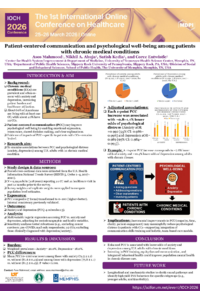
Introduction: Chronic medical conditions (CCs) are the leading causes of morbidity and mortality in the U.S. Patients with CCs often experience anxiety, depression, and other mental or emotional health problems. Although patient-centered communication (PCC) practices may address the mental health needs of patients, potentially through providing opportunities for emotional expression, reassurance, and support, there is limited scientific evidence on the effects of PCC on the psychological well-being of patients with CCs.
Methods: Pooled cross-sectional data were extracted from the U.S. National Cancer Institute’s Health Information National Trends Survey (HINTS5; Cycles 1–4; 2017–2020) for 9,199 respondents (≥18 years, reported ≥1 CC, non-Hispanic White=65.7%). PCC was measured on a composite score scale (0–100). Psychological distress (anxiety and depression) was assessed using the Patient Health Questionnaire-4 (PHQ-4). We performed multivariable logistic regressions to investigate associations between PCC and psychological distress.
Results: Nearly 20.4% of the patients experienced clinically significant anxiety, and 18.0% experienced depressive symptoms. With each additional unit increase on the PCC score scale, the odds of experiencing anxiety (aOR=0.992; 95% CI: 0.986, 0.998) and depression (aOR=0.989; 95% CI: 0.984, 0.995) decreased by approximately 1%.
Conclusions: Our findings revealed that enhanced PCC is associated with reduced odds of anxiety and depression among patients with CCs. Integrating holistic care models will be crucial to addressing the complex needs of patients with CCs. Policymakers and healthcare providers could expand training programs to strengthen the PCC skills of healthcare providers and potentially enhance the mental well-being of patients with chronic medical conditions.
Keywords
Patient-centered communication
Patient-centered care
Chronic disease
Mental health
Emotional well-being
Anxiety
Depression
Poster
IOCH-2026_Poster_Asos-Mahmood.pdf
Validity and Reliability of The HandCube: A Novel Multi-Camera Computer Vision System for Automated, Objective Assessment of Finger Kinematics in Rehabilitation
Prescribing Practices, Polypharmacy, and Drug Interaction Risks in Anticoagulant Therapy: Insights from a Secondary Care Hospital