Event submissions
Published
This submission belongs to the session S1. Digital Health Adoption and Innovation—A Vision for the Future of Healthcare of the event The 1st International Online Conference on Healthcare
Published date
20 Mar, 2026
Academic Editor
'%3e%3cpath%20d='M12.6657%2010.9104C12.4185%2010.325%2012.0599%209.79327%2011.6097%209.34482C11.1609%208.89508%2010.6293%208.5365%2010.0442%208.28888C10.0389%208.28626%2010.0337%208.28495%2010.0285%208.28233C10.8446%207.69279%2011.3752%206.73249%2011.3752%205.64904C11.3752%203.8542%209.92103%202.39999%208.1262%202.39999C6.33136%202.39999%204.87715%203.8542%204.87715%205.64904C4.87715%206.73249%205.40774%207.69279%206.22393%208.28364C6.21869%208.28626%206.21345%208.28757%206.20821%208.29019C5.62129%208.5378%205.09463%208.89284%204.64265%209.34613C4.1929%209.79493%203.83432%2010.3266%203.58671%2010.9117C3.34345%2011.4845%203.21226%2012.0987%203.20023%2012.7209C3.19988%2012.7349%203.20233%2012.7488%203.20744%2012.7619C3.21255%2012.7749%203.22022%2012.7867%203.22998%2012.7968C3.23975%2012.8068%203.25142%2012.8147%203.26431%2012.8202C3.2772%2012.8256%203.29105%2012.8284%203.30504%2012.8284H4.09109C4.14874%2012.8284%204.19459%2012.7825%204.1959%2012.7262C4.2221%2011.7148%204.62823%2010.7676%205.34617%2010.0497C6.08899%209.30683%207.0755%208.89808%208.1262%208.89808C9.17689%208.89808%2010.1634%209.30683%2010.9062%2010.0497C11.6242%2010.7676%2012.0303%2011.7148%2012.0565%2012.7262C12.0578%2012.7838%2012.1037%2012.8284%2012.1613%2012.8284H12.9474C12.9613%2012.8284%2012.9752%2012.8256%2012.9881%2012.8202C13.001%2012.8147%2013.0126%2012.8068%2013.0224%2012.7968C13.0322%2012.7867%2013.0398%2012.7749%2013.0449%2012.7619C13.0501%2012.7488%2013.0525%2012.7349%2013.0522%2012.7209C13.0391%2012.0947%2012.9094%2011.4855%2012.6657%2010.9104ZM8.1262%207.9024C7.52486%207.9024%206.9589%207.6679%206.53312%207.24211C6.10733%206.81633%205.87283%206.25037%205.87283%205.64904C5.87283%205.0477%206.10733%204.48174%206.53312%204.05596C6.9589%203.63018%207.52486%203.39567%208.1262%203.39567C8.72753%203.39567%209.29349%203.63018%209.71927%204.05596C10.1451%204.48174%2010.3796%205.0477%2010.3796%205.64904C10.3796%206.25037%2010.1451%206.81633%209.71927%207.24211C9.29349%207.6679%208.72753%207.9024%208.1262%207.9024Z'%20fill='%235D1EE1'/%3e%3c/g%3e%3c/svg%3e) James Chow
James ChowCitation
Irena Xhaferri, Lindita Durmishi, Elona Hasalla, Elda Ruçi, Digital Health Adoption and Innovation: Psychological Benefits and Risks in the Future of Healthcare, in Proceedings of The 1st International Online Conference on Healthcare, 25 March–26 March 2026, MDPI: Basel, Switzerland
Share
Email
Facebook
Twitter
LinkedIn
Digital Health Adoption and Innovation: Psychological Benefits and Risks in the Future of Healthcare
'%3e%3cpath%20d='M12.6647%2010.9104C12.4176%2010.325%2012.0589%209.7933%2011.6088%209.34485C11.16%208.89511%2010.6283%208.53653%2010.0432%208.28891C10.038%208.28629%2010.0327%208.28498%2010.0275%208.28236C10.8437%207.69282%2011.3743%206.73252%2011.3743%205.64907C11.3743%203.85423%209.92005%202.40002%208.12522%202.40002C6.33038%202.40002%204.87618%203.85423%204.87618%205.64907C4.87618%206.73252%205.40677%207.69282%206.22296%208.28367C6.21772%208.28629%206.21248%208.2876%206.20724%208.29022C5.62031%208.53783%205.09365%208.89287%204.64167%209.34616C4.19192%209.79496%203.83334%2010.3266%203.58573%2010.9117C3.34247%2011.4846%203.21128%2012.0987%203.19925%2012.721C3.1989%2012.735%203.20135%2012.7489%203.20646%2012.7619C3.21157%2012.7749%203.21924%2012.7868%203.22901%2012.7968C3.23877%2012.8068%203.25045%2012.8148%203.26334%2012.8202C3.27623%2012.8256%203.29007%2012.8284%203.30406%2012.8284H4.09012C4.14776%2012.8284%204.19362%2012.7825%204.19493%2012.7262C4.22113%2011.7148%204.62726%2010.7676%205.34519%2010.0497C6.08802%209.30686%207.07452%208.89811%208.12522%208.89811C9.17592%208.89811%2010.1624%209.30686%2010.9052%2010.0497C11.6232%2010.7676%2012.0293%2011.7148%2012.0555%2012.7262C12.0568%2012.7839%2012.1027%2012.8284%2012.1603%2012.8284H12.9464C12.9604%2012.8284%2012.9742%2012.8256%2012.9871%2012.8202C13%2012.8148%2013.0117%2012.8068%2013.0214%2012.7968C13.0312%2012.7868%2013.0389%2012.7749%2013.044%2012.7619C13.0491%2012.7489%2013.0515%2012.735%2013.0512%2012.721C13.0381%2012.0947%2012.9084%2011.4856%2012.6647%2010.9104ZM8.12522%207.90243C7.52388%207.90243%206.95792%207.66793%206.53214%207.24215C6.10636%206.81636%205.87185%206.2504%205.87185%205.64907C5.87185%205.04773%206.10636%204.48177%206.53214%204.05599C6.95792%203.63021%207.52388%203.3957%208.12522%203.3957C8.72655%203.3957%209.29252%203.63021%209.7183%204.05599C10.1441%204.48177%2010.3786%205.04773%2010.3786%205.64907C10.3786%206.2504%2010.1441%206.81636%209.7183%207.24215C9.29252%207.66793%208.72655%207.90243%208.12522%207.90243Z'%20fill='%235D1EE1'/%3e%3c/g%3e%3c/svg%3e)
Irena Xhaferri 1
Lindita Durmishi 1
Elona Hasalla 1
Elda Ruçi 1
1. University of Elbasan "Aleksander Xhuvani", Elbasan, Albania, Albania
Abstract
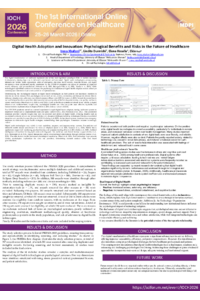
Digital health innovations are revolutionizing today's healthcare models, unveiling unique prospects for boosting accessibility, personalized approaches, and seamless care. With technological innovations like telemedicine, health monitoring apps, remote tracking, and AI-assisted tools steadily integrating into healthcare, recognizing their psychological effects on both patients and healthcare professionals is becoming increasingly vital.
This study employed a systematic scoping review to examine the psychological effects of technology use in healthcare following the accelerated digital adoption observed after the COVID-19 pandemic. A systematic literature search identified approximately 500 publications, of which 50 studies published after 2020 up to mid-2024 were included after excluding COVID-19-specific research, in order to avoid confounding effects. Findings from the included studies were synthesized to develop an analytical framework for understanding the psychological effects of technology use in both the delivery and receipt of healthcare services.
On a positive note, digital health has the potential to augment users’ perception of agency, foster self-efficacy in the management of chronic illnesses, alleviate anxiety associated with travel or prolonged waiting periods, and reinforce feelings of security through persistent support. Numerous individuals also report heightened motivation, enhanced engagement in therapeutic processes, and alleviation from geographic or social constraints.
Conversely, the digital transformation engenders several noteworthy psychological risks. A subset of users experiences anxiety when engaging with unfamiliar technologies or depending on automated systems, while apprehensions regarding data security and incessant monitoring may evoke feelings of vulnerability. The diminishment of in-person interactions may erode emotional bonds and trust between patients and clinicians, thereby exacerbating feelings of uncertainty or frustration. Moreover, individuals possessing limited digital competencies may encounter exclusion, resulting in diminished self-confidence and increased stress levels.
Comprehending both the advantages and challenges associated with digital health is paramount for the development of human-centered systems that safeguard psychological well-being and facilitate equitable healthcare innovation.
Keywords
digital health
psychological wellbeing
telemedicine
health technology adoption
patient experience
Poster
DigitalHealthAdoptionandInnovationAVisionfortheFutureofHealthcare_30006_Digital_Health_Adoption_and_In_slides.pdf
Research on the Application and Effect of Generative AI in the Risk Assessment of Elderly Patients with Chronic Diseases in Nursing Care
The Effect of Digital Cognitive Behavioral Therapy on Ruminative Thinking in Young Adults with Depression: A Randomized Controlled Trial