Event submissions
Published
This submission belongs to the session S1. Digital Health Adoption and Innovation—A Vision for the Future of Healthcare of the event The 1st International Online Conference on Healthcare
Published date
20 Mar, 2026
Academic Editor
'%3e%3cpath%20d='M12.6657%2010.9104C12.4185%2010.325%2012.0599%209.79327%2011.6097%209.34482C11.1609%208.89508%2010.6293%208.5365%2010.0442%208.28888C10.0389%208.28626%2010.0337%208.28495%2010.0285%208.28233C10.8446%207.69279%2011.3752%206.73249%2011.3752%205.64904C11.3752%203.8542%209.92103%202.39999%208.1262%202.39999C6.33136%202.39999%204.87715%203.8542%204.87715%205.64904C4.87715%206.73249%205.40774%207.69279%206.22393%208.28364C6.21869%208.28626%206.21345%208.28757%206.20821%208.29019C5.62129%208.5378%205.09463%208.89284%204.64265%209.34613C4.1929%209.79493%203.83432%2010.3266%203.58671%2010.9117C3.34345%2011.4845%203.21226%2012.0987%203.20023%2012.7209C3.19988%2012.7349%203.20233%2012.7488%203.20744%2012.7619C3.21255%2012.7749%203.22022%2012.7867%203.22998%2012.7968C3.23975%2012.8068%203.25142%2012.8147%203.26431%2012.8202C3.2772%2012.8256%203.29105%2012.8284%203.30504%2012.8284H4.09109C4.14874%2012.8284%204.19459%2012.7825%204.1959%2012.7262C4.2221%2011.7148%204.62823%2010.7676%205.34617%2010.0497C6.08899%209.30683%207.0755%208.89808%208.1262%208.89808C9.17689%208.89808%2010.1634%209.30683%2010.9062%2010.0497C11.6242%2010.7676%2012.0303%2011.7148%2012.0565%2012.7262C12.0578%2012.7838%2012.1037%2012.8284%2012.1613%2012.8284H12.9474C12.9613%2012.8284%2012.9752%2012.8256%2012.9881%2012.8202C13.001%2012.8147%2013.0126%2012.8068%2013.0224%2012.7968C13.0322%2012.7867%2013.0398%2012.7749%2013.0449%2012.7619C13.0501%2012.7488%2013.0525%2012.7349%2013.0522%2012.7209C13.0391%2012.0947%2012.9094%2011.4855%2012.6657%2010.9104ZM8.1262%207.9024C7.52486%207.9024%206.9589%207.6679%206.53312%207.24211C6.10733%206.81633%205.87283%206.25037%205.87283%205.64904C5.87283%205.0477%206.10733%204.48174%206.53312%204.05596C6.9589%203.63018%207.52486%203.39567%208.1262%203.39567C8.72753%203.39567%209.29349%203.63018%209.71927%204.05596C10.1451%204.48174%2010.3796%205.0477%2010.3796%205.64904C10.3796%206.25037%2010.1451%206.81633%209.71927%207.24211C9.29349%207.6679%208.72753%207.9024%208.1262%207.9024Z'%20fill='%235D1EE1'/%3e%3c/g%3e%3c/svg%3e) James Chow
James ChowCitation
yawei chang, The Effect of Digital Cognitive Behavioral Therapy on Ruminative Thinking in Young Adults with Depression: A Randomized Controlled Trial, in Proceedings of The 1st International Online Conference on Healthcare, 25 March–26 March 2026, MDPI: Basel, Switzerland
Share
Email
Facebook
Twitter
LinkedIn
The Effect of Digital Cognitive Behavioral Therapy on Ruminative Thinking in Young Adults with Depression: A Randomized Controlled Trial
'%3e%3cpath%20d='M12.6647%2010.9104C12.4176%2010.325%2012.0589%209.7933%2011.6088%209.34485C11.16%208.89511%2010.6283%208.53653%2010.0432%208.28891C10.038%208.28629%2010.0327%208.28498%2010.0275%208.28236C10.8437%207.69282%2011.3743%206.73252%2011.3743%205.64907C11.3743%203.85423%209.92005%202.40002%208.12522%202.40002C6.33038%202.40002%204.87618%203.85423%204.87618%205.64907C4.87618%206.73252%205.40677%207.69282%206.22296%208.28367C6.21772%208.28629%206.21248%208.2876%206.20724%208.29022C5.62031%208.53783%205.09365%208.89287%204.64167%209.34616C4.19192%209.79496%203.83334%2010.3266%203.58573%2010.9117C3.34247%2011.4846%203.21128%2012.0987%203.19925%2012.721C3.1989%2012.735%203.20135%2012.7489%203.20646%2012.7619C3.21157%2012.7749%203.21924%2012.7868%203.22901%2012.7968C3.23877%2012.8068%203.25045%2012.8148%203.26334%2012.8202C3.27623%2012.8256%203.29007%2012.8284%203.30406%2012.8284H4.09012C4.14776%2012.8284%204.19362%2012.7825%204.19493%2012.7262C4.22113%2011.7148%204.62726%2010.7676%205.34519%2010.0497C6.08802%209.30686%207.07452%208.89811%208.12522%208.89811C9.17592%208.89811%2010.1624%209.30686%2010.9052%2010.0497C11.6232%2010.7676%2012.0293%2011.7148%2012.0555%2012.7262C12.0568%2012.7839%2012.1027%2012.8284%2012.1603%2012.8284H12.9464C12.9604%2012.8284%2012.9742%2012.8256%2012.9871%2012.8202C13%2012.8148%2013.0117%2012.8068%2013.0214%2012.7968C13.0312%2012.7868%2013.0389%2012.7749%2013.044%2012.7619C13.0491%2012.7489%2013.0515%2012.735%2013.0512%2012.721C13.0381%2012.0947%2012.9084%2011.4856%2012.6647%2010.9104ZM8.12522%207.90243C7.52388%207.90243%206.95792%207.66793%206.53214%207.24215C6.10636%206.81636%205.87185%206.2504%205.87185%205.64907C5.87185%205.04773%206.10636%204.48177%206.53214%204.05599C6.95792%203.63021%207.52388%203.3957%208.12522%203.3957C8.72655%203.3957%209.29252%203.63021%209.7183%204.05599C10.1441%204.48177%2010.3786%205.04773%2010.3786%205.64907C10.3786%206.2504%2010.1441%206.81636%209.7183%207.24215C9.29252%207.66793%208.72655%207.90243%208.12522%207.90243Z'%20fill='%235D1EE1'/%3e%3c/g%3e%3c/svg%3e)
yawei chang 1
1. China Medical University, Shenyang, China, China
Abstract
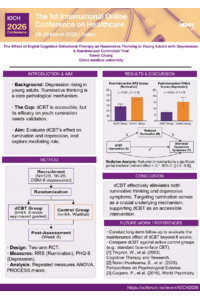
Introduction: The prevalence of depression among young adults continues to rise, with its core pathological mechanism—ruminative thinking (the persistent immersion in negative thoughts)—significantly affecting prognosis. While digital cognitive behavioral therapy (dCBT) represents a highly accessible intervention, its specific efficacy in targeting ruminative thinking in young depressed patients requires further empirical validation.
Methods: A two-arm, randomized controlled trial was conducted. Participants included 128 young patients (aged 16-25) meeting the DSM-5 diagnostic criteria for depression, recruited through hospital platforms and online channels. They were randomly assigned to either a dCBT intervention group (n=64) or a waitlist control group (n=64). The intervention group received 8 weeks of app-based, guided dCBT, which included psychoeducation, cognitive restructuring, behavioral activation, and mindfulness training. The control group received no intervention during the 8-week period. Assessments were conducted at baseline and post-intervention (week 8) using the Ruminative Response Scale (RRS) and the Patient Health Questionnaire-9 (PHQ-9) to evaluate levels of ruminative thinking and depressive symptoms, respectively. Repeated-measures ANOVA was used to compare between-group differences, and the PROCESS macro was employed for mediation effect analysis.
Results: Post-intervention, the dCBT group demonstrated significantly lower RRS scores (28.5 ± 5.2 vs. 45.8 ± 6.1; F(1, 125) = 105.3, p < 0.001) and PHQ-9 scores (7.1 ± 3.5 vs. 15.3 ± 4.0; F(1, 125) = 98.7, p < 0.001) than the waitlist control group, with effect sizes of η² = 0.36 and η² = 0.35, respectively. Mediation analysis further indicated that the reduction in ruminative thinking played a significant partial mediating role in the alleviation of depressive symptoms through dCBT (indirect effect = -2.1, 95% CI: [-3.5, -0.9]).
Conclusion: This study demonstrates that dCBT effectively alleviates both ruminative thinking and depressive symptoms in young adults with depression, and that reduction in rumination serves as an important mechanism of symptom improvement. These findings provide robust evidence supporting dCBT as an accessible intervention targeting the core pathological mechanism of youth depression.
Keywords
digital cognitive behavioral therapy
youth depression
ruminative thinking
randomized controlled trial
mediating effect
Poster
国际会议海报.pdf
Digital Health Adoption and Innovation: Psychological Benefits and Risks in the Future of Healthcare
Automatic Identification of First-Degree Atrioventricular Blocks