Event submissions
Published
This submission belongs to the session S4. Photonics and Optical Communications of the event The 1st International Online Conference on Optics
Published date
20 Mar, 2026
Academic Editor
'%3e%3cpath%20d='M12.6657%2010.9104C12.4185%2010.325%2012.0599%209.79327%2011.6097%209.34482C11.1609%208.89508%2010.6293%208.5365%2010.0442%208.28888C10.0389%208.28626%2010.0337%208.28495%2010.0285%208.28233C10.8446%207.69279%2011.3752%206.73249%2011.3752%205.64904C11.3752%203.8542%209.92103%202.39999%208.1262%202.39999C6.33136%202.39999%204.87715%203.8542%204.87715%205.64904C4.87715%206.73249%205.40774%207.69279%206.22393%208.28364C6.21869%208.28626%206.21345%208.28757%206.20821%208.29019C5.62129%208.5378%205.09463%208.89284%204.64265%209.34613C4.1929%209.79493%203.83432%2010.3266%203.58671%2010.9117C3.34345%2011.4845%203.21226%2012.0987%203.20023%2012.7209C3.19988%2012.7349%203.20233%2012.7488%203.20744%2012.7619C3.21255%2012.7749%203.22022%2012.7867%203.22998%2012.7968C3.23975%2012.8068%203.25142%2012.8147%203.26431%2012.8202C3.2772%2012.8256%203.29105%2012.8284%203.30504%2012.8284H4.09109C4.14874%2012.8284%204.19459%2012.7825%204.1959%2012.7262C4.2221%2011.7148%204.62823%2010.7676%205.34617%2010.0497C6.08899%209.30683%207.0755%208.89808%208.1262%208.89808C9.17689%208.89808%2010.1634%209.30683%2010.9062%2010.0497C11.6242%2010.7676%2012.0303%2011.7148%2012.0565%2012.7262C12.0578%2012.7838%2012.1037%2012.8284%2012.1613%2012.8284H12.9474C12.9613%2012.8284%2012.9752%2012.8256%2012.9881%2012.8202C13.001%2012.8147%2013.0126%2012.8068%2013.0224%2012.7968C13.0322%2012.7867%2013.0398%2012.7749%2013.0449%2012.7619C13.0501%2012.7488%2013.0525%2012.7349%2013.0522%2012.7209C13.0391%2012.0947%2012.9094%2011.4855%2012.6657%2010.9104ZM8.1262%207.9024C7.52486%207.9024%206.9589%207.6679%206.53312%207.24211C6.10733%206.81633%205.87283%206.25037%205.87283%205.64904C5.87283%205.0477%206.10733%204.48174%206.53312%204.05596C6.9589%203.63018%207.52486%203.39567%208.1262%203.39567C8.72753%203.39567%209.29349%203.63018%209.71927%204.05596C10.1451%204.48174%2010.3796%205.0477%2010.3796%205.64904C10.3796%206.25037%2010.1451%206.81633%209.71927%207.24211C9.29349%207.6679%208.72753%207.9024%208.1262%207.9024Z'%20fill='%235D1EE1'/%3e%3c/g%3e%3c/svg%3e) Jiahao Huo
Jiahao HuoCitation
Luís Henrique Raimundo, Beate Saegesser Santos, Plasmon-Induced Fluorescence Enhancement of Methylene Blue by Silver Nanoparticles, in Proceedings of The 1st International Online Conference on Optics, 25 March–27 March 2026, MDPI: Basel, Switzerland
Share
Email
Facebook
Twitter
LinkedIn
Plasmon-Induced Fluorescence Enhancement of Methylene Blue by Silver Nanoparticles
'%3e%3cpath%20d='M12.6647%2010.9104C12.4176%2010.325%2012.0589%209.7933%2011.6088%209.34485C11.16%208.89511%2010.6283%208.53653%2010.0432%208.28891C10.038%208.28629%2010.0327%208.28498%2010.0275%208.28236C10.8437%207.69282%2011.3743%206.73252%2011.3743%205.64907C11.3743%203.85423%209.92005%202.40002%208.12522%202.40002C6.33038%202.40002%204.87618%203.85423%204.87618%205.64907C4.87618%206.73252%205.40677%207.69282%206.22296%208.28367C6.21772%208.28629%206.21248%208.2876%206.20724%208.29022C5.62031%208.53783%205.09365%208.89287%204.64167%209.34616C4.19192%209.79496%203.83334%2010.3266%203.58573%2010.9117C3.34247%2011.4846%203.21128%2012.0987%203.19925%2012.721C3.1989%2012.735%203.20135%2012.7489%203.20646%2012.7619C3.21157%2012.7749%203.21924%2012.7868%203.22901%2012.7968C3.23877%2012.8068%203.25045%2012.8148%203.26334%2012.8202C3.27623%2012.8256%203.29007%2012.8284%203.30406%2012.8284H4.09012C4.14776%2012.8284%204.19362%2012.7825%204.19493%2012.7262C4.22113%2011.7148%204.62726%2010.7676%205.34519%2010.0497C6.08802%209.30686%207.07452%208.89811%208.12522%208.89811C9.17592%208.89811%2010.1624%209.30686%2010.9052%2010.0497C11.6232%2010.7676%2012.0293%2011.7148%2012.0555%2012.7262C12.0568%2012.7839%2012.1027%2012.8284%2012.1603%2012.8284H12.9464C12.9604%2012.8284%2012.9742%2012.8256%2012.9871%2012.8202C13%2012.8148%2013.0117%2012.8068%2013.0214%2012.7968C13.0312%2012.7868%2013.0389%2012.7749%2013.044%2012.7619C13.0491%2012.7489%2013.0515%2012.735%2013.0512%2012.721C13.0381%2012.0947%2012.9084%2011.4856%2012.6647%2010.9104ZM8.12522%207.90243C7.52388%207.90243%206.95792%207.66793%206.53214%207.24215C6.10636%206.81636%205.87185%206.2504%205.87185%205.64907C5.87185%205.04773%206.10636%204.48177%206.53214%204.05599C6.95792%203.63021%207.52388%203.3957%208.12522%203.3957C8.72655%203.3957%209.29252%203.63021%209.7183%204.05599C10.1441%204.48177%2010.3786%205.04773%2010.3786%205.64907C10.3786%206.2504%2010.1441%206.81636%209.7183%207.24215C9.29252%207.66793%208.72655%207.90243%208.12522%207.90243Z'%20fill='%235D1EE1'/%3e%3c/g%3e%3c/svg%3e)
Luís Henrique Raimundo 1
Beate Saegesser Santos 2
1. Departamento de Ciência dos Materiais, Universidade Federal de Pernambuco, Recife, 50670-901, Brasil, Brazil
2. Departamento de Ciências Farmacêuticas, Universidade Federal de Pernambuco, Recife, 50740-520, Brasil, Brazil
Abstract
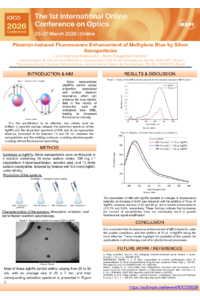
INTRODUCTION: Silver nanoparticles (AgNPs) exhibit optical properties associated with surface plasmon resonance, which can enhance the local electric field in the vicinity of molecules such as methylene blue (MB), leading to increased fluorescence intensity. For this amplification to be effective, two criteria must be fulfilled: (i) spectral overlap between the extinction spectrum of the AgNPs and the absorption spectrum of MB; and (ii) an appropriate distance, estimated to be between 10 and 20 nm, between the nanoparticles and the emitting molecule, enabling electromagnetic coupling without fluorescence quenching.
METHODOLOGY: AgNPs were synthesized using a bottom-up approach through the chemical reduction of Ag⁺ ions with sodium borohydride (NaBH₄), yielding nanoparticles with an extinction band compatible with the absorption region of MB. Subsequently, different volumes of the AgNP suspension (10, 20, and 40 µL) were added to MB solutions, adjusting the final dye concentration to 15 µmol L⁻¹. An MB solution at the same concentration, without AgNPs, was used as a control. The samples were analyzed by spectrofluorimetry to evaluate the fluorescence behavior of MB in the absence and presence of the nanoparticles.
RESULTS AND DISCUSSION: The association of MB with AgNPs resulted in changes in fluorescence intensity. An increase of 9.0% was observed with the addition of 10 µL of AgNPs, whereas volumes of 20 and 40 µL led to smaller enhancements of 6.1% and 5.4%, respectively. These findings indicate that increasing the amount of nanoparticles does not necessarily result in greater fluorescence signal amplification.
CONCLUSION: It is concluded that fluorescence enhancement of MB is feasible under the studied conditions, with the addition of 10 µL of AgNPs being the most effective. These results highlight the potential of this system for applications in phototherapy and other photoinduced processes.
Keywords
Silver nanoparticles
Methylene blue
Fluorescence enhancement
Surface plasmon resonance
Plasmon–fluorophore interaction
Poster
Plasmon-Induced Fluorescence Enhancement of Methylene Blue by Silver Nanoparticles.pdf
Photophysical Characterization of Nanocomposites Formed by Silver Nanoparticles and Methylene Blue
Design and Analysis of Achromatic Metalenses in the Visible Regime