Event submissions
Published
This submission belongs to the session S2. Optoelectronics & Optical Engineering of the event The 1st International Online Conference on Optics
Published date
20 Mar, 2026
Academic Editor
'%3e%3cpath%20d='M12.6657%2010.9104C12.4185%2010.325%2012.0599%209.79327%2011.6097%209.34482C11.1609%208.89508%2010.6293%208.5365%2010.0442%208.28888C10.0389%208.28626%2010.0337%208.28495%2010.0285%208.28233C10.8446%207.69279%2011.3752%206.73249%2011.3752%205.64904C11.3752%203.8542%209.92103%202.39999%208.1262%202.39999C6.33136%202.39999%204.87715%203.8542%204.87715%205.64904C4.87715%206.73249%205.40774%207.69279%206.22393%208.28364C6.21869%208.28626%206.21345%208.28757%206.20821%208.29019C5.62129%208.5378%205.09463%208.89284%204.64265%209.34613C4.1929%209.79493%203.83432%2010.3266%203.58671%2010.9117C3.34345%2011.4845%203.21226%2012.0987%203.20023%2012.7209C3.19988%2012.7349%203.20233%2012.7488%203.20744%2012.7619C3.21255%2012.7749%203.22022%2012.7867%203.22998%2012.7968C3.23975%2012.8068%203.25142%2012.8147%203.26431%2012.8202C3.2772%2012.8256%203.29105%2012.8284%203.30504%2012.8284H4.09109C4.14874%2012.8284%204.19459%2012.7825%204.1959%2012.7262C4.2221%2011.7148%204.62823%2010.7676%205.34617%2010.0497C6.08899%209.30683%207.0755%208.89808%208.1262%208.89808C9.17689%208.89808%2010.1634%209.30683%2010.9062%2010.0497C11.6242%2010.7676%2012.0303%2011.7148%2012.0565%2012.7262C12.0578%2012.7838%2012.1037%2012.8284%2012.1613%2012.8284H12.9474C12.9613%2012.8284%2012.9752%2012.8256%2012.9881%2012.8202C13.001%2012.8147%2013.0126%2012.8068%2013.0224%2012.7968C13.0322%2012.7867%2013.0398%2012.7749%2013.0449%2012.7619C13.0501%2012.7488%2013.0525%2012.7349%2013.0522%2012.7209C13.0391%2012.0947%2012.9094%2011.4855%2012.6657%2010.9104ZM8.1262%207.9024C7.52486%207.9024%206.9589%207.6679%206.53312%207.24211C6.10733%206.81633%205.87283%206.25037%205.87283%205.64904C5.87283%205.0477%206.10733%204.48174%206.53312%204.05596C6.9589%203.63018%207.52486%203.39567%208.1262%203.39567C8.72753%203.39567%209.29349%203.63018%209.71927%204.05596C10.1451%204.48174%2010.3796%205.0477%2010.3796%205.64904C10.3796%206.25037%2010.1451%206.81633%209.71927%207.24211C9.29349%207.6679%208.72753%207.9024%208.1262%207.9024Z'%20fill='%235D1EE1'/%3e%3c/g%3e%3c/svg%3e) Yuriy Garbovskiy
Yuriy GarbovskiyCitation
Viktor Sergeevich Goryainov, Jacques Bernice Ngoua Ndong Avele, Laboratory Tests of a Low-Cost Multispectral Camera for Environmental Monitoring, in Proceedings of The 1st International Online Conference on Optics, 25 March–27 March 2026, MDPI: Basel, Switzerland
Share
Email
Facebook
Twitter
LinkedIn
Laboratory Tests of a Low-Cost Multispectral Camera for Environmental Monitoring
'%3e%3cpath%20d='M12.6647%2010.9104C12.4176%2010.325%2012.0589%209.7933%2011.6088%209.34485C11.16%208.89511%2010.6283%208.53653%2010.0432%208.28891C10.038%208.28629%2010.0327%208.28498%2010.0275%208.28236C10.8437%207.69282%2011.3743%206.73252%2011.3743%205.64907C11.3743%203.85423%209.92005%202.40002%208.12522%202.40002C6.33038%202.40002%204.87618%203.85423%204.87618%205.64907C4.87618%206.73252%205.40677%207.69282%206.22296%208.28367C6.21772%208.28629%206.21248%208.2876%206.20724%208.29022C5.62031%208.53783%205.09365%208.89287%204.64167%209.34616C4.19192%209.79496%203.83334%2010.3266%203.58573%2010.9117C3.34247%2011.4846%203.21128%2012.0987%203.19925%2012.721C3.1989%2012.735%203.20135%2012.7489%203.20646%2012.7619C3.21157%2012.7749%203.21924%2012.7868%203.22901%2012.7968C3.23877%2012.8068%203.25045%2012.8148%203.26334%2012.8202C3.27623%2012.8256%203.29007%2012.8284%203.30406%2012.8284H4.09012C4.14776%2012.8284%204.19362%2012.7825%204.19493%2012.7262C4.22113%2011.7148%204.62726%2010.7676%205.34519%2010.0497C6.08802%209.30686%207.07452%208.89811%208.12522%208.89811C9.17592%208.89811%2010.1624%209.30686%2010.9052%2010.0497C11.6232%2010.7676%2012.0293%2011.7148%2012.0555%2012.7262C12.0568%2012.7839%2012.1027%2012.8284%2012.1603%2012.8284H12.9464C12.9604%2012.8284%2012.9742%2012.8256%2012.9871%2012.8202C13%2012.8148%2013.0117%2012.8068%2013.0214%2012.7968C13.0312%2012.7868%2013.0389%2012.7749%2013.044%2012.7619C13.0491%2012.7489%2013.0515%2012.735%2013.0512%2012.721C13.0381%2012.0947%2012.9084%2011.4856%2012.6647%2010.9104ZM8.12522%207.90243C7.52388%207.90243%206.95792%207.66793%206.53214%207.24215C6.10636%206.81636%205.87185%206.2504%205.87185%205.64907C5.87185%205.04773%206.10636%204.48177%206.53214%204.05599C6.95792%203.63021%207.52388%203.3957%208.12522%203.3957C8.72655%203.3957%209.29252%203.63021%209.7183%204.05599C10.1441%204.48177%2010.3786%205.04773%2010.3786%205.64907C10.3786%206.2504%2010.1441%206.81636%209.7183%207.24215C9.29252%207.66793%208.72655%207.90243%208.12522%207.90243Z'%20fill='%235D1EE1'/%3e%3c/g%3e%3c/svg%3e)
Viktor Sergeevich Goryainov 1
Jacques Bernice Ngoua Ndong Avele 2
1. Department of Photonics, Faculty of Electronics and Nanoelectronics, St-Petersburg State Electrotechnical University, Saint Petersburg 197022, Russia, Russia
2. Radionavigation and Radar Research Group, Department of Radio Engineering Systems, Faculty of Radio Engineering and Telecommunications, St-Petersburg State Electrotechnical University, Saint Petersburg 197022, Russia, Russia
Abstract
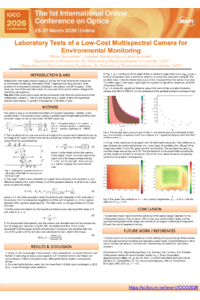
Widespread distribution of inexpensive CMOS image sensors has enabled researchers, including enthusiasts and educators, to create low-cost multispectral imagers for environmental studies. In this paper, we present the methods and results of some laboratory tests of a low-cost portable multispectral camera, previously designed for the monitoring of vegetation. The study was aimed at evaluating the parameters that affect the performance of the multispectral camera. The angular size of the field of view and the resulting focal length was calculated from an image of an object with known dimensions set at a predefined distance, using trigonometric relations. Depth of field and hyperfocal distance distributions were calculated from the aperture diameter and distance to the object. To test the spectral homogeneity of the field of view, parallel and uniform light from the overcast sky was directed at the sensor, and then the ratio between red and green values in the resulting image was considered. The study proposes some methods to resolve the tasks of performance assessment for a low-cost multispectral camera. The calculated total focal distance of the camera was 58 mm, and the angular size of its field of view was 3.6 degrees. The calculated depth of field ranged from 2 mm to infinity (following the definition of hyperfocal distance). Hyperfocal distance values ranged from 52.5 to 885.6 m for the smallest and the greatest aperture correspondingly. Adjustments of the optical system using the parallel daylight beam allowed us to reduce the standard deviation of the red-to-green ratio over the image down to 0.025, showing an acceptably small spectral inhomogeneity.
Keywords
multispectral imaging
low-cost multispectral camera
optical system
vegetation monitoring
hyperfocal distance
spectral inhomogeneity
Poster
sciforum-163620.pdf
ACCURATE DETERMINATION OF THIN PET FILM STRUCTURAL DISORDER AND BANDGAP ENERGY BY ABSORPTION OPTICAL SPECTROSCOPY
A long wave cutoff perfect absorber with a nanocone array structure