Event submissions
Published
This submission belongs to the session S6. Health Psychology of the event The 1st International Online Conference on Behavioral Sciences
Published date
27 Mar, 2026
Academic Editor
'%3e%3cpath%20d='M12.6657%2010.9104C12.4185%2010.325%2012.0599%209.79327%2011.6097%209.34482C11.1609%208.89508%2010.6293%208.5365%2010.0442%208.28888C10.0389%208.28626%2010.0337%208.28495%2010.0285%208.28233C10.8446%207.69279%2011.3752%206.73249%2011.3752%205.64904C11.3752%203.8542%209.92103%202.39999%208.1262%202.39999C6.33136%202.39999%204.87715%203.8542%204.87715%205.64904C4.87715%206.73249%205.40774%207.69279%206.22393%208.28364C6.21869%208.28626%206.21345%208.28757%206.20821%208.29019C5.62129%208.5378%205.09463%208.89284%204.64265%209.34613C4.1929%209.79493%203.83432%2010.3266%203.58671%2010.9117C3.34345%2011.4845%203.21226%2012.0987%203.20023%2012.7209C3.19988%2012.7349%203.20233%2012.7488%203.20744%2012.7619C3.21255%2012.7749%203.22022%2012.7867%203.22998%2012.7968C3.23975%2012.8068%203.25142%2012.8147%203.26431%2012.8202C3.2772%2012.8256%203.29105%2012.8284%203.30504%2012.8284H4.09109C4.14874%2012.8284%204.19459%2012.7825%204.1959%2012.7262C4.2221%2011.7148%204.62823%2010.7676%205.34617%2010.0497C6.08899%209.30683%207.0755%208.89808%208.1262%208.89808C9.17689%208.89808%2010.1634%209.30683%2010.9062%2010.0497C11.6242%2010.7676%2012.0303%2011.7148%2012.0565%2012.7262C12.0578%2012.7838%2012.1037%2012.8284%2012.1613%2012.8284H12.9474C12.9613%2012.8284%2012.9752%2012.8256%2012.9881%2012.8202C13.001%2012.8147%2013.0126%2012.8068%2013.0224%2012.7968C13.0322%2012.7867%2013.0398%2012.7749%2013.0449%2012.7619C13.0501%2012.7488%2013.0525%2012.7349%2013.0522%2012.7209C13.0391%2012.0947%2012.9094%2011.4855%2012.6657%2010.9104ZM8.1262%207.9024C7.52486%207.9024%206.9589%207.6679%206.53312%207.24211C6.10733%206.81633%205.87283%206.25037%205.87283%205.64904C5.87283%205.0477%206.10733%204.48174%206.53312%204.05596C6.9589%203.63018%207.52486%203.39567%208.1262%203.39567C8.72753%203.39567%209.29349%203.63018%209.71927%204.05596C10.1451%204.48174%2010.3796%205.0477%2010.3796%205.64904C10.3796%206.25037%2010.1451%206.81633%209.71927%207.24211C9.29349%207.6679%208.72753%207.9024%208.1262%207.9024Z'%20fill='%235D1EE1'/%3e%3c/g%3e%3c/svg%3e) Andrew Soundy
Andrew SoundyCitation
Francisco Nieto-Escamez, Cleiton Ferreira, Paula Latorre, Aurora Molina-Muñoz, Democratizing Urban Well-being: Virtual Biophilic Interventions Mitigate Socioeconomic Disparities in Environmental Perception and Affect, in Proceedings of The 1st International Online Conference on Behavioral Sciences, 1 April–3 April 2026, MDPI: Basel, Switzerland
Share
Email
Facebook
Twitter
LinkedIn
Democratizing Urban Well-being: Virtual Biophilic Interventions Mitigate Socioeconomic Disparities in Environmental Perception and Affect
'%3e%3cpath%20d='M12.6647%2010.9104C12.4176%2010.325%2012.0589%209.7933%2011.6088%209.34485C11.16%208.89511%2010.6283%208.53653%2010.0432%208.28891C10.038%208.28629%2010.0327%208.28498%2010.0275%208.28236C10.8437%207.69282%2011.3743%206.73252%2011.3743%205.64907C11.3743%203.85423%209.92005%202.40002%208.12522%202.40002C6.33038%202.40002%204.87618%203.85423%204.87618%205.64907C4.87618%206.73252%205.40677%207.69282%206.22296%208.28367C6.21772%208.28629%206.21248%208.2876%206.20724%208.29022C5.62031%208.53783%205.09365%208.89287%204.64167%209.34616C4.19192%209.79496%203.83334%2010.3266%203.58573%2010.9117C3.34247%2011.4846%203.21128%2012.0987%203.19925%2012.721C3.1989%2012.735%203.20135%2012.7489%203.20646%2012.7619C3.21157%2012.7749%203.21924%2012.7868%203.22901%2012.7968C3.23877%2012.8068%203.25045%2012.8148%203.26334%2012.8202C3.27623%2012.8256%203.29007%2012.8284%203.30406%2012.8284H4.09012C4.14776%2012.8284%204.19362%2012.7825%204.19493%2012.7262C4.22113%2011.7148%204.62726%2010.7676%205.34519%2010.0497C6.08802%209.30686%207.07452%208.89811%208.12522%208.89811C9.17592%208.89811%2010.1624%209.30686%2010.9052%2010.0497C11.6232%2010.7676%2012.0293%2011.7148%2012.0555%2012.7262C12.0568%2012.7839%2012.1027%2012.8284%2012.1603%2012.8284H12.9464C12.9604%2012.8284%2012.9742%2012.8256%2012.9871%2012.8202C13%2012.8148%2013.0117%2012.8068%2013.0214%2012.7968C13.0312%2012.7868%2013.0389%2012.7749%2013.044%2012.7619C13.0491%2012.7489%2013.0515%2012.735%2013.0512%2012.721C13.0381%2012.0947%2012.9084%2011.4856%2012.6647%2010.9104ZM8.12522%207.90243C7.52388%207.90243%206.95792%207.66793%206.53214%207.24215C6.10636%206.81636%205.87185%206.2504%205.87185%205.64907C5.87185%205.04773%206.10636%204.48177%206.53214%204.05599C6.95792%203.63021%207.52388%203.3957%208.12522%203.3957C8.72655%203.3957%209.29252%203.63021%209.7183%204.05599C10.1441%204.48177%2010.3786%205.04773%2010.3786%205.64907C10.3786%206.2504%2010.1441%206.81636%209.7183%207.24215C9.29252%207.66793%208.72655%207.90243%208.12522%207.90243Z'%20fill='%235D1EE1'/%3e%3c/g%3e%3c/svg%3e)
Cleiton Ferreira 1
Paula Latorre 2
Aurora Molina-Muñoz 2

Francisco Nieto-Escamez 2,3
1. Instituto Federal de Educação, Ciência e Tecnologia do Rio Grande do Sul (IFRS), Campus Rio Grande, Rio Grande, Rio Grande do Sul, Brasil., Brazil
2. Department of Psychology, University of Almeria, Almeria, 04120, Spain, Spain
3. Centro de Investigación para el Bienestar y la Inclusión Social (CIBIS), Universidad de Almería, Almería, 04120, Spain
Abstract
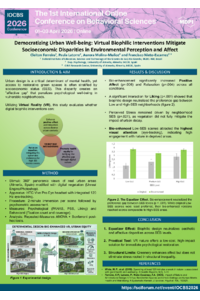
Introduction: Urban environments significantly influence mental health, yet access to restorative green spaces is often stratified by socioeconomic status (SES). This study investigates whether digital biophilic interventions in Virtual Reality (VR) can enhance psychological well-being and mitigate the affective gap between neighborhoods of different socioeconomic levels.
Methods: A fully counterbalanced 3 × 2 within-subjects design was employed in this exploratory pilot study. A convenience sample of sixteen participants (university students; normal/corrected vision; no VR contraindications) were exposed to VR scenes of three neighborhoods (Low, Medium, High SES), each presented as Original and Bio-enhanced (with digital vegetation). No a priori power calculation was performed, consistent with the study's exploratory phase. Self-reported measures (PANAS, Perceived Stress, Relaxation, Liking) were analyzed using Repeated-Measures ANOVA (with Greenhouse–Geisser correction where applicable), followed by Bonferroni-adjusted post hoc tests to examine significant main and interaction effects.
Results: Our results revealed that bio-enhanced scenes significantly increased Positive Affect (p = .006) and Relaxation (p = .004) compared to original designs. Crucially, a significant Condition × SES interaction (p < .001) was found for Liking scores. While original scenes showed a steep preference gradient favoring High-SES neighborhoods, bio-enhanced conditions eliminated this disparity, yielding uniformly high ratings across all SES levels. However, Perceived Stress remained driven by neighborhood SES (p = .021), with Low-SES scenes eliciting higher stress regardless of vegetation.
Discussion: Our findings suggest that while biophilic interventions are effective in boosting positive affect and perceived restoration, basal stress reactions may be tethered to structural environmental cues. Importantly, the study demonstrates that biophilic design can act as an equalizer for aesthetic and affective appreciation, offering a pathway for promoting health equity in urban planning.
Keywords
Biophilic Design
Virtual Reality
Socioeconomic Status
Restorative Environments
Urban Well-being.
Poster
IOCBS 2026.pdf
Empathy and Cognitive Behavior Therapy in Oncology—strategies for intervention
Fibromyalgia and emotional vulnerability: exploring the roles of psychological inflexibility and anxiety sensitivity