Event submissions
Published
This submission belongs to the session S5. Photoluminescent Materials of the event The 1st International Online Conference on Photochemistry
Published date
03 Apr, 2026
Academic Editor
'%3e%3cpath%20d='M12.6657%2010.9104C12.4185%2010.325%2012.0599%209.79327%2011.6097%209.34482C11.1609%208.89508%2010.6293%208.5365%2010.0442%208.28888C10.0389%208.28626%2010.0337%208.28495%2010.0285%208.28233C10.8446%207.69279%2011.3752%206.73249%2011.3752%205.64904C11.3752%203.8542%209.92103%202.39999%208.1262%202.39999C6.33136%202.39999%204.87715%203.8542%204.87715%205.64904C4.87715%206.73249%205.40774%207.69279%206.22393%208.28364C6.21869%208.28626%206.21345%208.28757%206.20821%208.29019C5.62129%208.5378%205.09463%208.89284%204.64265%209.34613C4.1929%209.79493%203.83432%2010.3266%203.58671%2010.9117C3.34345%2011.4845%203.21226%2012.0987%203.20023%2012.7209C3.19988%2012.7349%203.20233%2012.7488%203.20744%2012.7619C3.21255%2012.7749%203.22022%2012.7867%203.22998%2012.7968C3.23975%2012.8068%203.25142%2012.8147%203.26431%2012.8202C3.2772%2012.8256%203.29105%2012.8284%203.30504%2012.8284H4.09109C4.14874%2012.8284%204.19459%2012.7825%204.1959%2012.7262C4.2221%2011.7148%204.62823%2010.7676%205.34617%2010.0497C6.08899%209.30683%207.0755%208.89808%208.1262%208.89808C9.17689%208.89808%2010.1634%209.30683%2010.9062%2010.0497C11.6242%2010.7676%2012.0303%2011.7148%2012.0565%2012.7262C12.0578%2012.7838%2012.1037%2012.8284%2012.1613%2012.8284H12.9474C12.9613%2012.8284%2012.9752%2012.8256%2012.9881%2012.8202C13.001%2012.8147%2013.0126%2012.8068%2013.0224%2012.7968C13.0322%2012.7867%2013.0398%2012.7749%2013.0449%2012.7619C13.0501%2012.7488%2013.0525%2012.7349%2013.0522%2012.7209C13.0391%2012.0947%2012.9094%2011.4855%2012.6657%2010.9104ZM8.1262%207.9024C7.52486%207.9024%206.9589%207.6679%206.53312%207.24211C6.10733%206.81633%205.87283%206.25037%205.87283%205.64904C5.87283%205.0477%206.10733%204.48174%206.53312%204.05596C6.9589%203.63018%207.52486%203.39567%208.1262%203.39567C8.72753%203.39567%209.29349%203.63018%209.71927%204.05596C10.1451%204.48174%2010.3796%205.0477%2010.3796%205.64904C10.3796%206.25037%2010.1451%206.81633%209.71927%207.24211C9.29349%207.6679%208.72753%207.9024%208.1262%207.9024Z'%20fill='%235D1EE1'/%3e%3c/g%3e%3c/svg%3e) Dirk Poelman
Dirk PoelmanCitation
Inna Tanaeva, Dmitry Shurpik, Olga Mostovaya, Ivan Stoikov, Photoluminescent sulfur quantum dots stabilized by pillar[5]arenes containing amide and amino groups, in Proceedings of The 1st International Online Conference on Photochemistry, 8 April–9 April 2026, MDPI: Basel, Switzerland
Share
Email
Facebook
Twitter
LinkedIn
Photoluminescent sulfur quantum dots stabilized by pillar[5]arenes containing amide and amino groups
'%3e%3cpath%20d='M12.6647%2010.9104C12.4176%2010.325%2012.0589%209.7933%2011.6088%209.34485C11.16%208.89511%2010.6283%208.53653%2010.0432%208.28891C10.038%208.28629%2010.0327%208.28498%2010.0275%208.28236C10.8437%207.69282%2011.3743%206.73252%2011.3743%205.64907C11.3743%203.85423%209.92005%202.40002%208.12522%202.40002C6.33038%202.40002%204.87618%203.85423%204.87618%205.64907C4.87618%206.73252%205.40677%207.69282%206.22296%208.28367C6.21772%208.28629%206.21248%208.2876%206.20724%208.29022C5.62031%208.53783%205.09365%208.89287%204.64167%209.34616C4.19192%209.79496%203.83334%2010.3266%203.58573%2010.9117C3.34247%2011.4846%203.21128%2012.0987%203.19925%2012.721C3.1989%2012.735%203.20135%2012.7489%203.20646%2012.7619C3.21157%2012.7749%203.21924%2012.7868%203.22901%2012.7968C3.23877%2012.8068%203.25045%2012.8148%203.26334%2012.8202C3.27623%2012.8256%203.29007%2012.8284%203.30406%2012.8284H4.09012C4.14776%2012.8284%204.19362%2012.7825%204.19493%2012.7262C4.22113%2011.7148%204.62726%2010.7676%205.34519%2010.0497C6.08802%209.30686%207.07452%208.89811%208.12522%208.89811C9.17592%208.89811%2010.1624%209.30686%2010.9052%2010.0497C11.6232%2010.7676%2012.0293%2011.7148%2012.0555%2012.7262C12.0568%2012.7839%2012.1027%2012.8284%2012.1603%2012.8284H12.9464C12.9604%2012.8284%2012.9742%2012.8256%2012.9871%2012.8202C13%2012.8148%2013.0117%2012.8068%2013.0214%2012.7968C13.0312%2012.7868%2013.0389%2012.7749%2013.044%2012.7619C13.0491%2012.7489%2013.0515%2012.735%2013.0512%2012.721C13.0381%2012.0947%2012.9084%2011.4856%2012.6647%2010.9104ZM8.12522%207.90243C7.52388%207.90243%206.95792%207.66793%206.53214%207.24215C6.10636%206.81636%205.87185%206.2504%205.87185%205.64907C5.87185%205.04773%206.10636%204.48177%206.53214%204.05599C6.95792%203.63021%207.52388%203.3957%208.12522%203.3957C8.72655%203.3957%209.29252%203.63021%209.7183%204.05599C10.1441%204.48177%2010.3786%205.04773%2010.3786%205.64907C10.3786%206.2504%2010.1441%206.81636%209.7183%207.24215C9.29252%207.66793%208.72655%207.90243%208.12522%207.90243Z'%20fill='%235D1EE1'/%3e%3c/g%3e%3c/svg%3e)
Inna Tanaeva 1
Dmitry Shurpik 1
Olga Mostovaya 1

Ivan Stoikov 1
1. A. M. Butlerov Chemical Institute, Kazan (Volga Region) Federal University, Kazan, Russia.
Abstract
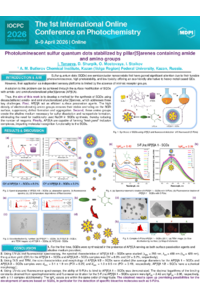
Sulfur quantum dots (SQDs) have gained significant attention due to their tunable photoluminescence, high photostability, and low toxicity, offering an eco-friendly alternative to heavy-metal-based QDs. However, their application as independent sensory platforms is limited by the absence of intrinsic receptor groups.
This study presents a novel synthesis of SQDs using decasubstituted amide- and amino-functionalized pillar[5]arenes (P[5]As), addressing three key challenges. Firstly, the P[5]As act as effective surface passivation agents. The high density of electron-donating amino groups ensures their stable anchoring to the SQD surface, suppressing defect formation and aggregation. Secondly, these amino groups generate an alkaline medium necessary for sulfur dissolution and nanoparticle formation, eliminating the need for traditionally used NaOH in SQD synthesis, thereby reducing the number of reagents. Finally, P[5]As are capable of forming host–guest inclusion complexes, which imparts molecular recognition functionality to the SQDs. The sensory potential of the resulting nanomaterials was evaluated by studying their interaction with a series of antitumor drugs (tegafur, floxuridine, 5-fluorouracil, dacarbazine, and lomustine).
The following methods were applied to achieve the goal: NMR, IR, UV-vis, and fluorescence spectroscopy; MALDI-TOF mass spectrometry; elemental analysis; DLS; and TEM.
For the first time, SQDs were synthesized in the presence of P[5]As, serving as both surface passivation agents and alkaline medium providers. The resulting P[5]As-SQDs exhibit high-intensity blue fluorescence, average sizes of up to 10 nm, and a spherical morphology. UV-vis spectroscopy demonstrated the selective binding of 5-fluorouracil to the P[5]As-SQDs, confirming the key role of the macrocyclic ligand in recognition. Binding constants (lgKas) determined by UV-vis and fluorescence titration were 2.42 and 2.06, respectively.
Thus, functionalization with amide- and amino-functionalized P[5]As provides a validated single-step strategy to create stable, recognition-capable SQDs. This approach opens promising avenues for developing SQD-based sensors, particularly for detecting specific bioactive molecules such as 5-fluorouracil.
Keywords
Sulfur quantum dots
photoluminescence
nanomaterials
pillar[5]arenes
supramolecular chemistry
5-fluorouracil
Poster
Poster_I. Tanaeva_IOCPC 2026.pdf
Tailored Co- and Sn-Doped YMnO₃ Perovskites for Sustainable Removal of 17α-Ethinylestradiol
Aggregation-induced emission (AIE) dye-polymer nanoformulations via electrostatic complexation