Event submissions
Published
This submission belongs to the session S6. Fractal Geometry: Mathematical Foundations and Real-World Applications of the event The 1st International Online Conference on Fractal and Fractional
Published date
08 Apr, 2026
Academic Editor
'%3e%3cpath%20d='M12.6657%2010.9104C12.4185%2010.325%2012.0599%209.79327%2011.6097%209.34482C11.1609%208.89508%2010.6293%208.5365%2010.0442%208.28888C10.0389%208.28626%2010.0337%208.28495%2010.0285%208.28233C10.8446%207.69279%2011.3752%206.73249%2011.3752%205.64904C11.3752%203.8542%209.92103%202.39999%208.1262%202.39999C6.33136%202.39999%204.87715%203.8542%204.87715%205.64904C4.87715%206.73249%205.40774%207.69279%206.22393%208.28364C6.21869%208.28626%206.21345%208.28757%206.20821%208.29019C5.62129%208.5378%205.09463%208.89284%204.64265%209.34613C4.1929%209.79493%203.83432%2010.3266%203.58671%2010.9117C3.34345%2011.4845%203.21226%2012.0987%203.20023%2012.7209C3.19988%2012.7349%203.20233%2012.7488%203.20744%2012.7619C3.21255%2012.7749%203.22022%2012.7867%203.22998%2012.7968C3.23975%2012.8068%203.25142%2012.8147%203.26431%2012.8202C3.2772%2012.8256%203.29105%2012.8284%203.30504%2012.8284H4.09109C4.14874%2012.8284%204.19459%2012.7825%204.1959%2012.7262C4.2221%2011.7148%204.62823%2010.7676%205.34617%2010.0497C6.08899%209.30683%207.0755%208.89808%208.1262%208.89808C9.17689%208.89808%2010.1634%209.30683%2010.9062%2010.0497C11.6242%2010.7676%2012.0303%2011.7148%2012.0565%2012.7262C12.0578%2012.7838%2012.1037%2012.8284%2012.1613%2012.8284H12.9474C12.9613%2012.8284%2012.9752%2012.8256%2012.9881%2012.8202C13.001%2012.8147%2013.0126%2012.8068%2013.0224%2012.7968C13.0322%2012.7867%2013.0398%2012.7749%2013.0449%2012.7619C13.0501%2012.7488%2013.0525%2012.7349%2013.0522%2012.7209C13.0391%2012.0947%2012.9094%2011.4855%2012.6657%2010.9104ZM8.1262%207.9024C7.52486%207.9024%206.9589%207.6679%206.53312%207.24211C6.10733%206.81633%205.87283%206.25037%205.87283%205.64904C5.87283%205.0477%206.10733%204.48174%206.53312%204.05596C6.9589%203.63018%207.52486%203.39567%208.1262%203.39567C8.72753%203.39567%209.29349%203.63018%209.71927%204.05596C10.1451%204.48174%2010.3796%205.0477%2010.3796%205.64904C10.3796%206.25037%2010.1451%206.81633%209.71927%207.24211C9.29349%207.6679%208.72753%207.9024%208.1262%207.9024Z'%20fill='%235D1EE1'/%3e%3c/g%3e%3c/svg%3e) Camillo Porcaro
Camillo PorcaroCitation
Najoua Soudi, Dounia Zaidouni, Ikram El Asri, Fractal Mathematics of Global Deprivation: New Evidence for Scale-Invariant Complexity, in Proceedings of The 1st International Online Conference on Fractal and Fractional, 13 April–15 April 2026, MDPI: Basel, Switzerland
Share
Email
Facebook
Twitter
LinkedIn
Fractal Mathematics of Global Deprivation: New Evidence for Scale-Invariant Complexity
'%3e%3cpath%20d='M12.6647%2010.9104C12.4176%2010.325%2012.0589%209.7933%2011.6088%209.34485C11.16%208.89511%2010.6283%208.53653%2010.0432%208.28891C10.038%208.28629%2010.0327%208.28498%2010.0275%208.28236C10.8437%207.69282%2011.3743%206.73252%2011.3743%205.64907C11.3743%203.85423%209.92005%202.40002%208.12522%202.40002C6.33038%202.40002%204.87618%203.85423%204.87618%205.64907C4.87618%206.73252%205.40677%207.69282%206.22296%208.28367C6.21772%208.28629%206.21248%208.2876%206.20724%208.29022C5.62031%208.53783%205.09365%208.89287%204.64167%209.34616C4.19192%209.79496%203.83334%2010.3266%203.58573%2010.9117C3.34247%2011.4846%203.21128%2012.0987%203.19925%2012.721C3.1989%2012.735%203.20135%2012.7489%203.20646%2012.7619C3.21157%2012.7749%203.21924%2012.7868%203.22901%2012.7968C3.23877%2012.8068%203.25045%2012.8148%203.26334%2012.8202C3.27623%2012.8256%203.29007%2012.8284%203.30406%2012.8284H4.09012C4.14776%2012.8284%204.19362%2012.7825%204.19493%2012.7262C4.22113%2011.7148%204.62726%2010.7676%205.34519%2010.0497C6.08802%209.30686%207.07452%208.89811%208.12522%208.89811C9.17592%208.89811%2010.1624%209.30686%2010.9052%2010.0497C11.6232%2010.7676%2012.0293%2011.7148%2012.0555%2012.7262C12.0568%2012.7839%2012.1027%2012.8284%2012.1603%2012.8284H12.9464C12.9604%2012.8284%2012.9742%2012.8256%2012.9871%2012.8202C13%2012.8148%2013.0117%2012.8068%2013.0214%2012.7968C13.0312%2012.7868%2013.0389%2012.7749%2013.044%2012.7619C13.0491%2012.7489%2013.0515%2012.735%2013.0512%2012.721C13.0381%2012.0947%2012.9084%2011.4856%2012.6647%2010.9104ZM8.12522%207.90243C7.52388%207.90243%206.95792%207.66793%206.53214%207.24215C6.10636%206.81636%205.87185%206.2504%205.87185%205.64907C5.87185%205.04773%206.10636%204.48177%206.53214%204.05599C6.95792%203.63021%207.52388%203.3957%208.12522%203.3957C8.72655%203.3957%209.29252%203.63021%209.7183%204.05599C10.1441%204.48177%2010.3786%205.04773%2010.3786%205.64907C10.3786%206.2504%2010.1441%206.81636%209.7183%207.24215C9.29252%207.66793%208.72655%207.90243%208.12522%207.90243Z'%20fill='%235D1EE1'/%3e%3c/g%3e%3c/svg%3e)
Najoua Soudi 1
Dounia Zaidouni 1
Ikram El Asri 1
1. The Mathematics and Networks Department, The National Institute of Posts and Telecommunications, Rabat 10000, Morocco, Morocco
Abstract
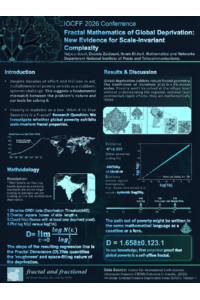
This study presents a novel application of fractal geometry and complex systems theory to a mufti-layered socioeconomic dataset: NASA's GRDI v1, a global high-resolution (≈1 km) index of multidimensional deprivation. We present evidence that the spatial architecture of multidimensional deprivation is self-similar across scales, exhibiting a robust fractal geometry. Analyzing data from the Global Relative Deprivation Index (GRDI v1), we compute the box-counting dimension across six continental regimes. The analysis reveals a mean fractal dimension of D = 1.60 ± 0.40, demonstrating significant regional heterogeneity (ANOVA F = 122.27, p = 7.28 × 10⁻¹⁰), from densely clustered deprivation in South Asia (D = 1.904) to sparse, fragmented patterns in South America (D = 0.781). This power-law scaling is exceptionally strong (mean R² = 0.997) and is validated within 5% tolerance by correlation dimension analysis in 90% of regions.
The observed scaling is not an artifact of methodology. Fractal dimensions are stable across deprivation thresholds (coefficient of variation = 3.40%) and are statistically preferred over log-normal or stretched-exponential alternatives (likelihood ratio test, p < 0.001). Controlling for spatial autocorrelation, we identify a significant association between fractal dimension and governance indicators (Mantel test r = 0.73, p = 0.003).
Theoretically, these findings characterize deprivation as a spatially embedded complex system with a non-trivial topological dimension (1 < D < 2). This indicates a sparse, hierarchical network structure that is nested across scales, implying that local interventions may propagate through self-similar pathways.
Practically, D serves as a scale-invariant metric for comparative analysis. It delineates distinct policy arenas: regions with D > 1.7 necessitate multi-scale strategies addressing hierarchical clustering, while regions with D < 1.2 may be more responsive to targeted, nodal interventions. We further demonstrate that higher D correlates with slower recovery from economic shocks (r = -0.61, p= 0.02), suggesting that fractal complexity quantifies systemic fragility.
We argue that fractal mathematics provides an essential analytical tool for dismantling persistent deprivation structures, offering the first rigorous proof that poverty functions as a complex adaptive system with scale-invariant properties.
Keywords
Fractal geometry
nonlinear dynamics
global deprivation
fractal dimension
complexity science
multidimensional poverty
scale-invariance
complex adaptive systems
self-similarity
Poster
Global Poverty Poster IOCFF 2026 Conference.pdf
Brain dynamics fractality as a biomarker for drug-responsive epilepsy
Fractal-Inspired Multiscale Surface Topography Characterization via ISO 25178 Sdr