Event submissions
Published
This submission belongs to the session S2. Fractional Calculus and Its Applications in Engineering Systems of the event The 1st International Online Conference on Fractal and Fractional
Published date
08 Apr, 2026
Academic Editor
'%3e%3cpath%20d='M12.6657%2010.9104C12.4185%2010.325%2012.0599%209.79327%2011.6097%209.34482C11.1609%208.89508%2010.6293%208.5365%2010.0442%208.28888C10.0389%208.28626%2010.0337%208.28495%2010.0285%208.28233C10.8446%207.69279%2011.3752%206.73249%2011.3752%205.64904C11.3752%203.8542%209.92103%202.39999%208.1262%202.39999C6.33136%202.39999%204.87715%203.8542%204.87715%205.64904C4.87715%206.73249%205.40774%207.69279%206.22393%208.28364C6.21869%208.28626%206.21345%208.28757%206.20821%208.29019C5.62129%208.5378%205.09463%208.89284%204.64265%209.34613C4.1929%209.79493%203.83432%2010.3266%203.58671%2010.9117C3.34345%2011.4845%203.21226%2012.0987%203.20023%2012.7209C3.19988%2012.7349%203.20233%2012.7488%203.20744%2012.7619C3.21255%2012.7749%203.22022%2012.7867%203.22998%2012.7968C3.23975%2012.8068%203.25142%2012.8147%203.26431%2012.8202C3.2772%2012.8256%203.29105%2012.8284%203.30504%2012.8284H4.09109C4.14874%2012.8284%204.19459%2012.7825%204.1959%2012.7262C4.2221%2011.7148%204.62823%2010.7676%205.34617%2010.0497C6.08899%209.30683%207.0755%208.89808%208.1262%208.89808C9.17689%208.89808%2010.1634%209.30683%2010.9062%2010.0497C11.6242%2010.7676%2012.0303%2011.7148%2012.0565%2012.7262C12.0578%2012.7838%2012.1037%2012.8284%2012.1613%2012.8284H12.9474C12.9613%2012.8284%2012.9752%2012.8256%2012.9881%2012.8202C13.001%2012.8147%2013.0126%2012.8068%2013.0224%2012.7968C13.0322%2012.7867%2013.0398%2012.7749%2013.0449%2012.7619C13.0501%2012.7488%2013.0525%2012.7349%2013.0522%2012.7209C13.0391%2012.0947%2012.9094%2011.4855%2012.6657%2010.9104ZM8.1262%207.9024C7.52486%207.9024%206.9589%207.6679%206.53312%207.24211C6.10733%206.81633%205.87283%206.25037%205.87283%205.64904C5.87283%205.0477%206.10733%204.48174%206.53312%204.05596C6.9589%203.63018%207.52486%203.39567%208.1262%203.39567C8.72753%203.39567%209.29349%203.63018%209.71927%204.05596C10.1451%204.48174%2010.3796%205.0477%2010.3796%205.64904C10.3796%206.25037%2010.1451%206.81633%209.71927%207.24211C9.29349%207.6679%208.72753%207.9024%208.1262%207.9024Z'%20fill='%235D1EE1'/%3e%3c/g%3e%3c/svg%3e) Saptarshi Das
Saptarshi DasCitation
Gabriel Antonio Felipe, Carlos Alberto Valentim Junior, Sergio Adriani David, On the Analytical Treatment of Fractional Elliptic Equations: Applications to Steady-State Heat Conduction, in Proceedings of The 1st International Online Conference on Fractal and Fractional, 13 April–15 April 2026, MDPI: Basel, Switzerland
Share
Email
Facebook
Twitter
LinkedIn
On the Analytical Treatment of Fractional Elliptic Equations: Applications to Steady-State Heat Conduction
'%3e%3cpath%20d='M12.6647%2010.9104C12.4176%2010.325%2012.0589%209.7933%2011.6088%209.34485C11.16%208.89511%2010.6283%208.53653%2010.0432%208.28891C10.038%208.28629%2010.0327%208.28498%2010.0275%208.28236C10.8437%207.69282%2011.3743%206.73252%2011.3743%205.64907C11.3743%203.85423%209.92005%202.40002%208.12522%202.40002C6.33038%202.40002%204.87618%203.85423%204.87618%205.64907C4.87618%206.73252%205.40677%207.69282%206.22296%208.28367C6.21772%208.28629%206.21248%208.2876%206.20724%208.29022C5.62031%208.53783%205.09365%208.89287%204.64167%209.34616C4.19192%209.79496%203.83334%2010.3266%203.58573%2010.9117C3.34247%2011.4846%203.21128%2012.0987%203.19925%2012.721C3.1989%2012.735%203.20135%2012.7489%203.20646%2012.7619C3.21157%2012.7749%203.21924%2012.7868%203.22901%2012.7968C3.23877%2012.8068%203.25045%2012.8148%203.26334%2012.8202C3.27623%2012.8256%203.29007%2012.8284%203.30406%2012.8284H4.09012C4.14776%2012.8284%204.19362%2012.7825%204.19493%2012.7262C4.22113%2011.7148%204.62726%2010.7676%205.34519%2010.0497C6.08802%209.30686%207.07452%208.89811%208.12522%208.89811C9.17592%208.89811%2010.1624%209.30686%2010.9052%2010.0497C11.6232%2010.7676%2012.0293%2011.7148%2012.0555%2012.7262C12.0568%2012.7839%2012.1027%2012.8284%2012.1603%2012.8284H12.9464C12.9604%2012.8284%2012.9742%2012.8256%2012.9871%2012.8202C13%2012.8148%2013.0117%2012.8068%2013.0214%2012.7968C13.0312%2012.7868%2013.0389%2012.7749%2013.044%2012.7619C13.0491%2012.7489%2013.0515%2012.735%2013.0512%2012.721C13.0381%2012.0947%2012.9084%2011.4856%2012.6647%2010.9104ZM8.12522%207.90243C7.52388%207.90243%206.95792%207.66793%206.53214%207.24215C6.10636%206.81636%205.87185%206.2504%205.87185%205.64907C5.87185%205.04773%206.10636%204.48177%206.53214%204.05599C6.95792%203.63021%207.52388%203.3957%208.12522%203.3957C8.72655%203.3957%209.29252%203.63021%209.7183%204.05599C10.1441%204.48177%2010.3786%205.04773%2010.3786%205.64907C10.3786%206.2504%2010.1441%206.81636%209.7183%207.24215C9.29252%207.66793%208.72655%207.90243%208.12522%207.90243Z'%20fill='%235D1EE1'/%3e%3c/g%3e%3c/svg%3e)
Gabriel Antonio Felipe 1
Carlos Alberto Valentim Junior 2

Sergio Adriani David 3
1. School of Animal Science and Food Engineering, University of São Paulo (USP), São Paulo, Brazil, Brazil
2. Department of Biosystems Engineering, Faculty of Animal Science and Food Engineering, University of São Paulo (USP), São Paulo, Brazil, Brazil
3. Department of Biosystems Engineering, Faculty of Animal Science and Food Engineering, University of São Paulo (USP),São Paulo, Brazil, Brazil
Abstract
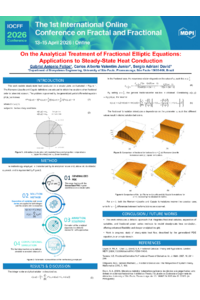
Modeling fractional behaviors is fundamental for characterizing complex phenomena governed by power-law dynamics, long-range temporal and spatial correlations, fractal structures, and memory effects, which are commonly observed in diverse scientific and engineering applications. In this work, we provide an analytical derivation of a fractional formulation for steady-state heat-conduction modeling. The boundary-value problem is defined on an annular domain, with boundary conditions prescribed as functions of the angular coordinate. The proposed approach integrates two analytical techniques, namely separation of variables and fractional power-series expansion, within a framework based on the Caputo fractional derivative. Beyond heat conduction, the methodology presented here is also directly applicable to a broader class of boundary-value problems governed by elliptic fractional differential equations, supporting advancements in modeling heterogeneous materials, porous media, biological tissues, and systems with multiscale or memory-driven behavior. A distinguishing aspect of this study is its emphasis on analytical transparency and didactic clarity, with each mathematical step introduced and developed systematically. The resulting closed-form solution provides a useful reference for future investigations into fractional differential equations, offering both methodological guidance and conceptual insight. The results include the explicit solution in polar coordinates and its interpretation as a function of an arbitrarily selected fractional order, thereby illustrating how fractional operators modulate steady-state heat conduction under the specified boundary conditions.
Keywords
fractional partial differential equation
fractional modeling
dynamic analysis
generalized fractional Laplace equation
Poster
Poster.pdf
The use of generalised fractional models to elucidate the rheological behaviour of nanofluids
Spectral Analysis of Sierpinski Microwave Resonators