Event submissions
Published
This submission belongs to the session S2. Sustainable Propulsion & Energy Systems of the event The 1st International Online Conference on Aerospace
Published date
13 Apr, 2026
Academic Editor
'%3e%3cpath%20d='M12.6657%2010.9104C12.4185%2010.325%2012.0599%209.79327%2011.6097%209.34482C11.1609%208.89508%2010.6293%208.5365%2010.0442%208.28888C10.0389%208.28626%2010.0337%208.28495%2010.0285%208.28233C10.8446%207.69279%2011.3752%206.73249%2011.3752%205.64904C11.3752%203.8542%209.92103%202.39999%208.1262%202.39999C6.33136%202.39999%204.87715%203.8542%204.87715%205.64904C4.87715%206.73249%205.40774%207.69279%206.22393%208.28364C6.21869%208.28626%206.21345%208.28757%206.20821%208.29019C5.62129%208.5378%205.09463%208.89284%204.64265%209.34613C4.1929%209.79493%203.83432%2010.3266%203.58671%2010.9117C3.34345%2011.4845%203.21226%2012.0987%203.20023%2012.7209C3.19988%2012.7349%203.20233%2012.7488%203.20744%2012.7619C3.21255%2012.7749%203.22022%2012.7867%203.22998%2012.7968C3.23975%2012.8068%203.25142%2012.8147%203.26431%2012.8202C3.2772%2012.8256%203.29105%2012.8284%203.30504%2012.8284H4.09109C4.14874%2012.8284%204.19459%2012.7825%204.1959%2012.7262C4.2221%2011.7148%204.62823%2010.7676%205.34617%2010.0497C6.08899%209.30683%207.0755%208.89808%208.1262%208.89808C9.17689%208.89808%2010.1634%209.30683%2010.9062%2010.0497C11.6242%2010.7676%2012.0303%2011.7148%2012.0565%2012.7262C12.0578%2012.7838%2012.1037%2012.8284%2012.1613%2012.8284H12.9474C12.9613%2012.8284%2012.9752%2012.8256%2012.9881%2012.8202C13.001%2012.8147%2013.0126%2012.8068%2013.0224%2012.7968C13.0322%2012.7867%2013.0398%2012.7749%2013.0449%2012.7619C13.0501%2012.7488%2013.0525%2012.7349%2013.0522%2012.7209C13.0391%2012.0947%2012.9094%2011.4855%2012.6657%2010.9104ZM8.1262%207.9024C7.52486%207.9024%206.9589%207.6679%206.53312%207.24211C6.10733%206.81633%205.87283%206.25037%205.87283%205.64904C5.87283%205.0477%206.10733%204.48174%206.53312%204.05596C6.9589%203.63018%207.52486%203.39567%208.1262%203.39567C8.72753%203.39567%209.29349%203.63018%209.71927%204.05596C10.1451%204.48174%2010.3796%205.0477%2010.3796%205.64904C10.3796%206.25037%2010.1451%206.81633%209.71927%207.24211C9.29349%207.6679%208.72753%207.9024%208.1262%207.9024Z'%20fill='%235D1EE1'/%3e%3c/g%3e%3c/svg%3e) Stephen Whitmore
Stephen WhitmoreCitation
Adrian Winter, Yannick Pott, Kay Kochan, Experimental Study of Cryogenic Fill-Level Sensors for Liquid Hydrogen Aircraft Applications, in Proceedings of The 1st International Online Conference on Aerospace, 16 April–17 April 2026, MDPI: Basel, Switzerland
Share
Email
Facebook
Twitter
LinkedIn
Experimental Study of Cryogenic Fill-Level Sensors for Liquid Hydrogen Aircraft Applications
'%3e%3cpath%20d='M12.6647%2010.9104C12.4176%2010.325%2012.0589%209.7933%2011.6088%209.34485C11.16%208.89511%2010.6283%208.53653%2010.0432%208.28891C10.038%208.28629%2010.0327%208.28498%2010.0275%208.28236C10.8437%207.69282%2011.3743%206.73252%2011.3743%205.64907C11.3743%203.85423%209.92005%202.40002%208.12522%202.40002C6.33038%202.40002%204.87618%203.85423%204.87618%205.64907C4.87618%206.73252%205.40677%207.69282%206.22296%208.28367C6.21772%208.28629%206.21248%208.2876%206.20724%208.29022C5.62031%208.53783%205.09365%208.89287%204.64167%209.34616C4.19192%209.79496%203.83334%2010.3266%203.58573%2010.9117C3.34247%2011.4846%203.21128%2012.0987%203.19925%2012.721C3.1989%2012.735%203.20135%2012.7489%203.20646%2012.7619C3.21157%2012.7749%203.21924%2012.7868%203.22901%2012.7968C3.23877%2012.8068%203.25045%2012.8148%203.26334%2012.8202C3.27623%2012.8256%203.29007%2012.8284%203.30406%2012.8284H4.09012C4.14776%2012.8284%204.19362%2012.7825%204.19493%2012.7262C4.22113%2011.7148%204.62726%2010.7676%205.34519%2010.0497C6.08802%209.30686%207.07452%208.89811%208.12522%208.89811C9.17592%208.89811%2010.1624%209.30686%2010.9052%2010.0497C11.6232%2010.7676%2012.0293%2011.7148%2012.0555%2012.7262C12.0568%2012.7839%2012.1027%2012.8284%2012.1603%2012.8284H12.9464C12.9604%2012.8284%2012.9742%2012.8256%2012.9871%2012.8202C13%2012.8148%2013.0117%2012.8068%2013.0214%2012.7968C13.0312%2012.7868%2013.0389%2012.7749%2013.044%2012.7619C13.0491%2012.7489%2013.0515%2012.735%2013.0512%2012.721C13.0381%2012.0947%2012.9084%2011.4856%2012.6647%2010.9104ZM8.12522%207.90243C7.52388%207.90243%206.95792%207.66793%206.53214%207.24215C6.10636%206.81636%205.87185%206.2504%205.87185%205.64907C5.87185%205.04773%206.10636%204.48177%206.53214%204.05599C6.95792%203.63021%207.52388%203.3957%208.12522%203.3957C8.72655%203.3957%209.29252%203.63021%209.7183%204.05599C10.1441%204.48177%2010.3786%205.04773%2010.3786%205.64907C10.3786%206.2504%2010.1441%206.81636%209.7183%207.24215C9.29252%207.66793%208.72655%207.90243%208.12522%207.90243Z'%20fill='%235D1EE1'/%3e%3c/g%3e%3c/svg%3e)
Adrian Winter 1
Yannick Pott 1
Kay Kochan 1
1. Department of Automotive and Aeronautical Engineering, University of Applied Sciences of Hamburg, Hamburg 20099, Germany
Abstract
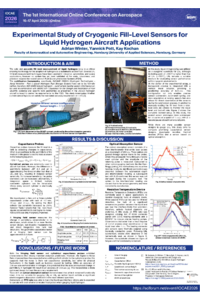
The safe and accurate measurement of liquid hydrogen (LH₂) tank fill levels is a critical enabling technology for the adoption of hydrogen as a sustainable aviation fuel. Although LH₂ level measurement techniques have been applied in industrial, automotive, and space applications, no integrated system has yet been validated at the scale, robustness, and precision required for modern aircraft Fuel Quantity Indication Systems (FQISs).
Differential pressure sensors are commonly employed in industrial cryogenic systems and hydrogen refueling stations; however, their accuracy is strongly influenced by dynamic effects such as filling transients and liquid sloshing, rendering them unsuitable for aviation-grade FQIS requirements. While simulations and analytical studies propose alternative LH₂ level sensing concepts, experimental validation and direct comparative assessments of different sensor architectures remain scarce. Furthermore, although several manufacturers offer LH₂ level sensors, their stated measurement accuracies have not been independently verified, highlighting the need for systematic experimental investigation under representative operating conditions.
In this work, five liquid level sensing concepts based on measurements of dielectric constant, thermal capacity, and optical absorption are experimentally evaluated. Cryogenic tests are conducted using liquid nitrogen as a representative surrogate for liquid hydrogen. The results demonstrate that optical absorption-based approaches are unsuitable for reliable cryogenic liquid level measurement. In contrast, capacitive probes and discrete resistive thermal sensors exhibit robust and repeatable performance under cryogenic conditions, achieving measurement accuracies better than ±1.5 mm. These findings provide experimentally grounded guidance for the development of future LH₂-compatible FQIS architectures for aviation applications.
Keywords
Cryogenic liquid level measurement
Fuel Quantity Indication System (FQIS)
Hydrogen-powered aircraft
Capacitive level sensing
Thermal resistive devices
Optical absorption sensing
Cryogenic tank instrumentation
Poster
Poster-IOCAE_PRECISE_POSTER_ADRIAN_WINTER.pdf
State-Based Estimation of Future Mission Capability for Degrading Unmanned Aerial Vehicles
Electro-Impulse De-Icing of the Leading Edge of a Slat