Event submissions
Published
This submission belongs to the session S4. Digitalization, Autonomy & Airspace Management of the event The 1st International Online Conference on Aerospace
Published date
13 Apr, 2026
Academic Editor
'%3e%3cpath%20d='M12.6657%2010.9104C12.4185%2010.325%2012.0599%209.79327%2011.6097%209.34482C11.1609%208.89508%2010.6293%208.5365%2010.0442%208.28888C10.0389%208.28626%2010.0337%208.28495%2010.0285%208.28233C10.8446%207.69279%2011.3752%206.73249%2011.3752%205.64904C11.3752%203.8542%209.92103%202.39999%208.1262%202.39999C6.33136%202.39999%204.87715%203.8542%204.87715%205.64904C4.87715%206.73249%205.40774%207.69279%206.22393%208.28364C6.21869%208.28626%206.21345%208.28757%206.20821%208.29019C5.62129%208.5378%205.09463%208.89284%204.64265%209.34613C4.1929%209.79493%203.83432%2010.3266%203.58671%2010.9117C3.34345%2011.4845%203.21226%2012.0987%203.20023%2012.7209C3.19988%2012.7349%203.20233%2012.7488%203.20744%2012.7619C3.21255%2012.7749%203.22022%2012.7867%203.22998%2012.7968C3.23975%2012.8068%203.25142%2012.8147%203.26431%2012.8202C3.2772%2012.8256%203.29105%2012.8284%203.30504%2012.8284H4.09109C4.14874%2012.8284%204.19459%2012.7825%204.1959%2012.7262C4.2221%2011.7148%204.62823%2010.7676%205.34617%2010.0497C6.08899%209.30683%207.0755%208.89808%208.1262%208.89808C9.17689%208.89808%2010.1634%209.30683%2010.9062%2010.0497C11.6242%2010.7676%2012.0303%2011.7148%2012.0565%2012.7262C12.0578%2012.7838%2012.1037%2012.8284%2012.1613%2012.8284H12.9474C12.9613%2012.8284%2012.9752%2012.8256%2012.9881%2012.8202C13.001%2012.8147%2013.0126%2012.8068%2013.0224%2012.7968C13.0322%2012.7867%2013.0398%2012.7749%2013.0449%2012.7619C13.0501%2012.7488%2013.0525%2012.7349%2013.0522%2012.7209C13.0391%2012.0947%2012.9094%2011.4855%2012.6657%2010.9104ZM8.1262%207.9024C7.52486%207.9024%206.9589%207.6679%206.53312%207.24211C6.10733%206.81633%205.87283%206.25037%205.87283%205.64904C5.87283%205.0477%206.10733%204.48174%206.53312%204.05596C6.9589%203.63018%207.52486%203.39567%208.1262%203.39567C8.72753%203.39567%209.29349%203.63018%209.71927%204.05596C10.1451%204.48174%2010.3796%205.0477%2010.3796%205.64904C10.3796%206.25037%2010.1451%206.81633%209.71927%207.24211C9.29349%207.6679%208.72753%207.9024%208.1262%207.9024Z'%20fill='%235D1EE1'/%3e%3c/g%3e%3c/svg%3e) Konstantinos Kontis
Konstantinos KontisCitation
Yun Sang Tse, Robust AI-Assisted HPC Borescope Inspection: Evaluating Stage-Level Decisions and Viewpoint Generalisation, in Proceedings of The 1st International Online Conference on Aerospace, 16 April–17 April 2026, MDPI: Basel, Switzerland
Share
Email
Facebook
Twitter
LinkedIn
Robust AI-Assisted HPC Borescope Inspection: Evaluating Stage-Level Decisions and Viewpoint Generalisation
'%3e%3cpath%20d='M12.6647%2010.9104C12.4176%2010.325%2012.0589%209.7933%2011.6088%209.34485C11.16%208.89511%2010.6283%208.53653%2010.0432%208.28891C10.038%208.28629%2010.0327%208.28498%2010.0275%208.28236C10.8437%207.69282%2011.3743%206.73252%2011.3743%205.64907C11.3743%203.85423%209.92005%202.40002%208.12522%202.40002C6.33038%202.40002%204.87618%203.85423%204.87618%205.64907C4.87618%206.73252%205.40677%207.69282%206.22296%208.28367C6.21772%208.28629%206.21248%208.2876%206.20724%208.29022C5.62031%208.53783%205.09365%208.89287%204.64167%209.34616C4.19192%209.79496%203.83334%2010.3266%203.58573%2010.9117C3.34247%2011.4846%203.21128%2012.0987%203.19925%2012.721C3.1989%2012.735%203.20135%2012.7489%203.20646%2012.7619C3.21157%2012.7749%203.21924%2012.7868%203.22901%2012.7968C3.23877%2012.8068%203.25045%2012.8148%203.26334%2012.8202C3.27623%2012.8256%203.29007%2012.8284%203.30406%2012.8284H4.09012C4.14776%2012.8284%204.19362%2012.7825%204.19493%2012.7262C4.22113%2011.7148%204.62726%2010.7676%205.34519%2010.0497C6.08802%209.30686%207.07452%208.89811%208.12522%208.89811C9.17592%208.89811%2010.1624%209.30686%2010.9052%2010.0497C11.6232%2010.7676%2012.0293%2011.7148%2012.0555%2012.7262C12.0568%2012.7839%2012.1027%2012.8284%2012.1603%2012.8284H12.9464C12.9604%2012.8284%2012.9742%2012.8256%2012.9871%2012.8202C13%2012.8148%2013.0117%2012.8068%2013.0214%2012.7968C13.0312%2012.7868%2013.0389%2012.7749%2013.044%2012.7619C13.0491%2012.7489%2013.0515%2012.735%2013.0512%2012.721C13.0381%2012.0947%2012.9084%2011.4856%2012.6647%2010.9104ZM8.12522%207.90243C7.52388%207.90243%206.95792%207.66793%206.53214%207.24215C6.10636%206.81636%205.87185%206.2504%205.87185%205.64907C5.87185%205.04773%206.10636%204.48177%206.53214%204.05599C6.95792%203.63021%207.52388%203.3957%208.12522%203.3957C8.72655%203.3957%209.29252%203.63021%209.7183%204.05599C10.1441%204.48177%2010.3786%205.04773%2010.3786%205.64907C10.3786%206.2504%2010.1441%206.81636%209.7183%207.24215C9.29252%207.66793%208.72655%207.90243%208.12522%207.90243Z'%20fill='%235D1EE1'/%3e%3c/g%3e%3c/svg%3e)
Yun Sang Tse 1
1. The Department of Electronic and Computer Engineering, Hong Kong University of Science and Technology (HKUST), Kowloon, Hong Kong
Abstract
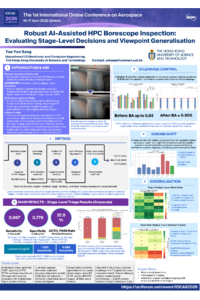
Borescope inspection of aircraft engine high-pressure compressors (HPCs) is safety-critical yet remains highly manual because inspection footage is noisy (blur, glare, occlusion), viewpoints vary across blade regions, and decisions must be traceable for audit. While deep learning has been applied to aero-engine defect detection, most studies focus on curated single-frame “snapshot” evaluation and accuracy, with limited attention to workflow-level decisions, evidence traceability (frames/timestamps), shortcut learning from on-screen UI overlays, and generalisation under real inspection view shift. This research proposes an audit-friendly decision support approach for HPC borescope inspection that outputs stage/segment-level decisions (AUTO_PASS/ NEEDS_REVIEW/AUTO_FLAG) together with evidence frames and timestamps. Using borescope videos from seven engines, covering early, mid, and late segments of the HPC, we construct a real-workflow dataset, exclude frames with unmaskable overlay states, and evaluate generalisation with engine-holdout, stage/segment-holdout, and view-holdout protocols. As a baseline, we train a ResNet-18 classifier using stage-level defect labels, then develop an event-window evidence model that learns from temporally localised defect windows and aggregates Top-K supporting frames (with timestamps) to form stage/segment-level decisions. UI overlays are neutralised to reduce shortcut learning, and leakage control is verified via UI-only “cheat tests.” Across engine-holdout folds, the proposed evidence-frame approach is expected to deliver high defect sensitivity with improved specificity compared with stage-label baseline, by leveraging temporally localised event learning and Top-K evidence aggregation to suppress UI- and noise-driven false positives. Robustness will be assessed by the stability of stage/segment-level decisions under realistic degradations, with low flip rates anticipated at the chosen operating point. In view-holdout transfer (Root-to-Platform vs. LE/Upper-Blade-to-Tip) and stage/segment-holdout, a measurable performance shift is anticipated, motivating explicit viewpoint validation when claiming inspection coverage. Overall, this work reframes borescope AI from image classification to audit-ready decision support aligned with real inspection workflows.
Keywords
High Pressure Compressor (HPC)
Maintenance Repair Overhaul (MRO)
Borescope Inspections
Engine-Holdout Generalisation
UI Overlay Masking
Poster
IOCAE 2026 Poster_TYS_vF.pdf
Design-Oriented Assessment of Composite Aircraft Panels under Multiple Loading Conditions
Geometric MPC for Robust UAV Flights using a 2-Manifold approach