Event submissions
Published
This submission belongs to the session S1. Next-Gen Aircraft Design & Optimization of the event The 1st International Online Conference on Aerospace
Published date
13 Apr, 2026
Academic Editor
'%3e%3cpath%20d='M12.6657%2010.9104C12.4185%2010.325%2012.0599%209.79327%2011.6097%209.34482C11.1609%208.89508%2010.6293%208.5365%2010.0442%208.28888C10.0389%208.28626%2010.0337%208.28495%2010.0285%208.28233C10.8446%207.69279%2011.3752%206.73249%2011.3752%205.64904C11.3752%203.8542%209.92103%202.39999%208.1262%202.39999C6.33136%202.39999%204.87715%203.8542%204.87715%205.64904C4.87715%206.73249%205.40774%207.69279%206.22393%208.28364C6.21869%208.28626%206.21345%208.28757%206.20821%208.29019C5.62129%208.5378%205.09463%208.89284%204.64265%209.34613C4.1929%209.79493%203.83432%2010.3266%203.58671%2010.9117C3.34345%2011.4845%203.21226%2012.0987%203.20023%2012.7209C3.19988%2012.7349%203.20233%2012.7488%203.20744%2012.7619C3.21255%2012.7749%203.22022%2012.7867%203.22998%2012.7968C3.23975%2012.8068%203.25142%2012.8147%203.26431%2012.8202C3.2772%2012.8256%203.29105%2012.8284%203.30504%2012.8284H4.09109C4.14874%2012.8284%204.19459%2012.7825%204.1959%2012.7262C4.2221%2011.7148%204.62823%2010.7676%205.34617%2010.0497C6.08899%209.30683%207.0755%208.89808%208.1262%208.89808C9.17689%208.89808%2010.1634%209.30683%2010.9062%2010.0497C11.6242%2010.7676%2012.0303%2011.7148%2012.0565%2012.7262C12.0578%2012.7838%2012.1037%2012.8284%2012.1613%2012.8284H12.9474C12.9613%2012.8284%2012.9752%2012.8256%2012.9881%2012.8202C13.001%2012.8147%2013.0126%2012.8068%2013.0224%2012.7968C13.0322%2012.7867%2013.0398%2012.7749%2013.0449%2012.7619C13.0501%2012.7488%2013.0525%2012.7349%2013.0522%2012.7209C13.0391%2012.0947%2012.9094%2011.4855%2012.6657%2010.9104ZM8.1262%207.9024C7.52486%207.9024%206.9589%207.6679%206.53312%207.24211C6.10733%206.81633%205.87283%206.25037%205.87283%205.64904C5.87283%205.0477%206.10733%204.48174%206.53312%204.05596C6.9589%203.63018%207.52486%203.39567%208.1262%203.39567C8.72753%203.39567%209.29349%203.63018%209.71927%204.05596C10.1451%204.48174%2010.3796%205.0477%2010.3796%205.64904C10.3796%206.25037%2010.1451%206.81633%209.71927%207.24211C9.29349%207.6679%208.72753%207.9024%208.1262%207.9024Z'%20fill='%235D1EE1'/%3e%3c/g%3e%3c/svg%3e) Norman Wereley
Norman WereleyCitation
Riccardo Andrew Oggioni, Carlo E. D. Riboldi, Filippo Coacci, Wind Tunnel Investigation of Spoiler Effectiveness on a low Aspect-Ratio Swept Wing with reflex Airfoils, in Proceedings of The 1st International Online Conference on Aerospace, 16 April–17 April 2026, MDPI: Basel, Switzerland
Share
Email
Facebook
Twitter
LinkedIn
Wind Tunnel Investigation of Spoiler Effectiveness on a low Aspect-Ratio Swept Wing with reflex Airfoils
'%3e%3cpath%20d='M12.6647%2010.9104C12.4176%2010.325%2012.0589%209.7933%2011.6088%209.34485C11.16%208.89511%2010.6283%208.53653%2010.0432%208.28891C10.038%208.28629%2010.0327%208.28498%2010.0275%208.28236C10.8437%207.69282%2011.3743%206.73252%2011.3743%205.64907C11.3743%203.85423%209.92005%202.40002%208.12522%202.40002C6.33038%202.40002%204.87618%203.85423%204.87618%205.64907C4.87618%206.73252%205.40677%207.69282%206.22296%208.28367C6.21772%208.28629%206.21248%208.2876%206.20724%208.29022C5.62031%208.53783%205.09365%208.89287%204.64167%209.34616C4.19192%209.79496%203.83334%2010.3266%203.58573%2010.9117C3.34247%2011.4846%203.21128%2012.0987%203.19925%2012.721C3.1989%2012.735%203.20135%2012.7489%203.20646%2012.7619C3.21157%2012.7749%203.21924%2012.7868%203.22901%2012.7968C3.23877%2012.8068%203.25045%2012.8148%203.26334%2012.8202C3.27623%2012.8256%203.29007%2012.8284%203.30406%2012.8284H4.09012C4.14776%2012.8284%204.19362%2012.7825%204.19493%2012.7262C4.22113%2011.7148%204.62726%2010.7676%205.34519%2010.0497C6.08802%209.30686%207.07452%208.89811%208.12522%208.89811C9.17592%208.89811%2010.1624%209.30686%2010.9052%2010.0497C11.6232%2010.7676%2012.0293%2011.7148%2012.0555%2012.7262C12.0568%2012.7839%2012.1027%2012.8284%2012.1603%2012.8284H12.9464C12.9604%2012.8284%2012.9742%2012.8256%2012.9871%2012.8202C13%2012.8148%2013.0117%2012.8068%2013.0214%2012.7968C13.0312%2012.7868%2013.0389%2012.7749%2013.044%2012.7619C13.0491%2012.7489%2013.0515%2012.735%2013.0512%2012.721C13.0381%2012.0947%2012.9084%2011.4856%2012.6647%2010.9104ZM8.12522%207.90243C7.52388%207.90243%206.95792%207.66793%206.53214%207.24215C6.10636%206.81636%205.87185%206.2504%205.87185%205.64907C5.87185%205.04773%206.10636%204.48177%206.53214%204.05599C6.95792%203.63021%207.52388%203.3957%208.12522%203.3957C8.72655%203.3957%209.29252%203.63021%209.7183%204.05599C10.1441%204.48177%2010.3786%205.04773%2010.3786%205.64907C10.3786%206.2504%2010.1441%206.81636%209.7183%207.24215C9.29252%207.66793%208.72655%207.90243%208.12522%207.90243Z'%20fill='%235D1EE1'/%3e%3c/g%3e%3c/svg%3e)
Riccardo Andrew Oggioni 1

Carlo E. D. Riboldi 1
Filippo Coacci 1
1. DAER, Aerospace Engineering, Politecnico di Milano, Milano, IT 20133, Italy
Abstract
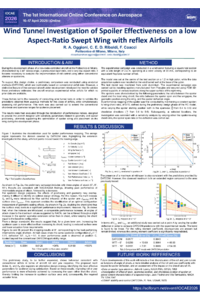
During the design phase of a fixed-wing remotely piloted aircraft developed at Politecnico di Milano, an experimental investigation was conducted to validate preliminary sizing methods for spoileron. Traditional regression-based and semi-empirical approaches (such as DATCOM and Roskam) were compared with results obtained from a dedicated wind tunnel test campaign.
The need for validation arises from the application of these methodologies to a non-conventional configuration characterized by newly designed reflex airfoils and a distinctive geometric layout, including a highly swept wing, low aspect ratio, and pronounced taper. The lack of prior experimental data on reflex airfoils applied to similar wing configurations equipped with spoileron-type control surfaces raises uncertainties regarding the reliability of estimates derived from traditional approaches, which are generally calibrated on conventional airfoil geometries.
The wind tunnel campaign was conducted using a 1.3 m wingspan aluminum model at a Reynolds number of 1×10⁶, during which roll and yaw performance was systematically mapped by varying the spanwise and chordwise spoiler positions. In an initial phase, the ratio between spoiler chord and local wing chord was kept constant. Subsequently, the sensitivity to variations in this ratio, spoiler spanwise extension, and control surface deflection was analyzed.
Results show qualitative agreement with trends reported in the literature, highlighting maximum effectiveness at intermediate angles of attack (5–8°) and a reduction in effectiveness when the spoiler is placed toward the wing tip. Quantitatively, the measured performance is slightly higher than that predicted using traditional preliminary methods. The results therefore indicate that conventional regression-based approaches can be reasonably applied to wings equipped with reflex airfoils, despite their original calibration on conventional airfoil geometries. Moreover, the observed systematic deviation suggests the need for minor correction factors when applying these methods to similar unconventional configurations, contributing to enhanced confidence in early-stage control surface sizing.
Keywords
spoileron
windtunnel
reflex airfoil
Poster
IOCAE_Oggioni_Riboldi_Coacci_POSTER.pdf
Flight-Test-Based Analysis of Blowing Effects on Trimmed Aerodynamic Polars of a Distributed Electric Propulsion Aircraft Demonstrator
On the feasibility of a lighter-than-air platform for Martian exploration