Event submissions
Published
This submission belongs to the session S4. Applied Mathematics of the event The 2nd International Online Conference on Mathematics and Applications
Published date
05 Jun, 2026
Academic Editor
'%3e%3cpath%20d='M12.6657%2010.9104C12.4185%2010.325%2012.0599%209.79327%2011.6097%209.34482C11.1609%208.89508%2010.6293%208.5365%2010.0442%208.28888C10.0389%208.28626%2010.0337%208.28495%2010.0285%208.28233C10.8446%207.69279%2011.3752%206.73249%2011.3752%205.64904C11.3752%203.8542%209.92103%202.39999%208.1262%202.39999C6.33136%202.39999%204.87715%203.8542%204.87715%205.64904C4.87715%206.73249%205.40774%207.69279%206.22393%208.28364C6.21869%208.28626%206.21345%208.28757%206.20821%208.29019C5.62129%208.5378%205.09463%208.89284%204.64265%209.34613C4.1929%209.79493%203.83432%2010.3266%203.58671%2010.9117C3.34345%2011.4845%203.21226%2012.0987%203.20023%2012.7209C3.19988%2012.7349%203.20233%2012.7488%203.20744%2012.7619C3.21255%2012.7749%203.22022%2012.7867%203.22998%2012.7968C3.23975%2012.8068%203.25142%2012.8147%203.26431%2012.8202C3.2772%2012.8256%203.29105%2012.8284%203.30504%2012.8284H4.09109C4.14874%2012.8284%204.19459%2012.7825%204.1959%2012.7262C4.2221%2011.7148%204.62823%2010.7676%205.34617%2010.0497C6.08899%209.30683%207.0755%208.89808%208.1262%208.89808C9.17689%208.89808%2010.1634%209.30683%2010.9062%2010.0497C11.6242%2010.7676%2012.0303%2011.7148%2012.0565%2012.7262C12.0578%2012.7838%2012.1037%2012.8284%2012.1613%2012.8284H12.9474C12.9613%2012.8284%2012.9752%2012.8256%2012.9881%2012.8202C13.001%2012.8147%2013.0126%2012.8068%2013.0224%2012.7968C13.0322%2012.7867%2013.0398%2012.7749%2013.0449%2012.7619C13.0501%2012.7488%2013.0525%2012.7349%2013.0522%2012.7209C13.0391%2012.0947%2012.9094%2011.4855%2012.6657%2010.9104ZM8.1262%207.9024C7.52486%207.9024%206.9589%207.6679%206.53312%207.24211C6.10733%206.81633%205.87283%206.25037%205.87283%205.64904C5.87283%205.0477%206.10733%204.48174%206.53312%204.05596C6.9589%203.63018%207.52486%203.39567%208.1262%203.39567C8.72753%203.39567%209.29349%203.63018%209.71927%204.05596C10.1451%204.48174%2010.3796%205.0477%2010.3796%205.64904C10.3796%206.25037%2010.1451%206.81633%209.71927%207.24211C9.29349%207.6679%208.72753%207.9024%208.1262%207.9024Z'%20fill='%235D1EE1'/%3e%3c/g%3e%3c/svg%3e) Francisco Chiclana
Francisco ChiclanaCitation
Ilya Galaktionov, Andrey Sharafislamov, Vladimir Toporovsky, Oleg Kolesnikov, Optimization of light distribution of lenses for Li-Fi luminaires: comparative study of models LIA and LIB with photometric calculations, in Proceedings of The 2nd International Online Conference on Mathematics and Applications, 10 June–12 June 2026, MDPI: Basel, Switzerland
Share
Email
Facebook
Twitter
LinkedIn
Optimization of light distribution of lenses for Li-Fi luminaires: comparative study of models LIA and LIB with photometric calculations
'%3e%3cpath%20d='M12.6647%2010.9104C12.4176%2010.325%2012.0589%209.7933%2011.6088%209.34485C11.16%208.89511%2010.6283%208.53653%2010.0432%208.28891C10.038%208.28629%2010.0327%208.28498%2010.0275%208.28236C10.8437%207.69282%2011.3743%206.73252%2011.3743%205.64907C11.3743%203.85423%209.92005%202.40002%208.12522%202.40002C6.33038%202.40002%204.87618%203.85423%204.87618%205.64907C4.87618%206.73252%205.40677%207.69282%206.22296%208.28367C6.21772%208.28629%206.21248%208.2876%206.20724%208.29022C5.62031%208.53783%205.09365%208.89287%204.64167%209.34616C4.19192%209.79496%203.83334%2010.3266%203.58573%2010.9117C3.34247%2011.4846%203.21128%2012.0987%203.19925%2012.721C3.1989%2012.735%203.20135%2012.7489%203.20646%2012.7619C3.21157%2012.7749%203.21924%2012.7868%203.22901%2012.7968C3.23877%2012.8068%203.25045%2012.8148%203.26334%2012.8202C3.27623%2012.8256%203.29007%2012.8284%203.30406%2012.8284H4.09012C4.14776%2012.8284%204.19362%2012.7825%204.19493%2012.7262C4.22113%2011.7148%204.62726%2010.7676%205.34519%2010.0497C6.08802%209.30686%207.07452%208.89811%208.12522%208.89811C9.17592%208.89811%2010.1624%209.30686%2010.9052%2010.0497C11.6232%2010.7676%2012.0293%2011.7148%2012.0555%2012.7262C12.0568%2012.7839%2012.1027%2012.8284%2012.1603%2012.8284H12.9464C12.9604%2012.8284%2012.9742%2012.8256%2012.9871%2012.8202C13%2012.8148%2013.0117%2012.8068%2013.0214%2012.7968C13.0312%2012.7868%2013.0389%2012.7749%2013.044%2012.7619C13.0491%2012.7489%2013.0515%2012.735%2013.0512%2012.721C13.0381%2012.0947%2012.9084%2011.4856%2012.6647%2010.9104ZM8.12522%207.90243C7.52388%207.90243%206.95792%207.66793%206.53214%207.24215C6.10636%206.81636%205.87185%206.2504%205.87185%205.64907C5.87185%205.04773%206.10636%204.48177%206.53214%204.05599C6.95792%203.63021%207.52388%203.3957%208.12522%203.3957C8.72655%203.3957%209.29252%203.63021%209.7183%204.05599C10.1441%204.48177%2010.3786%205.04773%2010.3786%205.64907C10.3786%206.2504%2010.1441%206.81636%209.7183%207.24215C9.29252%207.66793%208.72655%207.90243%208.12522%207.90243Z'%20fill='%235D1EE1'/%3e%3c/g%3e%3c/svg%3e)
Ilya Galaktionov 1,2
Andrey Sharafislamov 3

Vladimir Toporovsky 1
Oleg Kolesnikov 1
1. Quantum Center, Moscow Technical University of Communications and Informatics, Moscow, 111024, Russia
2. Physics Department, Moscow Polytechnic University, Moscow, 107023, Russia
3. Department of quantum and optical links, Moscow Technical University of Communications and Informatics, Moscow 111024, Russia
Abstract
Li-Fi (Light Fidelity) uses visible light for wireless data transmission. System performance depends on both the light source's modulation and secondary optics. Spatial light distribution is critical for coverage uniformity and communication stability. This study presents a comparative analysis of two lenses, LiA and LiB, conducted using Techno Team 3D software. The goal was to evaluate how geometric modification affects photometric properties and identify the optimal configuration for a Li-Fi luminaire requiring wider beam angles and uniform light distribution.
Lens LiA Analysis
Simulation results show LiA has a maximum luminous intensity of 4689 cd and a beam angle of approximately 60° at half maximum. Estimated luminous flux is around 2755 lm. LiA produces a concentrated beam with distinct high-intensity zones. While suitable for directional lighting, this pattern limits the stable signal reception area and creates uneven coverage, which is undesirable for indoor optical wireless communication.
Lens LiB Analysis
After geometric modification, LiB shows a maximum intensity of 4304 cd. The beam angle at half maximum increases to about 80°. Simulations indicate wider light diffusion and smoother intensity distribution. Peak values are reduced, and luminous flux is spread more evenly. This is particularly beneficial for Li-Fi luminaires, as a larger illumination area improves channel accessibility.
An additional advantage of LiB is reduced contrast between the center and periphery of the light spot. This homogeneous illumination minimizes "dead zones" and enhances communication reliability. The optical redesign yields parameters better suited for advanced Li-Fi devices. For Li-Fi systems, uniform light distribution is more critical than high directionality. Expanding the emission angle increases coverage and reduces the likelihood of signal gaps. Calculated data confirm that transitioning from LiA to LiB broadens the solid angle and provides more homogeneous illumination, making LiB the preferred choice for integration into Li-Fi lighting systems.
Keywords
Li-Fi
model LIA
model LIB
photometric calculations
Poster
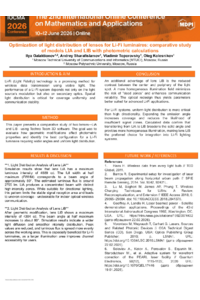
IOCMA2026_poster_Sharafislamov.pdf
A parametric study on the effect of horizontal and vertical location parameters on surface deformation due to a buried tensile fault
The Socio-Digital-Economic Corruption Model (SDECM): A Novel Framework for Analyzing Cyber Fraud and Civic Enforcement