Please login first

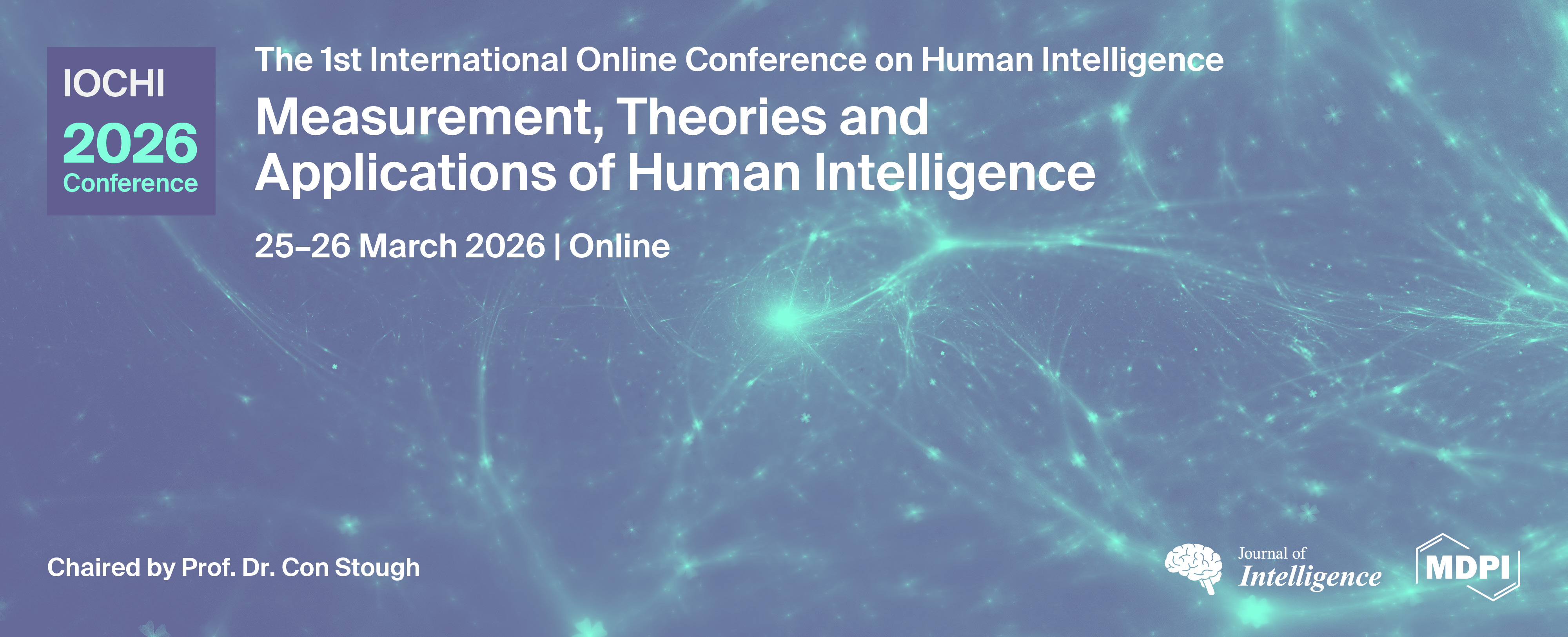
The 1st International Online Conference on Human Intelligence

Measurement, Theories and Applications of Human Intelligence

Part of the International Online Conference on Human Intelligence series
25–26 March 2026
Event's Timezone: Central European Time
Abstract Submission Deadline
23 December 2025
Abstract Acceptance Notification
23 January 2026

Registration Deadline
19 March 2026

Giftedness, Psychometrics, Theories and models of intelligence, Intelligence test, Assessment methods, Cognitive aging, Cognitive neuro-science, Emotional intelligence
Bookmark
Bookmark event Remove event from bookmarks
Add this event to bookmarks
Event Registration Contact Us
Registrations are Open till 19th March 2026. Register for Free HERE.

Program Overview has been announced!
Abstract presentation is now being notified.
Please check your email frequently to avoid missing notifications. Thank you for your patience.

For any inquiries, please contact us at iochi2026@mdpi.com.

Welcome from the Chair

Human intelligence is central to modern society and is one of the oldest and most important constructs in psychology and related disciplines. Understanding the causes and influences of intelligence, how to measure and assess it, and ultimately how to improve it across the lifespan are key considerations for researchers and practitioners.

To bring researchers together on these topics, we will hold the 1st International Online Conference on Human Intelligence (IOCHI 2026), organized by MDPI—an open access journal publisher—and the J. Intell. (Journal of Intelligence) (ISSN: 2079-3200; Impact Factor: 3.4). The conference will be held from 25 to 26 March 2026.

The aim of this two-day conference is to explore new research, foster deeper understanding, and generate new ideas on the construct of human intelligence. We are planning several symposia, which will be broadly arranged in terms of the journal’s current Sections:

S1 Theoretical Contributions and Measurement of Intelligence
S2 Cross-Temporal Within- and Between-Individual Intelligence Changes
S3 Social and Emotional Intelligence
S4 Approaches to Improving Intelligence
S5 Studies on Cognitive Processes

Both oral presentations and a poster session, along with an online Q&A session, will be presented in this online conference, which can be freely accessed and joined from any part of the world. We also welcome novel symposium proposals and current perspectives on topics related to intelligence research.

We are also planning to present awards for outstanding presentations, including both poster and oral sessions. We warmly welcome abstract submissions from all interested participants — whether you are a student, academic researcher, or industry professional.

In addition, participants in this conference are cordially invited to contribute a full manuscript to the conference's Special Issue, in the Journal of Intelligence, with a 20% discount on the publication fee. Please note that the discount can solely be utilized in conjunction with the IOAP discount, and no additional discounts are applicable. All submitted papers will undergo MDPI’s standard peer-review procedure. The abstracts should be cited and noted on the first page of the paper.

We look forward to receiving your engagement and contribution to this scientific event and hope that this conference will bring greater benefits to our human intelligence community.

Kind regards,
Prof. Dr. Con Stough
Chair of the 1st International Online Conference on Human Intelligence

Follow J. Intell news on Social Media.


MDPI conference news on Social Media.

IOCHI 2026 Program (DAY 1)

Program for DAY 1

Date: 25 March 2026 (Wednesday)
Morning Session
Time: 9.00 (CET) | 4:00 (EDT, New York) | 16:00 (CST, Asia, Beijing)

Session 5: Studies on Cognitive Processes

CET
(Central European Time)

Speaker

Title

9.00 – 9.05

Prof. Dr. Con Stough
Event Chair

Welcome from the Event Chair

9.05 – 9.10

Prof. Dr. Andreas Demetriou
Session Chair

Welcome from the Session Chair

9.10 – 9.40

Prof. Dr. Andreas Demetriou
Keynote Speaker

From Reflexes to Reasoning and AGI: A Developmental Theory of Intelligence

9.40 - 10.00

Prof. Dr. Timothy C. Papadopoulos
Invited Speaker

Unraveling The Multifaceted Nature of Intelligence: A Correlated Factor Model Approach Grounded in PASS Theory

10.00 - 10.15

Jérémy Lamri
Selected Speaker

The ATHENA Competency Framework: An Evaluation of its Validity According to Instructional Designers and Human Resource Development Professionals

10.15 - 10.30

Paula Denisa Saragea
Selected Speaker

Neurobiological and Behavioral Signatures of Intelligence-Related Cognitive Processes: Evidence from a Transgenic Alzheimer Model and Modulation by Rubus fruticosus Bioactives

10.30 - 10.45

Florence Dejardin
Selected Speaker

The Cross-Temporal Stability of Sex Differences in Piaget’s Water Level Tasks: A Meta-Analytical Multiverse

10.45 - 11.00

Johanna Heller
Selected Speaker

Spatial Ability across Nations: Measurement Invariance of the Three-Dimensional Cubes Test in Filipino and Austrian Undergraduates

11.00 - 11.15

Stefan Johannes Troche
Selected Speaker

Reasoning Ability but Not the Item-Position Effect is Related to Implicit Learning

11.15 - 11.35

Dr. Gilles Gignac
Invited Speaker

Beyond the Human Ceiling: A Psychometric Framework for Superintelligence


Afternoon Session
Time: 14.00 (CET) | 9:00 (EDT, New York) | 21:00 (CST, Asia, Beijing)

Session 4: Approaches to Improving Intelligence

CET
(Central European Time)

Speaker

Title

14.00 - 14.05

Dr. David Giofre
Session Chair

Welcome from the Session Chair

14.05 - 14.35

Dr. David Giofre
Keynote Speaker

How Anxiety, Self-Beliefs, and Cognitive Abilities Shape Sex/Gender Differences in Achievement and STEM Choices in School

14. 35 - 14.50

Loredana Adriana I. Patrascoiu
Selected Speaker

School Opportunity for Developing Human Intelligence Potential—An Inclusive Case Study Model based on Organizational Needs Analysis

14.50 - 15.05

Francesca Granone
Selected Speaker

Extending Mediation to Support Human Intelligence: Insights from Inclusive Research on Mathematics and Technology in Early Childhood Education

15.05 - 15.20

Benedikt Steininger
Selected Speaker

The Decline Effect Permeates Not Only Intelligence Research, But Psychology as a Whole: Meta-Meta-Analytic Evidence From 648 Meta-Analyses

15.20 - 15.25

Flash Poster Presentation

Marina Corrêa Freitas
Interventions to Enhance Human Intelligence Across the Lifespan: An Integrative Review of Cognitive Training and Neuroplasticity Studies

15.25 - 15.35

Break
Session 3: Social and Emotional Intelligence

CET (Central European Time)

Speaker

Title

15.35 - 15.40

Prof. Dr. Steven E. Stemler
Session Co-Chair

Welcome from the Co-Chair

15.40 - 16.00

Prof. Dr. Steven E. Stemler
Invited Speaker

Could Social Intelligence be the Missing Link?

16.00 - 16.15

Solvita Lodiņa
Selected Speaker

Aspects of social and emotional intelligence in the context of the personal cultural competence of primary school students in the learning process

16.15 - 16.45

TBA – Keynote Speaker

IOCHI 2026 Program (DAY 2)

Program for DAY 2

Date: 26 March 2026 (Thursday)
Morning Session
Time: 9.00 (CET) | 4:00 (EDT, New York) | 16:00 (CST, Asia, Beijing)

Session 1: Theoretical Contributions and Measurement of Intelligence

CET
(Central European Time)

Speaker

Title

9.00 - 9.05

Dr. Damian Patrick Birney
Session Chair

Welcome from the Session Chair

9.05 - 9.35

Dr. Damian Patrick Birney
Keynote Speaker

Adaptive Flexibility: A Theory of Intelligence for Learning and Innovation

9.35 - 9.55

Prof. Dr. Florian Schmitz
Invited Speaker

9.55 - 10.10

J. F. Beckmann
Selected Speaker

Prediction and Validity: Same sides of different coins

10.10 - 10.25

Corentin Gonthier
Selected Speaker

Where are we at with national IQ databases? 12 key issues and one live experiment

10.25 - 10.40

Whisnu Yudiana
Selected Speaker

Construct Validity of the Indonesian WISC-V (WISC-V-ID): Evidence from the 10 Primary Subtests and Ancillary Index Analyses

10.40 - 10.55

Rafli Sodiq Bagaskara
Selected Speaker

Global Trends in Cognitive Measurement: A Bibliometric Analysis

10.55 - 11.10

Helene M. von Gugelberg
Selected Speaker

Problem-Solving Behaviour in Reasoning Tests: Impact of Reasoning Ability, Item Difficulty and Item-Position.

11.10 - 11.25

Steven E. Stemler
Selected Speaker

Insightful Questioning: A New Paradigm for Understanding and Studying Human Intelligence

TBA

Flash Poster Presentation
(5 mins for each Presenter)

Afternoon Session
Time: 14.00 (CET) | 9:00 (EDT, New York) | 21:00 (CST, Asia, Beijing)

Session 2: Cross-temporal within- and between-individuals intelligence changes

CET
(Central European Time)

Speaker

Title

14.00 - 14.05

Dr. Jakob Pietschnig
Session Chair

Welcome from the Session Chair

14.05 - 14.35

Dr. Jakob Pietschnig
Keynote Speaker

Forty Years of Flynn Effect Research: More Questions than Answers about Generational Test Score Changes

14.35 - 14.50

Florian Dürlinger
Selected Speaker

Does Religiosity Prevent Cognitive Declines? Cross-Sectional and Longitudinal Examinations of Religiosity and Intelligence Associations in Elderly Europeans

14.50 - 15.05

Jonas Lesigang
Selected Speaker

Cross-Temporal Meta-Analysis of Trail Making Test Performance (1953-2024): A Flynn Effect for Executive Functioning

15.05 - 15.20

Sandra Oberleiter
Selected Speaker

Domain-Specific Patterns of The Flynn Effect: A CHC-Based Meta-Analysis of More Than a Century of IQ Changes (1909–2025)

15.20 – 15.40

Dr. Kristof Kovacs
Invited Speaker

TBA

Event Chair

Centre for Human Psychopharmacology, Swinburne University of Technology, Melbourne, Australia

Introduction
Bio
Prof. Dr. Con Stough is editor-in-chief of the Journal of Intelligence and has spent the entirety of his research career in psychology, studying human intelligence. Prof. Stough is an adjunct professor at Swinburne University, where he was the director of several research centers in psychology and neuroscience. His research has involved the assessment of intelligence, widely defined, and more recently, the biological basis of cognitive abilities and how to improve cognitive function across the lifespan. He is also working with schools in the area of emotional intelligence, helping schools measure and improve emotional competencies. Prof Stough was on the inaugural panel for the International Society for Intelligence Research when it was established and on the editorial board for the journal Intelligence. He was an invited member of the psychology panel of the World Economic Forum, as well as several Australian government bodies related to psychology and neuroscience. He has attracted more than $40 million in research grants and has published more than 270 peer-reviewed international publications.

Session Chairs

Dr. Damian Patrick Birney

School of Psychology, University of Sydney, Sydney, Australia

Introduction
Research Keywords
working memory; fluid intelligence and reasoning; relational integration; psychometrics and measurement

Dr. Jakob Pietschnig

Department of Developmental and Educational Psychology, University of Vienna, Vienna, Austria

Introduction
Research Keywords
Flynn effect; meta-analysis; reproducibility

Prof. Dr. Con Stough

Centre for Human Psychopharmacology, Swinburne University of Technology, Hawthorn, Australia

Introduction
Research Keywords
psychology; brain science and health; emotional intelligence; theories of intelligence; psychopharmacology of cognition and emotion; natural medicines, the brain and cognition; cognition; cognitive ageing; nutraceuticals; probiotics; improving cognitive performance across the lifespan

Dr. David Giofre

Department of Educational Sciences, University of Genoa, Genoa, Italy

Introduction
Research Keywords
general intelligence (g); working memory; neurodevelopmental disorders

Prof. Dr. Andreas Demetriou

Department of Psychology, University of Nicosia, Nicosia, Cyprus

Introduction
Research Keywords
cognitive development; intelligence; mind-brain relations; mind-education relations; mind-personality relations

Prof. Dr. Steven E. Stemler

Psychology and Education Studies, Wesleyan University Middletown, United States

Introduction
Research Keywords
intelligence; testing; mission; statements; creativity; Practical Intelligence

Event Committee

Department of Psychology, University of Duisburg-Essen, Essen, Germany

Introduction
Research Keywords
emotional abilities; interpersonal accuracy; nonverbal behavior; negotiation; intelligence; emotional competence training; job performance; assessment

Institute of Psychology, University of Bern, Bern, Switzerland

Introduction
Research Keywords
emotional abilities; interpersonal accuracy; nonverbal behavior; negotiation; intelligence; emotional competence training; job performance; assessment

LaPEA, Université Paris Cité and Univ Gustave Eiffel, Boulogne-Billancourt, France

Introduction
Research Keywords
creativity; definition of creativity; measurement of intelligence; measurement of creativity; relationship between intelligence and creativity

Faculty of Psychology and Education Sciences, University of Geneva, CH-1205 Geneva, Switzerland

Introduction
Research Keywords
intelligence; measure of intelligence; individual differences; intra-individual variability; psychometrics; psychological assessment

Department of General Psychology, University of Padova, Italy

Introduction
Research Keywords
intelligence, academic achievement, life satisfaction, 21st century skills

Faculty of Education, Tokyo Gakugei University

Introduction
Research Keywords
executive function, inhibition, working memory, intellectual and developmental disabilities

Institute of Psychology, ELTE Eotvos Lorand University, Hungary

Introduction
Research Keywords
cognitive abilities, working memory, theories of intelligence

Psychology and Education Studies, Wesleyan University Middletown, United States

Introduction
Research Keywords
intelligence testing; mission; statements; creativity; Practical Intelligence

Department of Psychiatry and Behavioral Sciences, University of New Mexico, USA

Introduction
Research Keywords
neuroimaging; intelligence; creativity; personality; individual differences

Department of Developmental and Educational Psychology, Faculty of Education, University of Murcia, Spain

University of Talca, Faculty of Psychology/Millennium Nucleus for the Science of Learning (MiNSoL)/Research Center on Cognitive Sciences, Chile

Introduction
Research Keywords
Executive functions (cold and hot); early stimulation; technology as a learning support tool; vulnerable population.

Keynote Speakers

Department of Psychology, University of Nicosia, Nicosia, Cyprus

Introduction
Talk
From Reflexes to Reasoning and AGI: A Developmental Theory of Intelligence
Bio
Andreas Demetriou is Professor Emeritus of Psychology of the University of Cyprus and the University of Nicosia and fellow of the Cyprus Academy of Sciences, Letters, and Arts, Academia Europea, and the International Academy of Education. He holds Honorary Doctorates or Professorships of several Universities, including Middlesex University, University of Szeged, Hungary, Durham University, and the Northeastern Normal University, China. He was the Minister of Education and Culture of Cyprus and President of the Cyprus University of Technology. He published about 300 books and articles on cognitive development and intelligence. Several journals (Developmental Review, Developmental Science, Intelligence, Human Development) devoted special issues to his theory.

Research Keywords
cognitive development; intelligence; mind-brain relations; mind-education relations; mind-personality relations

School of Psychology, University of Sydney, Sydney, Australia

Introduction
Talk
Adaptive Flexibility: A Theory of Intelligence for Learning and Innovation
Research Keywords
working memory; fluid intelligence and reasoning; relational integration; psychometrics and measurement

Department of Educational Sciences, University of Genoa, Italy

Introduction
Research Keywords
general intelligence (g); working memory; neurodevelopmental disorders

Department of Developmental and Educational Psychology, University of Vienna, Austria

Introduction
Talk
Forty years of Flynn effect research: More Questions than answers about generational test score changes
Research Keywords
flynn effect; meta-analysis; reproducibility

Invited Speakers

Department of Psychology, University of Duisburg-Essen, Germany

Introduction
Research Keywords
intelligence and cognitive abilities; working memory; mental speed; assessment; psychometrics; performance modeling

Institute of Psychology, ELTE Eotvos Lorand University, Hungary

Introduction
Research Keywords
cognitive abilities; working memory; theories of intelligence

Department of Psychology & Center for Applied Neuroscience, University of Cyprus, Cyprus

Introduction
Talk
Unraveling the multifaceted nature of intelligence: A correlated factor model approach grounded in PASS theory
Bio
Timothy C. Papadopoulos, Ph.D., is Professor of Psychology at the University of Cyprus and a founding member of the Center for Applied Neuroscience. He completed his graduate studies in Educational Psychology at the University of Alberta, Canada, and served as a Research Associate at the J.P. Das Developmental Disabilities Centre. His research focuses on neurodevelopmental disorders and their treatment, examining protective and risk factors in specific learning disorders, cognitive components of ADHD (attention, executive functioning, inhibition, and processing speed), and the effects of web-based cognitive remediation programs. His work employs eye-tracking, EEG, training paradigms, and cognitive and behavioral assessments. He received the Distinguished Researcher Award from the Cyprus Research and Innovation Foundation in 2019 and was elected a Fellow of the International Academy for Research in Learning Disabilities (IARLD) in 2024.
Research Keywords
reading development; learning disabilities; neurodevelopmental disorders; intelligence

School of Psychological Science, University of Western Australia, Australia

Introduction
Talk
Beyond the Human Ceiling: A Psychometric Framework for Superintelligence
Bio
Dr. Gilles Gignac is an associate professor at the School of Psychological Science, University of Western Australia. His research focuses on the conceptualization, origins, measurement, and consequences of human intelligence, personality, and individual differences more broadly. More recently, he has focused on the intersection of human and machine cognition, exploring the qualitative and quantitative distinctions that define artificial versus biological intelligence. He holds an Honours degree (Psychology) from Laurentian University, a Master’s in Psychology (psychometrics specialization) from the University of Western Ontario, and a PhD from Swinburne University
Research Keywords
intelligence; meta-cognition; Rigorous psychometric approaches to measuring abilities

Psychology and Education Studies, Wesleyan University Middletown, United States

Introduction
Bio
Steven E. Stemler is a Professor of Psychology and Education Studies at Wesleyan University. His research involves the development of innovative ways of measuring broad constructs such as social intelligence, creativity, cultural competence, and ethical reasoning. Dr. Stemler has received $850,000 in external funding from a variety of State and Federal granting agencies. He has numerous publications in top-tier journals, and a 2020 study in PLOS Biology listed him as being in the top 2.5% of most highly cited scientists in the world across all fields of study and in the top 1% in the fields of social psychology and education. Professor Stemler graduated with a B.S. in Psychology from the University of Washington. He attained an M.Ed. and Ph.D. in Educational Research, Measurement, and Evaluation from the Lynch School of Education at Boston College. Subsequently, he was appointed as a Postdoctoral Associate at Yale University, where he worked directly with Robert J. Sternberg (then president of the American Psychological Association) and joined the research faculty at Yale as an Associate Research Scientist and became the Assistant Director of the Center for the Psychology of Abilities, Competencies, and Expertise (PACE Center) at Yale. In 2005, Professor Stemler joined the faculty at Wesleyan University, where he is currently appointed as a Professor of Psychology and Education Studies. He is the co-founder of the College of Education Studies at Wesleyan. Professor Stemler is a Past President of the New England Educational Research Organization (NEERO) and has served on the Advisory Board for Aspiring Minds, India (then the largest personnel selection company in India) and for the Centre for Assessment Research, Policy and Practice in Education (CARPE) at Dublin City University, Ireland.
Research Keywords
intelligence; testing; mission; statements; creativity; Practical Intelligence

Registration


The registration for IOCHI 2026 will be free of charge! The registration includes attendance to all conference sessions.

If you are registering several people under the same registration, please do not use the same email address for each person, but their individual university email addresses. Thank you for your understanding.

Please note that the submission and registration are two separate parts. Only scholars who registered can receive a link to access the conference live streaming. The deadline for registration is 19 March 2026.

Instructions for Authors

Procedure for Submisson

IOCHI 2026 will accept abstract only. The accepted abstracts will be available online on Sciforum.net during and after the conference.

Important Deadline
1. Deadline for abstract submission: 23 December 2025
2. Abstract acceptance notification: 23 January 2026
You will be notified of the acceptance of an oral/poster presentation in a separate email.

Please note:

An abstract acceptance email only confirms that your abstract has been accepted. Oral or poster presentation invitations are determined separately by the conference chairs, and you will receive an additional email with the presentation result.
Abstract Submission
If you do not have an account, please register at www.sciforum.net. After logging in, submit your abstract using the "Submit Abstract" button on the conference homepage. No template is required.

Abstract Requirements

1. Types of Submissions
- Accepted: Original research abstracts; systematic reviews or meta-analyses abstracts(must comply with PRISMA 2020).
- Not accepted: Narrative, scoping, comparative, perspective, opinion, or essay-style reviews

2. Content Requirements
- Length: 200–300 words
- Structure: Introduction, Methods, Results, Conclusions
- Language: Clear, publication-ready English
- Originality: Must be original and unpublished; previously published abstracts will not be considered

3. Authorship
- The submitting author must ensure all co-authors approve the content.
- Authors may submit multiple abstracts, but only one abstract per author may be selected for an oral presentation.
Presentation Requirements:

1. Each abstract must designate one presenter. To change the presenter, please contact us after you receive the oral/poster presentation invitation.
2. Only live presentations are accepted.
3. Presenters who do not attend the live session will not be eligible for awards or presentation certificates.

Oral Presentation and Slides Preparation

The slot for the oral presentation is 15 mins. We advise that your presentation lasts for a maximum of 12 mins, leaving at least 3 mins for the Q&A session.

Authors are encouraged to prepare a presentation in PowerPoint or similar software, to be displayed online along with the abstract. Slides, if available, will be displayed directly on the website using the proprietary slide viewer at Sciforum.net. Slides can be prepared in exactly the same way as for any traditional conference where research results are presented. Slides should be converted to PDF format prior to submission so that they can be converted for online display.

Poster Presentation

- Should include the title, authors, contact details and main research findings, as well as tables, figures and graphs where necessary.
- Size in pixel: 1080 width x 1536 height–portrait orientation.
- Size in cm: 38,1 width x 54,2 height–portrait orientation.
- Font size: ≥16.
- Examples of successful submissions can be viewed here at the following links: (1), (2), (3).
- You can use our free template to create your poster.

The poster template can be downloaded HERE. We will reach out to you closer to the dates of the conference with more information.

Potential Conflicts of Interest

It is the author's responsibility to identify and declare any personal circumstances or interests that may be perceived as inappropriately influencing the representation or interpretation of clinical research. If there is no conflict, please state "The authors declare no conflicts of interest." This should be conveyed in a separate "Conflict of Interest" statement preceding the "Acknowledgments" and "References" sections at the end of the manuscript. Any financial support for the study must be fully disclosed in the "Acknowledgments" section.

Copyright

MDPI, the publisher of the Sciforum.net platform, is an open access publisher. We believe authors should retain the copyright to their scholarly works. Hence, by submitting an abstract to this conference, you retain the copyright to the work, but you grant MDPI the non-exclusive right to publish this abstract online on the Sciforum.net platform. This means you can easily submit your full paper (with the abstract) to any scientific journal at a later stage and transfer the copyright to its publisher if required.

Publication Opportunities

1. Journal of Intelligence Publication

Participants in this conference are cordially invited to contribute a full manuscript to the conference's Special Issue (to be updated), published in Journal of Intelligence (ISSN 2079-3200, Impact Factor 3.4), with a 20% discount on the publication fee. Please note, if you have IOAP/association discounts, conference discounts will be combined with IOAP/association discounts. Conference discounts cannot be combined with reviewer vouchers. All submitted papers will undergo MDPI’s standard peer-review procedure. The abstracts should be cited and noted on the first page of the paper.

2. Proceedings Paper Publication

All accepted abstracts will be published free of charge in the conference report of IOCHI 2026 in the Proceedings (ISSN: 2504-3900); if you wish to publish an extended proceeding paper, free of charge, (4-8 pages), please submit it to the same journal after the conference.

Proceedings paper submission deadline: 10 May 2026.

Please click HERE to submit your proceeding paper to the Proceedings, and be sure to disclose the conference information in your cover letter or mention the conference name in your submission.
Proceedings Microsoft Word template file

Publication Notice: Proceedings papers will undergo peer-review procedure. Acceptance at the conference does not ensure final publication.

Event Awards


To acknowledge the support of the conference's esteemed authors and recognize their outstanding scientific accomplishments, we are pleased to announce that the conference will provide 6 awards including the Best Oral Presentation Award and the Best Poster Presentation Award.
The Awards
Best Oral Presentation Award and Best Poster Award

Number of Awards Available: 6

Best Oral Presentation Award
Eligibility:
Open to all authors selected as oral speakers who have delivered their presentation.
Criteria:
Evaluation based on content quality, deliver clarity, audience interaction, and overall impact.

Best Poster Award
Eligibility: Open to all authors who have presented their work through posters
Criteria: Evaluation based on scientific merit, creativity, and ability to attract and engage views.

The winners of Best Oral Presentation and Best Poster Award will receive a certificate and 200 CHF each.

Sponsors and Partners

Organizers


Media Partners

Partnering Event

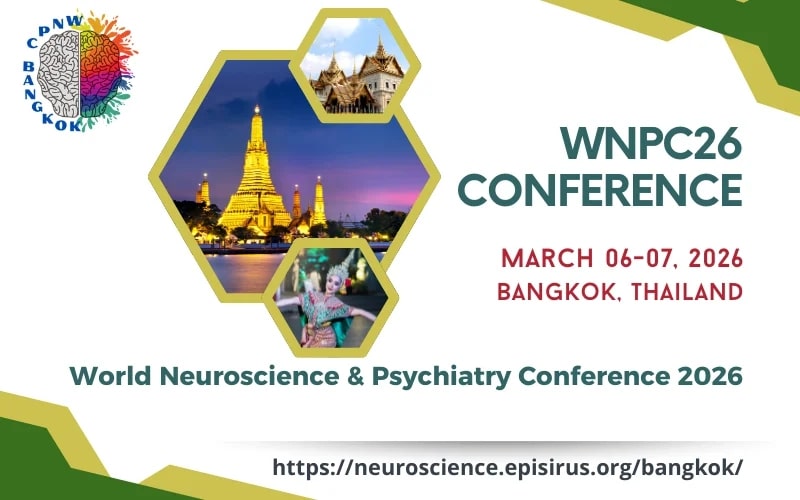
World Neuroscience and Psychiatry Conference 2026 (WNPC26)

6–7 March 2026, Jubilee Prestige Hotel Ratchadapisek, Bangkok

Conference Website: https://neuroscience.episirus.org/bangkok/

Conference Secretariat

Ms. Coco Hou
Ms. Nutthamon Subhaswasdikul


For inquires regarding submissions and sponsorship opportunities, please feel free to contact us.

Top