Event submissions
Published
This submission belongs to the session S4. Gels in Medicine, Regenerative Medicine, Pharmacy, and Personal Care Products of the event The 1st International Online Conference on Gels
Published date
28 Nov, 2025
Academic Editor
'%3e%3cpath%20d='M12.6657%2010.9104C12.4185%2010.325%2012.0599%209.79327%2011.6097%209.34482C11.1609%208.89508%2010.6293%208.5365%2010.0442%208.28888C10.0389%208.28626%2010.0337%208.28495%2010.0285%208.28233C10.8446%207.69279%2011.3752%206.73249%2011.3752%205.64904C11.3752%203.8542%209.92103%202.39999%208.1262%202.39999C6.33136%202.39999%204.87715%203.8542%204.87715%205.64904C4.87715%206.73249%205.40774%207.69279%206.22393%208.28364C6.21869%208.28626%206.21345%208.28757%206.20821%208.29019C5.62129%208.5378%205.09463%208.89284%204.64265%209.34613C4.1929%209.79493%203.83432%2010.3266%203.58671%2010.9117C3.34345%2011.4845%203.21226%2012.0987%203.20023%2012.7209C3.19988%2012.7349%203.20233%2012.7488%203.20744%2012.7619C3.21255%2012.7749%203.22022%2012.7867%203.22998%2012.7968C3.23975%2012.8068%203.25142%2012.8147%203.26431%2012.8202C3.2772%2012.8256%203.29105%2012.8284%203.30504%2012.8284H4.09109C4.14874%2012.8284%204.19459%2012.7825%204.1959%2012.7262C4.2221%2011.7148%204.62823%2010.7676%205.34617%2010.0497C6.08899%209.30683%207.0755%208.89808%208.1262%208.89808C9.17689%208.89808%2010.1634%209.30683%2010.9062%2010.0497C11.6242%2010.7676%2012.0303%2011.7148%2012.0565%2012.7262C12.0578%2012.7838%2012.1037%2012.8284%2012.1613%2012.8284H12.9474C12.9613%2012.8284%2012.9752%2012.8256%2012.9881%2012.8202C13.001%2012.8147%2013.0126%2012.8068%2013.0224%2012.7968C13.0322%2012.7867%2013.0398%2012.7749%2013.0449%2012.7619C13.0501%2012.7488%2013.0525%2012.7349%2013.0522%2012.7209C13.0391%2012.0947%2012.9094%2011.4855%2012.6657%2010.9104ZM8.1262%207.9024C7.52486%207.9024%206.9589%207.6679%206.53312%207.24211C6.10733%206.81633%205.87283%206.25037%205.87283%205.64904C5.87283%205.0477%206.10733%204.48174%206.53312%204.05596C6.9589%203.63018%207.52486%203.39567%208.1262%203.39567C8.72753%203.39567%209.29349%203.63018%209.71927%204.05596C10.1451%204.48174%2010.3796%205.0477%2010.3796%205.64904C10.3796%206.25037%2010.1451%206.81633%209.71927%207.24211C9.29349%207.6679%208.72753%207.9024%208.1262%207.9024Z'%20fill='%235D1EE1'/%3e%3c/g%3e%3c/svg%3e) Aline Miller
Aline MillerCitation
Burak ERAYHAN, Duygu Anaklı, Israfil Kucuk, Gülengül Dumanlı, Meltem Macit, Onur Cem Namlı, Muhammad Hamza, Muhammad Sohail Arshad, Microfluidic Fabrication of Graphene Oxide-Enriched Alginate Nanocomposite Hydrogels for Enhanced Porous Structure and Antibacterial Wound Dressings, in Proceedings of The 1st International Online Conference on Gels, 3 December–5 December 2025, MDPI: Basel, Switzerland
Share
Email
Facebook
Twitter
LinkedIn
Microfluidic Fabrication of Graphene Oxide-Enriched Alginate Nanocomposite Hydrogels for Enhanced Porous Structure and Antibacterial Wound Dressings
'%3e%3cpath%20d='M12.6647%2010.9104C12.4176%2010.325%2012.0589%209.7933%2011.6088%209.34485C11.16%208.89511%2010.6283%208.53653%2010.0432%208.28891C10.038%208.28629%2010.0327%208.28498%2010.0275%208.28236C10.8437%207.69282%2011.3743%206.73252%2011.3743%205.64907C11.3743%203.85423%209.92005%202.40002%208.12522%202.40002C6.33038%202.40002%204.87618%203.85423%204.87618%205.64907C4.87618%206.73252%205.40677%207.69282%206.22296%208.28367C6.21772%208.28629%206.21248%208.2876%206.20724%208.29022C5.62031%208.53783%205.09365%208.89287%204.64167%209.34616C4.19192%209.79496%203.83334%2010.3266%203.58573%2010.9117C3.34247%2011.4846%203.21128%2012.0987%203.19925%2012.721C3.1989%2012.735%203.20135%2012.7489%203.20646%2012.7619C3.21157%2012.7749%203.21924%2012.7868%203.22901%2012.7968C3.23877%2012.8068%203.25045%2012.8148%203.26334%2012.8202C3.27623%2012.8256%203.29007%2012.8284%203.30406%2012.8284H4.09012C4.14776%2012.8284%204.19362%2012.7825%204.19493%2012.7262C4.22113%2011.7148%204.62726%2010.7676%205.34519%2010.0497C6.08802%209.30686%207.07452%208.89811%208.12522%208.89811C9.17592%208.89811%2010.1624%209.30686%2010.9052%2010.0497C11.6232%2010.7676%2012.0293%2011.7148%2012.0555%2012.7262C12.0568%2012.7839%2012.1027%2012.8284%2012.1603%2012.8284H12.9464C12.9604%2012.8284%2012.9742%2012.8256%2012.9871%2012.8202C13%2012.8148%2013.0117%2012.8068%2013.0214%2012.7968C13.0312%2012.7868%2013.0389%2012.7749%2013.044%2012.7619C13.0491%2012.7489%2013.0515%2012.735%2013.0512%2012.721C13.0381%2012.0947%2012.9084%2011.4856%2012.6647%2010.9104ZM8.12522%207.90243C7.52388%207.90243%206.95792%207.66793%206.53214%207.24215C6.10636%206.81636%205.87185%206.2504%205.87185%205.64907C5.87185%205.04773%206.10636%204.48177%206.53214%204.05599C6.95792%203.63021%207.52388%203.3957%208.12522%203.3957C8.72655%203.3957%209.29252%203.63021%209.7183%204.05599C10.1441%204.48177%2010.3786%205.04773%2010.3786%205.64907C10.3786%206.2504%2010.1441%206.81636%209.7183%207.24215C9.29252%207.66793%208.72655%207.90243%208.12522%207.90243Z'%20fill='%235D1EE1'/%3e%3c/g%3e%3c/svg%3e)
Burak ERAYHAN 1
Duygu Anaklı 2

Israfil Kucuk 1
Meltem Macit 3
Gülengül Dumanlı 3

Onur Cem Namlı 4
Muhammad Hamza 5
Muhammad Sohail Arshad 5
1. Institute of Nanotechnology, Gebze Technical University, Kocaeli, Turkey, Turkey (Türkiye)
2. Faculty of Engineering, Department of Chemical Engineering, Sivas Cumhuriyet University, Sivas, Turkey, Turkey (Türkiye)
3. Department of Pharmaceutical Technology, Faculty of Pharmacy, Yeditepe University, Istanbul, Turkey, Turkey (Türkiye)
4. Department of Mechanical Engineering, Faculty of Engineering, Yeditepe University, Istanbul, Turkey, Turkey (Türkiye)
5. Faculty of Pharmacy, Bahauddin Zakariya University, Multan, Pakistan, Pakistan
Abstract
Wound healing aims to regenerate wounds with wound dressings such as hydrogels. An ideal wound dressing biomaterial has biocompatible, biodegradable, biomechanics, porous and anti-bacterial properties. The applicability of the general methods in wound healing material is simple, but their inadequacy given their antibacterial, porous and toxic properties can be eliminated using microfluidics. The hydrogel produced by reaction of microfluidic nanocomposite foams with a crosslinker can be used as wound dressing with more desirable antibacterial properties, a porous structure, and biocompatibility. Even though alginate polymer is a preferred biopolymer for hydrogel-based wound dressing production due to its biocompatible, biodegradable, and hydrophilic benefits, its strength and antibacterial properties remain weak. In this study, we aimed to characterize the production of nanocomposite hydrogels by enriching graphene oxide (GO), which has high biocompatibility, antibacterial, bioadhesion, thermal and mechanical abilities, to improve the mechanical, antibacterial and porous structure properties of alginate hydrogels, and to compare these results with alginate hydrogels by a traditional method. To achieve this, GO-enriched alginate hydrogels were produced both by the traditional method and microfluidics, and XRD, DSC, TGA-DTA, FTIR, SEM, tensile strength characterizations and antibacterial testing were performedf. According to these characterization results, it was observed that the GO enrichment improved the thermal, mechanic properties, and crystal structure properties of the alginate hydrogel. In addition, as a result of SEM results, it was observed that the microfluidic hydrogels had a more desirable porous structure. Additionally, according to the antibacterial test results, it was observed that GO-enriched microfluidic hydrogels showed more antibacterial performance. Our findings show that the use of a microfluidic system is a promising method to produce GO-enriched wound dressing hydrogels.
Keywords
GO
Alginate
Biocomposite Hydrogel
Microfluidics
Wound Healing
Poster
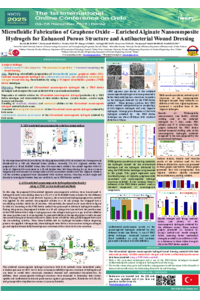
Burak Erayhan 1 Gels Conference Poster.pdf
State diagrams for binary monoglyceride mixtures
A High-Adhesion Polymer Gel for Polytetrafluoroethylene