Event submissions
Published
This submission belongs to the session S2. Hydrogels, Organogels, Xerogels, and Aerogels of the event The 1st International Online Conference on Gels
Published date
28 Nov, 2025
Academic Editor
'%3e%3cpath%20d='M12.6657%2010.9104C12.4185%2010.325%2012.0599%209.79327%2011.6097%209.34482C11.1609%208.89508%2010.6293%208.5365%2010.0442%208.28888C10.0389%208.28626%2010.0337%208.28495%2010.0285%208.28233C10.8446%207.69279%2011.3752%206.73249%2011.3752%205.64904C11.3752%203.8542%209.92103%202.39999%208.1262%202.39999C6.33136%202.39999%204.87715%203.8542%204.87715%205.64904C4.87715%206.73249%205.40774%207.69279%206.22393%208.28364C6.21869%208.28626%206.21345%208.28757%206.20821%208.29019C5.62129%208.5378%205.09463%208.89284%204.64265%209.34613C4.1929%209.79493%203.83432%2010.3266%203.58671%2010.9117C3.34345%2011.4845%203.21226%2012.0987%203.20023%2012.7209C3.19988%2012.7349%203.20233%2012.7488%203.20744%2012.7619C3.21255%2012.7749%203.22022%2012.7867%203.22998%2012.7968C3.23975%2012.8068%203.25142%2012.8147%203.26431%2012.8202C3.2772%2012.8256%203.29105%2012.8284%203.30504%2012.8284H4.09109C4.14874%2012.8284%204.19459%2012.7825%204.1959%2012.7262C4.2221%2011.7148%204.62823%2010.7676%205.34617%2010.0497C6.08899%209.30683%207.0755%208.89808%208.1262%208.89808C9.17689%208.89808%2010.1634%209.30683%2010.9062%2010.0497C11.6242%2010.7676%2012.0303%2011.7148%2012.0565%2012.7262C12.0578%2012.7838%2012.1037%2012.8284%2012.1613%2012.8284H12.9474C12.9613%2012.8284%2012.9752%2012.8256%2012.9881%2012.8202C13.001%2012.8147%2013.0126%2012.8068%2013.0224%2012.7968C13.0322%2012.7867%2013.0398%2012.7749%2013.0449%2012.7619C13.0501%2012.7488%2013.0525%2012.7349%2013.0522%2012.7209C13.0391%2012.0947%2012.9094%2011.4855%2012.6657%2010.9104ZM8.1262%207.9024C7.52486%207.9024%206.9589%207.6679%206.53312%207.24211C6.10733%206.81633%205.87283%206.25037%205.87283%205.64904C5.87283%205.0477%206.10733%204.48174%206.53312%204.05596C6.9589%203.63018%207.52486%203.39567%208.1262%203.39567C8.72753%203.39567%209.29349%203.63018%209.71927%204.05596C10.1451%204.48174%2010.3796%205.0477%2010.3796%205.64904C10.3796%206.25037%2010.1451%206.81633%209.71927%207.24211C9.29349%207.6679%208.72753%207.9024%208.1262%207.9024Z'%20fill='%235D1EE1'/%3e%3c/g%3e%3c/svg%3e) Esmaiel Jabbari
Esmaiel JabbariCitation
Toshiya Yamasaki, Jin Gong, A High-Adhesion Polymer Gel for Polytetrafluoroethylene, in Proceedings of The 1st International Online Conference on Gels, 3 December–5 December 2025, MDPI: Basel, Switzerland
Share
Email
Facebook
Twitter
LinkedIn
A High-Adhesion Polymer Gel for Polytetrafluoroethylene
'%3e%3cpath%20d='M12.6647%2010.9104C12.4176%2010.325%2012.0589%209.7933%2011.6088%209.34485C11.16%208.89511%2010.6283%208.53653%2010.0432%208.28891C10.038%208.28629%2010.0327%208.28498%2010.0275%208.28236C10.8437%207.69282%2011.3743%206.73252%2011.3743%205.64907C11.3743%203.85423%209.92005%202.40002%208.12522%202.40002C6.33038%202.40002%204.87618%203.85423%204.87618%205.64907C4.87618%206.73252%205.40677%207.69282%206.22296%208.28367C6.21772%208.28629%206.21248%208.2876%206.20724%208.29022C5.62031%208.53783%205.09365%208.89287%204.64167%209.34616C4.19192%209.79496%203.83334%2010.3266%203.58573%2010.9117C3.34247%2011.4846%203.21128%2012.0987%203.19925%2012.721C3.1989%2012.735%203.20135%2012.7489%203.20646%2012.7619C3.21157%2012.7749%203.21924%2012.7868%203.22901%2012.7968C3.23877%2012.8068%203.25045%2012.8148%203.26334%2012.8202C3.27623%2012.8256%203.29007%2012.8284%203.30406%2012.8284H4.09012C4.14776%2012.8284%204.19362%2012.7825%204.19493%2012.7262C4.22113%2011.7148%204.62726%2010.7676%205.34519%2010.0497C6.08802%209.30686%207.07452%208.89811%208.12522%208.89811C9.17592%208.89811%2010.1624%209.30686%2010.9052%2010.0497C11.6232%2010.7676%2012.0293%2011.7148%2012.0555%2012.7262C12.0568%2012.7839%2012.1027%2012.8284%2012.1603%2012.8284H12.9464C12.9604%2012.8284%2012.9742%2012.8256%2012.9871%2012.8202C13%2012.8148%2013.0117%2012.8068%2013.0214%2012.7968C13.0312%2012.7868%2013.0389%2012.7749%2013.044%2012.7619C13.0491%2012.7489%2013.0515%2012.735%2013.0512%2012.721C13.0381%2012.0947%2012.9084%2011.4856%2012.6647%2010.9104ZM8.12522%207.90243C7.52388%207.90243%206.95792%207.66793%206.53214%207.24215C6.10636%206.81636%205.87185%206.2504%205.87185%205.64907C5.87185%205.04773%206.10636%204.48177%206.53214%204.05599C6.95792%203.63021%207.52388%203.3957%208.12522%203.3957C8.72655%203.3957%209.29252%203.63021%209.7183%204.05599C10.1441%204.48177%2010.3786%205.04773%2010.3786%205.64907C10.3786%206.2504%2010.1441%206.81636%209.7183%207.24215C9.29252%207.66793%208.72655%207.90243%208.12522%207.90243Z'%20fill='%235D1EE1'/%3e%3c/g%3e%3c/svg%3e)
Toshiya Yamasaki 1
Jin Gong 1
1. Graduate School of Organic Materials Science, Yamagata University, Yonezawa, Yamagata, 992-8510, Japan, Japan
Abstract
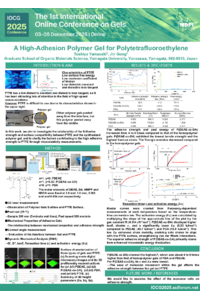
Polytetrafluoroethylene (PTFE) is valued for its low dielectric constant and loss tangent but has low surface free energy (SFE), hindering adhesion to other materials. Our group developed a copolymer gel, poly(2-(diethylamino)ethyl methacrylate-co-dodecyl acrylate) (P(DEAE-co-DA)), with exceptional adhesion to PTFE. Gel sheets were synthesized via photo-radical bulk polymerization, alongside homopolymer gels poly(2-(diethylamino)ethyl methacrylate) (PDEAE) and poly(dodecyl acrylate) (PDA) for comparison. These were assessed using 90° peel tests, contact angle measurements, and oscillatory frequency sweep tests. The 90° peel tests revealed that P(DEAE-co-DA) exhibited 4–6 times higher peel strength than PDEAE and PDA. SFE was highest for PDEAE, followed by P(DEAE-co-DA), PTFE, and PDA. Theoretical adhesive work (Wa) to PTFE was 48.41 mJ/m² for PDEAE, 44.99 mJ/m² for P(DEAE-co-DA), and 36.51 mJ/m² for PDA, suggesting PDEAE’s superior adhesion. However, experimental peel tests showed P(DEAE-co-DA) had the highest peel strength. To explore this discrepancy, oscillatory frequency sweep tests measured storage modulus, loss modulus, Tanδ, relaxation time (τ), and activation energy (Ea). P(DEAE-co-DA) displayed higher Tanδ, shorter τ, and a significantly lower Ea (8.03 kJ/mol) compared to PDEAE (49.7 kJ/mol) and PDA (15.9 kJ/mol). This low Ea enhances chain mobility, enabling side chains to align with the PTFE surface, strengthening van der Waals interactions. The superior peel strength of P(DEAE-co-DA) primarily stems from enhanced viscoelastic energy dissipation, explaining its outstanding adhesion despite a lower theoretical Wa.
Keywords
adhesion
polytetrafluoroethylene (PTFE)
polymer gel
Poster
Sciforum_poster_山崎提出.pdf
Microfluidic Fabrication of Graphene Oxide-Enriched Alginate Nanocomposite Hydrogels for Enhanced Porous Structure and Antibacterial Wound Dressings
Development of novel chitosan–gelatine-based hydrogels for drug delivery applications