Event submissions
Published
This submission belongs to the session S4. Gels in Medicine, Regenerative Medicine, Pharmacy, and Personal Care Products of the event The 1st International Online Conference on Gels
Published date
28 Nov, 2025
Academic Editor
'%3e%3cpath%20d='M12.6657%2010.9104C12.4185%2010.325%2012.0599%209.79327%2011.6097%209.34482C11.1609%208.89508%2010.6293%208.5365%2010.0442%208.28888C10.0389%208.28626%2010.0337%208.28495%2010.0285%208.28233C10.8446%207.69279%2011.3752%206.73249%2011.3752%205.64904C11.3752%203.8542%209.92103%202.39999%208.1262%202.39999C6.33136%202.39999%204.87715%203.8542%204.87715%205.64904C4.87715%206.73249%205.40774%207.69279%206.22393%208.28364C6.21869%208.28626%206.21345%208.28757%206.20821%208.29019C5.62129%208.5378%205.09463%208.89284%204.64265%209.34613C4.1929%209.79493%203.83432%2010.3266%203.58671%2010.9117C3.34345%2011.4845%203.21226%2012.0987%203.20023%2012.7209C3.19988%2012.7349%203.20233%2012.7488%203.20744%2012.7619C3.21255%2012.7749%203.22022%2012.7867%203.22998%2012.7968C3.23975%2012.8068%203.25142%2012.8147%203.26431%2012.8202C3.2772%2012.8256%203.29105%2012.8284%203.30504%2012.8284H4.09109C4.14874%2012.8284%204.19459%2012.7825%204.1959%2012.7262C4.2221%2011.7148%204.62823%2010.7676%205.34617%2010.0497C6.08899%209.30683%207.0755%208.89808%208.1262%208.89808C9.17689%208.89808%2010.1634%209.30683%2010.9062%2010.0497C11.6242%2010.7676%2012.0303%2011.7148%2012.0565%2012.7262C12.0578%2012.7838%2012.1037%2012.8284%2012.1613%2012.8284H12.9474C12.9613%2012.8284%2012.9752%2012.8256%2012.9881%2012.8202C13.001%2012.8147%2013.0126%2012.8068%2013.0224%2012.7968C13.0322%2012.7867%2013.0398%2012.7749%2013.0449%2012.7619C13.0501%2012.7488%2013.0525%2012.7349%2013.0522%2012.7209C13.0391%2012.0947%2012.9094%2011.4855%2012.6657%2010.9104ZM8.1262%207.9024C7.52486%207.9024%206.9589%207.6679%206.53312%207.24211C6.10733%206.81633%205.87283%206.25037%205.87283%205.64904C5.87283%205.0477%206.10733%204.48174%206.53312%204.05596C6.9589%203.63018%207.52486%203.39567%208.1262%203.39567C8.72753%203.39567%209.29349%203.63018%209.71927%204.05596C10.1451%204.48174%2010.3796%205.0477%2010.3796%205.64904C10.3796%206.25037%2010.1451%206.81633%209.71927%207.24211C9.29349%207.6679%208.72753%207.9024%208.1262%207.9024Z'%20fill='%235D1EE1'/%3e%3c/g%3e%3c/svg%3e) Aline Miller
Aline MillerCitation
Olena Gennadiivna Aliyeva, Igor Fedorovich Belenichev, Bogdan Serhiyovych Burlaka, Nina Viktorivna Bukhtiyarova, Kostyantin Petrovych Shabelnik, Prospects for the Rapid Delivery of Active Pharmaceutical Ingredients to the Brain for Neuroprotective Action: Examples of Nasal Gel Formulations, in Proceedings of The 1st International Online Conference on Gels, 3 December–5 December 2025, MDPI: Basel, Switzerland
Share
Email
Facebook
Twitter
LinkedIn
Prospects for the Rapid Delivery of Active Pharmaceutical Ingredients to the Brain for Neuroprotective Action: Examples of Nasal Gel Formulations
'%3e%3cpath%20d='M12.6647%2010.9104C12.4176%2010.325%2012.0589%209.7933%2011.6088%209.34485C11.16%208.89511%2010.6283%208.53653%2010.0432%208.28891C10.038%208.28629%2010.0327%208.28498%2010.0275%208.28236C10.8437%207.69282%2011.3743%206.73252%2011.3743%205.64907C11.3743%203.85423%209.92005%202.40002%208.12522%202.40002C6.33038%202.40002%204.87618%203.85423%204.87618%205.64907C4.87618%206.73252%205.40677%207.69282%206.22296%208.28367C6.21772%208.28629%206.21248%208.2876%206.20724%208.29022C5.62031%208.53783%205.09365%208.89287%204.64167%209.34616C4.19192%209.79496%203.83334%2010.3266%203.58573%2010.9117C3.34247%2011.4846%203.21128%2012.0987%203.19925%2012.721C3.1989%2012.735%203.20135%2012.7489%203.20646%2012.7619C3.21157%2012.7749%203.21924%2012.7868%203.22901%2012.7968C3.23877%2012.8068%203.25045%2012.8148%203.26334%2012.8202C3.27623%2012.8256%203.29007%2012.8284%203.30406%2012.8284H4.09012C4.14776%2012.8284%204.19362%2012.7825%204.19493%2012.7262C4.22113%2011.7148%204.62726%2010.7676%205.34519%2010.0497C6.08802%209.30686%207.07452%208.89811%208.12522%208.89811C9.17592%208.89811%2010.1624%209.30686%2010.9052%2010.0497C11.6232%2010.7676%2012.0293%2011.7148%2012.0555%2012.7262C12.0568%2012.7839%2012.1027%2012.8284%2012.1603%2012.8284H12.9464C12.9604%2012.8284%2012.9742%2012.8256%2012.9871%2012.8202C13%2012.8148%2013.0117%2012.8068%2013.0214%2012.7968C13.0312%2012.7868%2013.0389%2012.7749%2013.044%2012.7619C13.0491%2012.7489%2013.0515%2012.735%2013.0512%2012.721C13.0381%2012.0947%2012.9084%2011.4856%2012.6647%2010.9104ZM8.12522%207.90243C7.52388%207.90243%206.95792%207.66793%206.53214%207.24215C6.10636%206.81636%205.87185%206.2504%205.87185%205.64907C5.87185%205.04773%206.10636%204.48177%206.53214%204.05599C6.95792%203.63021%207.52388%203.3957%208.12522%203.3957C8.72655%203.3957%209.29252%203.63021%209.7183%204.05599C10.1441%204.48177%2010.3786%205.04773%2010.3786%205.64907C10.3786%206.2504%2010.1441%206.81636%209.7183%207.24215C9.29252%207.66793%208.72655%207.90243%208.12522%207.90243Z'%20fill='%235D1EE1'/%3e%3c/g%3e%3c/svg%3e)
Igor Fedorovich Belenichev 1

Olena Gennadiivna Aliyeva 2
Bogdan Serhiyovych Burlaka 3
Nina Viktorivna Bukhtiyarova 4
Kostyantin Petrovych Shabelnik 5
1. Department of Pharmacology and Medical Formulation with Course of Normal Physiology, Zaporizhzhia State Medical and Pharmaceutical University, Zaporizhzhia, 69035, Ukraine, Ukraine
2. Department of Histology, Cytology and Embryology, Zaporizhzhia State Medical and Pharmaceutical University, Zaporizhzhia, 69035, Ukraine, Ukraine
3. Department of Medicines Technology, Zaporizhzhia State Medical and Pharmaceutical University, Zaporizhzhia, 69035, Ukraine, Ukraine
4. Department of Clinical Laboratory Diagnostics and Biological Chemistry, Zaporizhzhia State Medical and Pharmaceutical University, Zaporizhzhia, 69035, Ukraine, Ukraine
5. Department of Pharmaceutical, Organic and Bioorganic Chemistry, Zaporizhzhia State Medical and Pharmaceutical University, Zaporizhzhia, 69035, Ukraine, Ukraine
Abstract
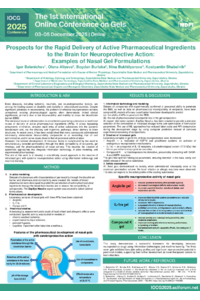
Neurological disorders, including cerebrovascular and neurodegenerative diseases, represent one of the most urgent challenges in modern medicine. Despite progress in neuropharmacology, many available drugs exhibit limited clinical efficacy, often due to poor penetration across the blood–brain barrier (BBB) and suboptimal bioavailability. Intranasal drug delivery has emerged as a promising route for non-invasive, rapid CNS targeting. Of special interest are intranasal gel dosage forms, which offer prolonged mucosal contact, improved drug retention, and increasing therapeutic effectiveness. The aim of this study was to develop and preclinically evaluate novel intranasal gel formulations of neuroprotective agents, using in silico modeling and machine learning tools to optimize composition and predict efficacy and safety.
Methods: We have created a new information technology for the in silico substantiation of rational formulations of intranasal dosage forms with neuroprotective effects and developed the expert system “ExpSys Nasalia”. We have created models for the machine learning of binary classification to predict the penetration of APIs through the BBB and to prevent the occurrence of pharmaceutical incompatibilities in the composition of the formulation. Three intranasal gels were formulated with neuroprotective agents: Angiolin, IL-1 receptor antagonist (IL-1ra), and Compound K (a triazoloquinazoline derivative).
Results: The resulting formulations demonstrated high safety in toxicological studies, with no observed local irritation or allergenicity. IL-1ra gel showed superior neuroprotective efficacy compared to citicoline in ischemia and multiple sclerosis models. Angiolin gel improved survival and cognitive outcomes in neonatal rats following prenatal hypoxia. Compound K gel reduced anxiety, improved memory, and exerted antioxidant and anti-apoptotic effects after ketamine anesthesia.
Conclusions: This study demonstrates a successful framework for developing intranasal neuroprotective drugs using information technologies and machine learning. The three novel gels exhibited favorable safety profiles and significant neuroprotective potential in preclinical models, supporting their further development as novel therapeutic options for brain disorders.
Keywords
Intranasal drug delivery
gel dosage forms
in silico
CNS
neuroprotection
Angiolin
IL-1ra
Poster
BelenichevI.pdf
Silk-Based Multiple Shape Memory Organohydrogels
Design and Development of an Injectable Hydrogel for Cartilage Repair