Event submissions
Published
This submission belongs to the session S4. Gels in Medicine, Regenerative Medicine, Pharmacy, and Personal Care Products of the event The 1st International Online Conference on Gels
Published date
28 Nov, 2025
Academic Editor
'%3e%3cpath%20d='M12.6657%2010.9104C12.4185%2010.325%2012.0599%209.79327%2011.6097%209.34482C11.1609%208.89508%2010.6293%208.5365%2010.0442%208.28888C10.0389%208.28626%2010.0337%208.28495%2010.0285%208.28233C10.8446%207.69279%2011.3752%206.73249%2011.3752%205.64904C11.3752%203.8542%209.92103%202.39999%208.1262%202.39999C6.33136%202.39999%204.87715%203.8542%204.87715%205.64904C4.87715%206.73249%205.40774%207.69279%206.22393%208.28364C6.21869%208.28626%206.21345%208.28757%206.20821%208.29019C5.62129%208.5378%205.09463%208.89284%204.64265%209.34613C4.1929%209.79493%203.83432%2010.3266%203.58671%2010.9117C3.34345%2011.4845%203.21226%2012.0987%203.20023%2012.7209C3.19988%2012.7349%203.20233%2012.7488%203.20744%2012.7619C3.21255%2012.7749%203.22022%2012.7867%203.22998%2012.7968C3.23975%2012.8068%203.25142%2012.8147%203.26431%2012.8202C3.2772%2012.8256%203.29105%2012.8284%203.30504%2012.8284H4.09109C4.14874%2012.8284%204.19459%2012.7825%204.1959%2012.7262C4.2221%2011.7148%204.62823%2010.7676%205.34617%2010.0497C6.08899%209.30683%207.0755%208.89808%208.1262%208.89808C9.17689%208.89808%2010.1634%209.30683%2010.9062%2010.0497C11.6242%2010.7676%2012.0303%2011.7148%2012.0565%2012.7262C12.0578%2012.7838%2012.1037%2012.8284%2012.1613%2012.8284H12.9474C12.9613%2012.8284%2012.9752%2012.8256%2012.9881%2012.8202C13.001%2012.8147%2013.0126%2012.8068%2013.0224%2012.7968C13.0322%2012.7867%2013.0398%2012.7749%2013.0449%2012.7619C13.0501%2012.7488%2013.0525%2012.7349%2013.0522%2012.7209C13.0391%2012.0947%2012.9094%2011.4855%2012.6657%2010.9104ZM8.1262%207.9024C7.52486%207.9024%206.9589%207.6679%206.53312%207.24211C6.10733%206.81633%205.87283%206.25037%205.87283%205.64904C5.87283%205.0477%206.10733%204.48174%206.53312%204.05596C6.9589%203.63018%207.52486%203.39567%208.1262%203.39567C8.72753%203.39567%209.29349%203.63018%209.71927%204.05596C10.1451%204.48174%2010.3796%205.0477%2010.3796%205.64904C10.3796%206.25037%2010.1451%206.81633%209.71927%207.24211C9.29349%207.6679%208.72753%207.9024%208.1262%207.9024Z'%20fill='%235D1EE1'/%3e%3c/g%3e%3c/svg%3e) Aline Miller
Aline MillerCitation
Debora Mondini, Maddalena Sguizzato, Francesca Ferrara, Elena Buratti, Monica Bertoldo, Rita Cortesi, Formulation strategies for pharmaceutical use of pNIPAM microgel, in Proceedings of The 1st International Online Conference on Gels, 3 December–5 December 2025, MDPI: Basel, Switzerland
Share
Email
Facebook
Twitter
LinkedIn
Formulation strategies for pharmaceutical use of pNIPAM microgel
'%3e%3cpath%20d='M12.6647%2010.9104C12.4176%2010.325%2012.0589%209.7933%2011.6088%209.34485C11.16%208.89511%2010.6283%208.53653%2010.0432%208.28891C10.038%208.28629%2010.0327%208.28498%2010.0275%208.28236C10.8437%207.69282%2011.3743%206.73252%2011.3743%205.64907C11.3743%203.85423%209.92005%202.40002%208.12522%202.40002C6.33038%202.40002%204.87618%203.85423%204.87618%205.64907C4.87618%206.73252%205.40677%207.69282%206.22296%208.28367C6.21772%208.28629%206.21248%208.2876%206.20724%208.29022C5.62031%208.53783%205.09365%208.89287%204.64167%209.34616C4.19192%209.79496%203.83334%2010.3266%203.58573%2010.9117C3.34247%2011.4846%203.21128%2012.0987%203.19925%2012.721C3.1989%2012.735%203.20135%2012.7489%203.20646%2012.7619C3.21157%2012.7749%203.21924%2012.7868%203.22901%2012.7968C3.23877%2012.8068%203.25045%2012.8148%203.26334%2012.8202C3.27623%2012.8256%203.29007%2012.8284%203.30406%2012.8284H4.09012C4.14776%2012.8284%204.19362%2012.7825%204.19493%2012.7262C4.22113%2011.7148%204.62726%2010.7676%205.34519%2010.0497C6.08802%209.30686%207.07452%208.89811%208.12522%208.89811C9.17592%208.89811%2010.1624%209.30686%2010.9052%2010.0497C11.6232%2010.7676%2012.0293%2011.7148%2012.0555%2012.7262C12.0568%2012.7839%2012.1027%2012.8284%2012.1603%2012.8284H12.9464C12.9604%2012.8284%2012.9742%2012.8256%2012.9871%2012.8202C13%2012.8148%2013.0117%2012.8068%2013.0214%2012.7968C13.0312%2012.7868%2013.0389%2012.7749%2013.044%2012.7619C13.0491%2012.7489%2013.0515%2012.735%2013.0512%2012.721C13.0381%2012.0947%2012.9084%2011.4856%2012.6647%2010.9104ZM8.12522%207.90243C7.52388%207.90243%206.95792%207.66793%206.53214%207.24215C6.10636%206.81636%205.87185%206.2504%205.87185%205.64907C5.87185%205.04773%206.10636%204.48177%206.53214%204.05599C6.95792%203.63021%207.52388%203.3957%208.12522%203.3957C8.72655%203.3957%209.29252%203.63021%209.7183%204.05599C10.1441%204.48177%2010.3786%205.04773%2010.3786%205.64907C10.3786%206.2504%2010.1441%206.81636%209.7183%207.24215C9.29252%207.66793%208.72655%207.90243%208.12522%207.90243Z'%20fill='%235D1EE1'/%3e%3c/g%3e%3c/svg%3e)
Debora Mondini 1

Maddalena Sguizzato 1
Francesca Ferrara 1

Elena Buratti 1
Monica Bertoldo 1

Rita Cortesi 1
1. DoCPAS, Università di Ferrara, Ferrara, Italy, Italy
Abstract
Introduction
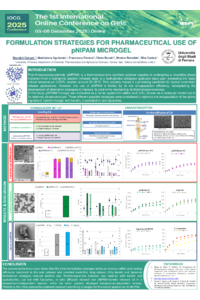
Poly-N-isopropylacrylamide (pNIPAM) is a thermoresponsive synthetic polymer that undergoes a
reversible phase transition from a swollen to a collapsed state when the lower critical solution
temperature (LCST) is exceeded (at around 32–33 °C). This property makes it a promising candidate
for controlled-release topical delivery.
However, its poor drug-loading capacity necessitates the development of alternative strategies to
enhance its effectiveness. In this study, a pNIPAM microgel was evaluated as a carrier for caffeic
acid (CA), which was selected as a model molecule due to its relatively simple structure.
Three approaches were explored:
1. Hybrid pNIPAM–keratin microgel: Keratin was selected for its biocompatibility with topical
use. It reduced the particle size without affecting the thermoresponsiveness of the polymer.
2. Use of β-cyclodextrins within pNIPAM: β-cyclodextrins can form inclusion complexes with
CA, improving its aqueous solubility (CA has poor solubility, LogP ≈ 1.2).
3. Liposomes embedded in the pNIPAM microgel: Liposomes composed of phosphatidylcholine
and cholesterol (2:1 molar ratio) were used to enhance CA encapsulation.
Methods
Formulations were characterized by morphology, particle size and surface charge. Stability and
loading efficiency were monitored. In vitro diffusion was tested using Franz cells and lipid-functionalized cellulose membranes mimicking the skin barrier.
Results
All strategies improved CA loading efficiency (>90%). Only keratin and liposome formulations
reduced particle size. Thermoresponsive behavior was retained with keratin and cyclodextrins, but
not with liposomes. In vitro diffusion showed that pNIPAM–keratin released CA in a temperature-independent manner, while the other systems displayed temperature-dependent release.
Conclusions
The three approaches explored represent promising strategies for the topical application of pNIPAM,
improving its functional properties. However, further studies are needed to evaluate the stability of
the systems, as well as their toxicity and rheological profiles.
Keywords
pNIPAM
microgel
Oral Presentation
Poster_Mondini_Debora.pdf
Poster
Poster_Mondini_Debora.pdf
Gels based on natural polymers containing silver nanoprisms for combined chemo/phototherapy of cancer
Generation of Carrageenan-Based Nanoporous Structures as Green Alternatives for Enhanced Water Uptake