Event submissions
Published
This submission belongs to the session S2. Hydrogels, Organogels, Xerogels, and Aerogels of the event The 1st International Online Conference on Gels
Published date
28 Nov, 2025
Academic Editor
'%3e%3cpath%20d='M12.6657%2010.9104C12.4185%2010.325%2012.0599%209.79327%2011.6097%209.34482C11.1609%208.89508%2010.6293%208.5365%2010.0442%208.28888C10.0389%208.28626%2010.0337%208.28495%2010.0285%208.28233C10.8446%207.69279%2011.3752%206.73249%2011.3752%205.64904C11.3752%203.8542%209.92103%202.39999%208.1262%202.39999C6.33136%202.39999%204.87715%203.8542%204.87715%205.64904C4.87715%206.73249%205.40774%207.69279%206.22393%208.28364C6.21869%208.28626%206.21345%208.28757%206.20821%208.29019C5.62129%208.5378%205.09463%208.89284%204.64265%209.34613C4.1929%209.79493%203.83432%2010.3266%203.58671%2010.9117C3.34345%2011.4845%203.21226%2012.0987%203.20023%2012.7209C3.19988%2012.7349%203.20233%2012.7488%203.20744%2012.7619C3.21255%2012.7749%203.22022%2012.7867%203.22998%2012.7968C3.23975%2012.8068%203.25142%2012.8147%203.26431%2012.8202C3.2772%2012.8256%203.29105%2012.8284%203.30504%2012.8284H4.09109C4.14874%2012.8284%204.19459%2012.7825%204.1959%2012.7262C4.2221%2011.7148%204.62823%2010.7676%205.34617%2010.0497C6.08899%209.30683%207.0755%208.89808%208.1262%208.89808C9.17689%208.89808%2010.1634%209.30683%2010.9062%2010.0497C11.6242%2010.7676%2012.0303%2011.7148%2012.0565%2012.7262C12.0578%2012.7838%2012.1037%2012.8284%2012.1613%2012.8284H12.9474C12.9613%2012.8284%2012.9752%2012.8256%2012.9881%2012.8202C13.001%2012.8147%2013.0126%2012.8068%2013.0224%2012.7968C13.0322%2012.7867%2013.0398%2012.7749%2013.0449%2012.7619C13.0501%2012.7488%2013.0525%2012.7349%2013.0522%2012.7209C13.0391%2012.0947%2012.9094%2011.4855%2012.6657%2010.9104ZM8.1262%207.9024C7.52486%207.9024%206.9589%207.6679%206.53312%207.24211C6.10733%206.81633%205.87283%206.25037%205.87283%205.64904C5.87283%205.0477%206.10733%204.48174%206.53312%204.05596C6.9589%203.63018%207.52486%203.39567%208.1262%203.39567C8.72753%203.39567%209.29349%203.63018%209.71927%204.05596C10.1451%204.48174%2010.3796%205.0477%2010.3796%205.64904C10.3796%206.25037%2010.1451%206.81633%209.71927%207.24211C9.29349%207.6679%208.72753%207.9024%208.1262%207.9024Z'%20fill='%235D1EE1'/%3e%3c/g%3e%3c/svg%3e) SIDI A. BENCHERIF
SIDI A. BENCHERIFCitation
Alessandra Zanotti, Stefano Cardea, Generation of Carrageenan-Based Nanoporous Structures as Green Alternatives for Enhanced Water Uptake, in Proceedings of The 1st International Online Conference on Gels, 3 December–5 December 2025, MDPI: Basel, Switzerland
Share
Email
Facebook
Twitter
LinkedIn
Generation of Carrageenan-Based Nanoporous Structures as Green Alternatives for Enhanced Water Uptake

Alessandra Zanotti 1

Stefano Cardea 1
1. Department of Industrial Engineering, University of Salerno, Via Giovanni Paolo II, 132, Fisciano (SA), 84084, Italy., Italy
Abstract
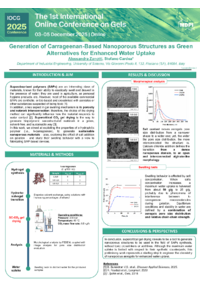
Superabsorbent polymers (SAPs) are an interesting class of materials, known for their ability to elastically swell and deswell in the presence of water: they are used in agriculture, as personal hygiene products, etc. However, most of the available commercial SAPs are synthetic, or bio-based and crosslinked with acrylates or other substances suspected of being toxic.
We propose using a hydrophilic algae-based polymer (i.e., k-carrageenan) as a greener alternative. Specifically, we aimed at enhancing water uptake capacity by engineering k-carrageenan nanoporosity: in this research, supercritical CO2-assisted drying has been performed on carrageenan gels, crosslinked by means of K+ and Ca2+. Different samples were produced, changing the relative concentration of potassium and calcium ions to carrageenan weight. Dried gels were observed by FESEM analysis accompanied by image analysis to compute pore size distribution. Then, water uptake capacity and mass loss were calculated at regular intervals of time, to assess the best-performing and most stable material.
Key findings regard nanostructured materials' water-responsiveness. k-carrageenan undergoes severe volume reduction after supercritical drying, but, surprisingly, regains its hydrogel state after contact with water rather than just accommodating it. Morphologically speaking, the obtained k-carrageenan dried gels are dense but offer nanopores available for water intrusion: however, when Ca2+ ion concentration increases after a certain threshold, an alginate-like organization is observed. During swelling tests, it was observed that the coexistence of monovalent and divalent cations can result in material solubilization after a few hours; the best result has been achieved using the salt-free gel, reaching a water uptake capacity of 50 g/g and stability over days with no significant mass loss.
In conclusion, k-carrageenan-based porous devices are valid alternatives to their synthetic counterparts; although water absorption capacity could be further enhanced, these results represent the first step towards the valorization of bio-based resources for large-scale applications.
Keywords
carrageenan
superabsorbent
water uptake
supercritical drying
gelation
Poster
Zanotti poster.pdf
Formulation strategies for pharmaceutical use of pNIPAM microgel
Electroconductive hydrogels for spinal cord regeneration