Event submissions
Published
This submission belongs to the session S3. Gels in Agriculture and Food of the event The 1st International Online Conference on Gels
Published date
28 Nov, 2025
Academic Editor
'%3e%3cpath%20d='M12.6657%2010.9104C12.4185%2010.325%2012.0599%209.79327%2011.6097%209.34482C11.1609%208.89508%2010.6293%208.5365%2010.0442%208.28888C10.0389%208.28626%2010.0337%208.28495%2010.0285%208.28233C10.8446%207.69279%2011.3752%206.73249%2011.3752%205.64904C11.3752%203.8542%209.92103%202.39999%208.1262%202.39999C6.33136%202.39999%204.87715%203.8542%204.87715%205.64904C4.87715%206.73249%205.40774%207.69279%206.22393%208.28364C6.21869%208.28626%206.21345%208.28757%206.20821%208.29019C5.62129%208.5378%205.09463%208.89284%204.64265%209.34613C4.1929%209.79493%203.83432%2010.3266%203.58671%2010.9117C3.34345%2011.4845%203.21226%2012.0987%203.20023%2012.7209C3.19988%2012.7349%203.20233%2012.7488%203.20744%2012.7619C3.21255%2012.7749%203.22022%2012.7867%203.22998%2012.7968C3.23975%2012.8068%203.25142%2012.8147%203.26431%2012.8202C3.2772%2012.8256%203.29105%2012.8284%203.30504%2012.8284H4.09109C4.14874%2012.8284%204.19459%2012.7825%204.1959%2012.7262C4.2221%2011.7148%204.62823%2010.7676%205.34617%2010.0497C6.08899%209.30683%207.0755%208.89808%208.1262%208.89808C9.17689%208.89808%2010.1634%209.30683%2010.9062%2010.0497C11.6242%2010.7676%2012.0303%2011.7148%2012.0565%2012.7262C12.0578%2012.7838%2012.1037%2012.8284%2012.1613%2012.8284H12.9474C12.9613%2012.8284%2012.9752%2012.8256%2012.9881%2012.8202C13.001%2012.8147%2013.0126%2012.8068%2013.0224%2012.7968C13.0322%2012.7867%2013.0398%2012.7749%2013.0449%2012.7619C13.0501%2012.7488%2013.0525%2012.7349%2013.0522%2012.7209C13.0391%2012.0947%2012.9094%2011.4855%2012.6657%2010.9104ZM8.1262%207.9024C7.52486%207.9024%206.9589%207.6679%206.53312%207.24211C6.10733%206.81633%205.87283%206.25037%205.87283%205.64904C5.87283%205.0477%206.10733%204.48174%206.53312%204.05596C6.9589%203.63018%207.52486%203.39567%208.1262%203.39567C8.72753%203.39567%209.29349%203.63018%209.71927%204.05596C10.1451%204.48174%2010.3796%205.0477%2010.3796%205.64904C10.3796%206.25037%2010.1451%206.81633%209.71927%207.24211C9.29349%207.6679%208.72753%207.9024%208.1262%207.9024Z'%20fill='%235D1EE1'/%3e%3c/g%3e%3c/svg%3e) Luis Alfonso Trujillo-Cayado
Luis Alfonso Trujillo-CayadoCitation
Aleida Selene Hernández-Cázares, Zuemy Hernández-Nolasco, Mariana Inés Acateca-Hernández, Natalia Real-Luna, Novel food-grade bigels structured with wax from the native stingless bee (Scaptotrigona mexicana) and canola oil, in Proceedings of The 1st International Online Conference on Gels, 3 December–5 December 2025, MDPI: Basel, Switzerland
Share
Email
Facebook
Twitter
LinkedIn
Novel food-grade bigels structured with wax from the native stingless bee (Scaptotrigona mexicana) and canola oil

Zuemy Hernández-Nolasco 1
'%3e%3cpath%20d='M12.6647%2010.9104C12.4176%2010.325%2012.0589%209.7933%2011.6088%209.34485C11.16%208.89511%2010.6283%208.53653%2010.0432%208.28891C10.038%208.28629%2010.0327%208.28498%2010.0275%208.28236C10.8437%207.69282%2011.3743%206.73252%2011.3743%205.64907C11.3743%203.85423%209.92005%202.40002%208.12522%202.40002C6.33038%202.40002%204.87618%203.85423%204.87618%205.64907C4.87618%206.73252%205.40677%207.69282%206.22296%208.28367C6.21772%208.28629%206.21248%208.2876%206.20724%208.29022C5.62031%208.53783%205.09365%208.89287%204.64167%209.34616C4.19192%209.79496%203.83334%2010.3266%203.58573%2010.9117C3.34247%2011.4846%203.21128%2012.0987%203.19925%2012.721C3.1989%2012.735%203.20135%2012.7489%203.20646%2012.7619C3.21157%2012.7749%203.21924%2012.7868%203.22901%2012.7968C3.23877%2012.8068%203.25045%2012.8148%203.26334%2012.8202C3.27623%2012.8256%203.29007%2012.8284%203.30406%2012.8284H4.09012C4.14776%2012.8284%204.19362%2012.7825%204.19493%2012.7262C4.22113%2011.7148%204.62726%2010.7676%205.34519%2010.0497C6.08802%209.30686%207.07452%208.89811%208.12522%208.89811C9.17592%208.89811%2010.1624%209.30686%2010.9052%2010.0497C11.6232%2010.7676%2012.0293%2011.7148%2012.0555%2012.7262C12.0568%2012.7839%2012.1027%2012.8284%2012.1603%2012.8284H12.9464C12.9604%2012.8284%2012.9742%2012.8256%2012.9871%2012.8202C13%2012.8148%2013.0117%2012.8068%2013.0214%2012.7968C13.0312%2012.7868%2013.0389%2012.7749%2013.044%2012.7619C13.0491%2012.7489%2013.0515%2012.735%2013.0512%2012.721C13.0381%2012.0947%2012.9084%2011.4856%2012.6647%2010.9104ZM8.12522%207.90243C7.52388%207.90243%206.95792%207.66793%206.53214%207.24215C6.10636%206.81636%205.87185%206.2504%205.87185%205.64907C5.87185%205.04773%206.10636%204.48177%206.53214%204.05599C6.95792%203.63021%207.52388%203.3957%208.12522%203.3957C8.72655%203.3957%209.29252%203.63021%209.7183%204.05599C10.1441%204.48177%2010.3786%205.04773%2010.3786%205.64907C10.3786%206.2504%2010.1441%206.81636%209.7183%207.24215C9.29252%207.66793%208.72655%207.90243%208.12522%207.90243Z'%20fill='%235D1EE1'/%3e%3c/g%3e%3c/svg%3e)
Mariana Inés Acateca-Hernández 1
Natalia Real-Luna 1

Aleida Selene Hernández-Cázares 1
1. Innovación Agroalimentaria Sustentable, Colegio de Postgraduados, Texcoco, Edo de México, 56264, Mexico, Mexico
Abstract
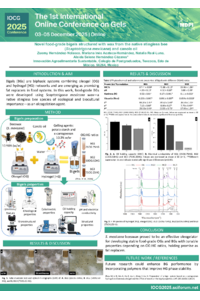
Introduction: Bigels (BGs) are biphasic systems combining oleogel (OG) and hydrogel (HG) networks and are emerging as promising fat replacers in food systems. In this work, food-grade BGs were developed using Scaptotrigona mexicana wax—a native stingless bee species of ecological and biocultural importance—as an oleogelation agent. Methods: The OG phase was formulated with S. mexicana wax and canola oil at a 10:90% (w/w) ratio, while the HG phase consisted of potato starch and κ-carrageenan (10:2% w/w). BGs were prepared at different OG:HG ratios—25:75 (BG1), 50:50 (BG2), and 75:25 (BG3)—and their physico-chemical, mechanical, structural, and microstructural properties were evaluated. Results: Oil holding capacity was highest in BG1 (86.46%) and significantly decreased with increasing OG proportion, reaching 64.98% in BG3, which also reduced moisture content (67.44–23.06%), pH (4.83–3.88), hardness (0.52–0.11 N), and viscosity (0.153–0.059 Pa·s). Regarding color, the L* value decreased from 48.3 to 26.6 and the b* value from 23.5 to 17.8 from BG1 to BG3, reflecting the natural brown hues characteristic of the wax. Different types of microstructures were identified: (O/W) in BG1, bicontinuous in BG2, and (W/O) in BG3. Electrical conductivity markedly decreased from 4.01×10⁻¹ mS/cm in BG1—indicating the HG as the continuous phase—to 5.9×10⁻⁶ mS/cm in BG3, attributable to the insulating nature of the OG phase. FTIR spectra exhibited characteristic peaks of the OG phase at 2918, 2852, 1740, 1462, and 721 cm⁻¹, with no evidence of new chemical interactions, suggesting physical integration determined by the OG:HG ratios. Conclusions: S. mexicana beeswax proved to be an effective oleogelator for developing stable food-grade OGs and BGs with tunable properties depending on OG:HG ratios, holding promise as fat replacers. Future research could enhance BG performance by incorporating polymers that improve HG phase stability.
Keywords
Bigel
Beeswax
Oleogel
Canola oil
Starch
κ-Carrageenan
Poster
sciforum-142613 Poster.pdf
Polysaccharide-derived hydrogel matrix-based platform for beverage quality monitoring
Tunable Hydrogel Platforms to Mimic Breast Cancer Microenvironments via 3D Bioprinting