Event submissions
Published
This submission belongs to the session S3. Gels in Agriculture and Food of the event The 1st International Online Conference on Gels
Published date
28 Nov, 2025
Academic Editor
'%3e%3cpath%20d='M12.6657%2010.9104C12.4185%2010.325%2012.0599%209.79327%2011.6097%209.34482C11.1609%208.89508%2010.6293%208.5365%2010.0442%208.28888C10.0389%208.28626%2010.0337%208.28495%2010.0285%208.28233C10.8446%207.69279%2011.3752%206.73249%2011.3752%205.64904C11.3752%203.8542%209.92103%202.39999%208.1262%202.39999C6.33136%202.39999%204.87715%203.8542%204.87715%205.64904C4.87715%206.73249%205.40774%207.69279%206.22393%208.28364C6.21869%208.28626%206.21345%208.28757%206.20821%208.29019C5.62129%208.5378%205.09463%208.89284%204.64265%209.34613C4.1929%209.79493%203.83432%2010.3266%203.58671%2010.9117C3.34345%2011.4845%203.21226%2012.0987%203.20023%2012.7209C3.19988%2012.7349%203.20233%2012.7488%203.20744%2012.7619C3.21255%2012.7749%203.22022%2012.7867%203.22998%2012.7968C3.23975%2012.8068%203.25142%2012.8147%203.26431%2012.8202C3.2772%2012.8256%203.29105%2012.8284%203.30504%2012.8284H4.09109C4.14874%2012.8284%204.19459%2012.7825%204.1959%2012.7262C4.2221%2011.7148%204.62823%2010.7676%205.34617%2010.0497C6.08899%209.30683%207.0755%208.89808%208.1262%208.89808C9.17689%208.89808%2010.1634%209.30683%2010.9062%2010.0497C11.6242%2010.7676%2012.0303%2011.7148%2012.0565%2012.7262C12.0578%2012.7838%2012.1037%2012.8284%2012.1613%2012.8284H12.9474C12.9613%2012.8284%2012.9752%2012.8256%2012.9881%2012.8202C13.001%2012.8147%2013.0126%2012.8068%2013.0224%2012.7968C13.0322%2012.7867%2013.0398%2012.7749%2013.0449%2012.7619C13.0501%2012.7488%2013.0525%2012.7349%2013.0522%2012.7209C13.0391%2012.0947%2012.9094%2011.4855%2012.6657%2010.9104ZM8.1262%207.9024C7.52486%207.9024%206.9589%207.6679%206.53312%207.24211C6.10733%206.81633%205.87283%206.25037%205.87283%205.64904C5.87283%205.0477%206.10733%204.48174%206.53312%204.05596C6.9589%203.63018%207.52486%203.39567%208.1262%203.39567C8.72753%203.39567%209.29349%203.63018%209.71927%204.05596C10.1451%204.48174%2010.3796%205.0477%2010.3796%205.64904C10.3796%206.25037%2010.1451%206.81633%209.71927%207.24211C9.29349%207.6679%208.72753%207.9024%208.1262%207.9024Z'%20fill='%235D1EE1'/%3e%3c/g%3e%3c/svg%3e) Luis Alfonso Trujillo-Cayado
Luis Alfonso Trujillo-CayadoCitation
Andrés Felipe Vélez Linares, Beatriz Gutiérrez Portal, Leire Ruiz Rubio, Leyre Perez Alvarez, Jose Luis Vilas Vilela, Sustainable Marine Biopolymer Gels for Active, Biodegradable Film Formation, in Proceedings of The 1st International Online Conference on Gels, 3 December–5 December 2025, MDPI: Basel, Switzerland
Share
Email
Facebook
Twitter
LinkedIn
Sustainable Marine Biopolymer Gels for Active, Biodegradable Film Formation
'%3e%3cpath%20d='M12.6647%2010.9104C12.4176%2010.325%2012.0589%209.7933%2011.6088%209.34485C11.16%208.89511%2010.6283%208.53653%2010.0432%208.28891C10.038%208.28629%2010.0327%208.28498%2010.0275%208.28236C10.8437%207.69282%2011.3743%206.73252%2011.3743%205.64907C11.3743%203.85423%209.92005%202.40002%208.12522%202.40002C6.33038%202.40002%204.87618%203.85423%204.87618%205.64907C4.87618%206.73252%205.40677%207.69282%206.22296%208.28367C6.21772%208.28629%206.21248%208.2876%206.20724%208.29022C5.62031%208.53783%205.09365%208.89287%204.64167%209.34616C4.19192%209.79496%203.83334%2010.3266%203.58573%2010.9117C3.34247%2011.4846%203.21128%2012.0987%203.19925%2012.721C3.1989%2012.735%203.20135%2012.7489%203.20646%2012.7619C3.21157%2012.7749%203.21924%2012.7868%203.22901%2012.7968C3.23877%2012.8068%203.25045%2012.8148%203.26334%2012.8202C3.27623%2012.8256%203.29007%2012.8284%203.30406%2012.8284H4.09012C4.14776%2012.8284%204.19362%2012.7825%204.19493%2012.7262C4.22113%2011.7148%204.62726%2010.7676%205.34519%2010.0497C6.08802%209.30686%207.07452%208.89811%208.12522%208.89811C9.17592%208.89811%2010.1624%209.30686%2010.9052%2010.0497C11.6232%2010.7676%2012.0293%2011.7148%2012.0555%2012.7262C12.0568%2012.7839%2012.1027%2012.8284%2012.1603%2012.8284H12.9464C12.9604%2012.8284%2012.9742%2012.8256%2012.9871%2012.8202C13%2012.8148%2013.0117%2012.8068%2013.0214%2012.7968C13.0312%2012.7868%2013.0389%2012.7749%2013.044%2012.7619C13.0491%2012.7489%2013.0515%2012.735%2013.0512%2012.721C13.0381%2012.0947%2012.9084%2011.4856%2012.6647%2010.9104ZM8.12522%207.90243C7.52388%207.90243%206.95792%207.66793%206.53214%207.24215C6.10636%206.81636%205.87185%206.2504%205.87185%205.64907C5.87185%205.04773%206.10636%204.48177%206.53214%204.05599C6.95792%203.63021%207.52388%203.3957%208.12522%203.3957C8.72655%203.3957%209.29252%203.63021%209.7183%204.05599C10.1441%204.48177%2010.3786%205.04773%2010.3786%205.64907C10.3786%206.2504%2010.1441%206.81636%209.7183%207.24215C9.29252%207.66793%208.72655%207.90243%208.12522%207.90243Z'%20fill='%235D1EE1'/%3e%3c/g%3e%3c/svg%3e)
Andrés Felipe Vélez Linares 1
Beatriz Gutiérrez Portal 1

Leire Ruiz Rubio 1,2

Leyre Perez Alvarez 1,2
Jose Luis Vilas Vilela 1,2
1. Innovative Macromolecular Materials (Imacromat), Physic-Chemistry department, Basque Country University UPV/EHU, 48940 Leioa, Spain, Spain
2. Basque Center for Materials, Applications and Nanostructures, UPV/EHU Science Park, 48940 Leioa, Spain
Abstract
The accumulation of petroleum-based plastics in food demands sustainable, high-performance alternatives. Marine biomass supplies abundant polysaccharides (agar, alginate, carrageenan, and chitosan) and polyphenolic co-extracts that assemble into hydrogels and, upon drying, yield functional xerogel films. Here, “gel-derived” denotes films obtained by drying pre-formed gels (e.g., thermo-reversible agar networks) or by casting network-tailored matrices (methacrylation, β-cyclodextrin complexation) that display gel behavior upon hydration. Edible coatings lie outside the scope.
Beachcast macroalgae collected by tidal action were processed within 48 h. This initial phase used red algae (Gelidium sesquipedale); the workflow will extend to brown/green macroalgae and microalgae. Polysaccharides were recovered by alkaline pretreatment followed by hot-water extraction or by ultrasound-assisted maceration; phenolic fractions were obtained by ethanolic maceration and quantified by Folin–Ciocalteu. Agar, alginate, and chitosan were methacrylated. Films were prepared by first inducing gelation (agar sol–gel cooling; network setting in methacrylated alginate/chitosan) and then drying to obtain xerogel films. FTIR and DSC assessed structure/complexation; swelling probed rehydration.
Conventional agar extraction yielded 0.80 g from 5 g dry biomass, whereas ultrasound yielded 0.50 g. Total phenolics were low in algal extracts (0.0925 mg GAE·g⁻¹ dry biomass in an early batch; later protocol: 10.49 mg·L⁻¹) with excellent calibration (R² = 0.992). FTIR revealed intensified C–O and emergent C=O bands consistent with methacrylation; β-cyclodextrin inclusion with curcumin/carvacrol was supported by band shifts and DSC. Agar hydrogels dried into uniform xerogel films; agar–lignin remained stable, while agar–tannic acid failed. Methacrylated alginate and chitosan films exhibited improved handling and cohesion.
This study delineates a gel-to-xerogel route from marine biomass to functional films, combining sustainable extractions with chemical and supramolecular tailoring. Early films show structural integrity and processability; ongoing work targets water stability, thermo-mechanical optimization, and expansion to brown/green/microalgae, with a quantitative assessment of barrier, antioxidant/antimicrobial performance, biodegradability, and scale-up for food-packaging applications.
Keywords
marine polysaccharides
gel-derived films
methacrylation
β-cyclodextrin inclusion complexes
ultrasound-assisted extraction
active biodegradable packaging
Poster
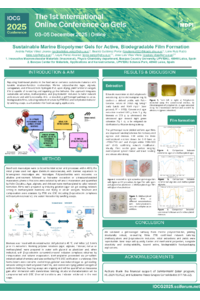
Poster_Sustainable Marine Biopolymer Gels for Active, Biodegradable Film Formation_AV_BG.pdf
Tunable Hydrogel Platforms to Mimic Breast Cancer Microenvironments via 3D Bioprinting
Three-dimensional-printed hierarchical hydrogel–nanogel scaffolds for controlled delivery of nonsteroidal anti-inflammatory drugs