Event submissions
Published
This submission belongs to the session S3. Gels in Agriculture and Food of the event The 1st International Online Conference on Gels
Published date
28 Nov, 2025
Academic Editor
'%3e%3cpath%20d='M12.6657%2010.9104C12.4185%2010.325%2012.0599%209.79327%2011.6097%209.34482C11.1609%208.89508%2010.6293%208.5365%2010.0442%208.28888C10.0389%208.28626%2010.0337%208.28495%2010.0285%208.28233C10.8446%207.69279%2011.3752%206.73249%2011.3752%205.64904C11.3752%203.8542%209.92103%202.39999%208.1262%202.39999C6.33136%202.39999%204.87715%203.8542%204.87715%205.64904C4.87715%206.73249%205.40774%207.69279%206.22393%208.28364C6.21869%208.28626%206.21345%208.28757%206.20821%208.29019C5.62129%208.5378%205.09463%208.89284%204.64265%209.34613C4.1929%209.79493%203.83432%2010.3266%203.58671%2010.9117C3.34345%2011.4845%203.21226%2012.0987%203.20023%2012.7209C3.19988%2012.7349%203.20233%2012.7488%203.20744%2012.7619C3.21255%2012.7749%203.22022%2012.7867%203.22998%2012.7968C3.23975%2012.8068%203.25142%2012.8147%203.26431%2012.8202C3.2772%2012.8256%203.29105%2012.8284%203.30504%2012.8284H4.09109C4.14874%2012.8284%204.19459%2012.7825%204.1959%2012.7262C4.2221%2011.7148%204.62823%2010.7676%205.34617%2010.0497C6.08899%209.30683%207.0755%208.89808%208.1262%208.89808C9.17689%208.89808%2010.1634%209.30683%2010.9062%2010.0497C11.6242%2010.7676%2012.0303%2011.7148%2012.0565%2012.7262C12.0578%2012.7838%2012.1037%2012.8284%2012.1613%2012.8284H12.9474C12.9613%2012.8284%2012.9752%2012.8256%2012.9881%2012.8202C13.001%2012.8147%2013.0126%2012.8068%2013.0224%2012.7968C13.0322%2012.7867%2013.0398%2012.7749%2013.0449%2012.7619C13.0501%2012.7488%2013.0525%2012.7349%2013.0522%2012.7209C13.0391%2012.0947%2012.9094%2011.4855%2012.6657%2010.9104ZM8.1262%207.9024C7.52486%207.9024%206.9589%207.6679%206.53312%207.24211C6.10733%206.81633%205.87283%206.25037%205.87283%205.64904C5.87283%205.0477%206.10733%204.48174%206.53312%204.05596C6.9589%203.63018%207.52486%203.39567%208.1262%203.39567C8.72753%203.39567%209.29349%203.63018%209.71927%204.05596C10.1451%204.48174%2010.3796%205.0477%2010.3796%205.64904C10.3796%206.25037%2010.1451%206.81633%209.71927%207.24211C9.29349%207.6679%208.72753%207.9024%208.1262%207.9024Z'%20fill='%235D1EE1'/%3e%3c/g%3e%3c/svg%3e) Luis Alfonso Trujillo-Cayado
Luis Alfonso Trujillo-CayadoCitation
Sudipta Talukder, Lina Casale Aragon Alegro, Roberta Claro Da Silva, Development of Cottonseed Oil–Carnauba Wax–Pectin Emulsion Gels as Innovative Fat Replacers in Processed Meat Products, in Proceedings of The 1st International Online Conference on Gels, 3 December–5 December 2025, MDPI: Basel, Switzerland
Share
Email
Facebook
Twitter
LinkedIn
Development of Cottonseed Oil–Carnauba Wax–Pectin Emulsion Gels as Innovative Fat Replacers in Processed Meat Products
'%3e%3cpath%20d='M12.6647%2010.9104C12.4176%2010.325%2012.0589%209.7933%2011.6088%209.34485C11.16%208.89511%2010.6283%208.53653%2010.0432%208.28891C10.038%208.28629%2010.0327%208.28498%2010.0275%208.28236C10.8437%207.69282%2011.3743%206.73252%2011.3743%205.64907C11.3743%203.85423%209.92005%202.40002%208.12522%202.40002C6.33038%202.40002%204.87618%203.85423%204.87618%205.64907C4.87618%206.73252%205.40677%207.69282%206.22296%208.28367C6.21772%208.28629%206.21248%208.2876%206.20724%208.29022C5.62031%208.53783%205.09365%208.89287%204.64167%209.34616C4.19192%209.79496%203.83334%2010.3266%203.58573%2010.9117C3.34247%2011.4846%203.21128%2012.0987%203.19925%2012.721C3.1989%2012.735%203.20135%2012.7489%203.20646%2012.7619C3.21157%2012.7749%203.21924%2012.7868%203.22901%2012.7968C3.23877%2012.8068%203.25045%2012.8148%203.26334%2012.8202C3.27623%2012.8256%203.29007%2012.8284%203.30406%2012.8284H4.09012C4.14776%2012.8284%204.19362%2012.7825%204.19493%2012.7262C4.22113%2011.7148%204.62726%2010.7676%205.34519%2010.0497C6.08802%209.30686%207.07452%208.89811%208.12522%208.89811C9.17592%208.89811%2010.1624%209.30686%2010.9052%2010.0497C11.6232%2010.7676%2012.0293%2011.7148%2012.0555%2012.7262C12.0568%2012.7839%2012.1027%2012.8284%2012.1603%2012.8284H12.9464C12.9604%2012.8284%2012.9742%2012.8256%2012.9871%2012.8202C13%2012.8148%2013.0117%2012.8068%2013.0214%2012.7968C13.0312%2012.7868%2013.0389%2012.7749%2013.044%2012.7619C13.0491%2012.7489%2013.0515%2012.735%2013.0512%2012.721C13.0381%2012.0947%2012.9084%2011.4856%2012.6647%2010.9104ZM8.12522%207.90243C7.52388%207.90243%206.95792%207.66793%206.53214%207.24215C6.10636%206.81636%205.87185%206.2504%205.87185%205.64907C5.87185%205.04773%206.10636%204.48177%206.53214%204.05599C6.95792%203.63021%207.52388%203.3957%208.12522%203.3957C8.72655%203.3957%209.29252%203.63021%209.7183%204.05599C10.1441%204.48177%2010.3786%205.04773%2010.3786%205.64907C10.3786%206.2504%2010.1441%206.81636%209.7183%207.24215C9.29252%207.66793%208.72655%207.90243%208.12522%207.90243Z'%20fill='%235D1EE1'/%3e%3c/g%3e%3c/svg%3e)
Sudipta Talukder 1
Lina Casale Aragon Alegro 1

Roberta Claro Da Silva 1
1. Department of Family and Consumer Sciences, North Carolina A&T State University, Greensboro, NC 27411, USA, USA
Abstract
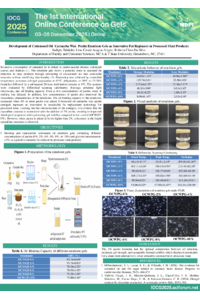
Currently, fat substitutes using unsaturated oils and emulsifiers are limited, particularly due to thermal instability at processing temperatures above 85°C, which results in emulsion breakdown, phase separation, and loss of functionality. Our objective was to develop and characterize novel emulgels consisting of cottonseed oil structured with carnauba wax (10% w/w of oil) and pectin (0-10% w/w of oil) as healthy alternative fats for meat products. Emulgels were prepared by mixing heated cottonseed oil–carnauba wax oleogel with glycerol monostearate (2% w/w) containing pectin solutions (0, 2%, 4%, 6%, 8% and 10% concentration). Processing was achieved by controlled temperature processes (oleogel preparation at 85°C, dehydration at 50°C to 25-28% humidity) followed by a subsequent 24-hour stabilization process at 4°C. The systems were evaluated by differential scanning calorimetry, rheology, polarized light microscopy, and oil binding capacity. Even at low concentrations of pectin, onset of melting was delayed. In addition, low concentrations of pectin also improved the viscoelastic characteristics of the emulsions. The oil-binding capacity of the emulsions decreased when 4% or more pectin was added. The 2% pectin emulgel exhibited a high onset temperature (101.71°C) and OBC (95.76%), as well as an improved storage modulus (125.74 kPa), indicating very good structural strength. Cottonseed oil–carnauba wax–pectin emulgels represent an innovation in sustainable fat replacement technology for processed meat. Looking into the microstructure of the emulgels, it is evident that the crystalline structure is maintained with the addition of 2% pectin, resulting in improved rheological properties while preserving gel stability compared to the control (no pectin). However, when pectin is added at levels higher than 2%, a decrease in the bright crystalline structures is observed. This novel approach has the potential to provide the food industry with an innovative solution for developing healthier processed meat products while addressing consumer demands for natural and sustainable ingredients.
Keywords
Emulsion gels
pectin
sustainable fat replacement
healthier processed meat
Poster
Online Conference Poster.pdf
Three-dimensional-printed hierarchical hydrogel–nanogel scaffolds for controlled delivery of nonsteroidal anti-inflammatory drugs
Microstructural, textural, and rheological properties of edible bigels designed for 3D food printing