Event submissions
Published
This submission belongs to the session S3. Gels in Agriculture and Food of the event The 1st International Online Conference on Gels
Published date
28 Nov, 2025
Academic Editor
'%3e%3cpath%20d='M12.6657%2010.9104C12.4185%2010.325%2012.0599%209.79327%2011.6097%209.34482C11.1609%208.89508%2010.6293%208.5365%2010.0442%208.28888C10.0389%208.28626%2010.0337%208.28495%2010.0285%208.28233C10.8446%207.69279%2011.3752%206.73249%2011.3752%205.64904C11.3752%203.8542%209.92103%202.39999%208.1262%202.39999C6.33136%202.39999%204.87715%203.8542%204.87715%205.64904C4.87715%206.73249%205.40774%207.69279%206.22393%208.28364C6.21869%208.28626%206.21345%208.28757%206.20821%208.29019C5.62129%208.5378%205.09463%208.89284%204.64265%209.34613C4.1929%209.79493%203.83432%2010.3266%203.58671%2010.9117C3.34345%2011.4845%203.21226%2012.0987%203.20023%2012.7209C3.19988%2012.7349%203.20233%2012.7488%203.20744%2012.7619C3.21255%2012.7749%203.22022%2012.7867%203.22998%2012.7968C3.23975%2012.8068%203.25142%2012.8147%203.26431%2012.8202C3.2772%2012.8256%203.29105%2012.8284%203.30504%2012.8284H4.09109C4.14874%2012.8284%204.19459%2012.7825%204.1959%2012.7262C4.2221%2011.7148%204.62823%2010.7676%205.34617%2010.0497C6.08899%209.30683%207.0755%208.89808%208.1262%208.89808C9.17689%208.89808%2010.1634%209.30683%2010.9062%2010.0497C11.6242%2010.7676%2012.0303%2011.7148%2012.0565%2012.7262C12.0578%2012.7838%2012.1037%2012.8284%2012.1613%2012.8284H12.9474C12.9613%2012.8284%2012.9752%2012.8256%2012.9881%2012.8202C13.001%2012.8147%2013.0126%2012.8068%2013.0224%2012.7968C13.0322%2012.7867%2013.0398%2012.7749%2013.0449%2012.7619C13.0501%2012.7488%2013.0525%2012.7349%2013.0522%2012.7209C13.0391%2012.0947%2012.9094%2011.4855%2012.6657%2010.9104ZM8.1262%207.9024C7.52486%207.9024%206.9589%207.6679%206.53312%207.24211C6.10733%206.81633%205.87283%206.25037%205.87283%205.64904C5.87283%205.0477%206.10733%204.48174%206.53312%204.05596C6.9589%203.63018%207.52486%203.39567%208.1262%203.39567C8.72753%203.39567%209.29349%203.63018%209.71927%204.05596C10.1451%204.48174%2010.3796%205.0477%2010.3796%205.64904C10.3796%206.25037%2010.1451%206.81633%209.71927%207.24211C9.29349%207.6679%208.72753%207.9024%208.1262%207.9024Z'%20fill='%235D1EE1'/%3e%3c/g%3e%3c/svg%3e) Luis Alfonso Trujillo-Cayado
Luis Alfonso Trujillo-CayadoCitation
Glykeria Stefanou, Areti Tasioula, Triantafyllia Biza, Thomas Moschakis, Formation of olive oil oleogels with anhydrous milk fat fractions, in Proceedings of The 1st International Online Conference on Gels, 3 December–5 December 2025, MDPI: Basel, Switzerland
Share
Email
Facebook
Twitter
LinkedIn
Formation of olive oil oleogels with anhydrous milk fat fractions
'%3e%3cpath%20d='M12.6647%2010.9104C12.4176%2010.325%2012.0589%209.7933%2011.6088%209.34485C11.16%208.89511%2010.6283%208.53653%2010.0432%208.28891C10.038%208.28629%2010.0327%208.28498%2010.0275%208.28236C10.8437%207.69282%2011.3743%206.73252%2011.3743%205.64907C11.3743%203.85423%209.92005%202.40002%208.12522%202.40002C6.33038%202.40002%204.87618%203.85423%204.87618%205.64907C4.87618%206.73252%205.40677%207.69282%206.22296%208.28367C6.21772%208.28629%206.21248%208.2876%206.20724%208.29022C5.62031%208.53783%205.09365%208.89287%204.64167%209.34616C4.19192%209.79496%203.83334%2010.3266%203.58573%2010.9117C3.34247%2011.4846%203.21128%2012.0987%203.19925%2012.721C3.1989%2012.735%203.20135%2012.7489%203.20646%2012.7619C3.21157%2012.7749%203.21924%2012.7868%203.22901%2012.7968C3.23877%2012.8068%203.25045%2012.8148%203.26334%2012.8202C3.27623%2012.8256%203.29007%2012.8284%203.30406%2012.8284H4.09012C4.14776%2012.8284%204.19362%2012.7825%204.19493%2012.7262C4.22113%2011.7148%204.62726%2010.7676%205.34519%2010.0497C6.08802%209.30686%207.07452%208.89811%208.12522%208.89811C9.17592%208.89811%2010.1624%209.30686%2010.9052%2010.0497C11.6232%2010.7676%2012.0293%2011.7148%2012.0555%2012.7262C12.0568%2012.7839%2012.1027%2012.8284%2012.1603%2012.8284H12.9464C12.9604%2012.8284%2012.9742%2012.8256%2012.9871%2012.8202C13%2012.8148%2013.0117%2012.8068%2013.0214%2012.7968C13.0312%2012.7868%2013.0389%2012.7749%2013.044%2012.7619C13.0491%2012.7489%2013.0515%2012.735%2013.0512%2012.721C13.0381%2012.0947%2012.9084%2011.4856%2012.6647%2010.9104ZM8.12522%207.90243C7.52388%207.90243%206.95792%207.66793%206.53214%207.24215C6.10636%206.81636%205.87185%206.2504%205.87185%205.64907C5.87185%205.04773%206.10636%204.48177%206.53214%204.05599C6.95792%203.63021%207.52388%203.3957%208.12522%203.3957C8.72655%203.3957%209.29252%203.63021%209.7183%204.05599C10.1441%204.48177%2010.3786%205.04773%2010.3786%205.64907C10.3786%206.2504%2010.1441%206.81636%209.7183%207.24215C9.29252%207.66793%208.72655%207.90243%208.12522%207.90243Z'%20fill='%235D1EE1'/%3e%3c/g%3e%3c/svg%3e)
Glykeria Stefanou 1
Areti Tasioula 1
Triantafyllia Biza 1
Thomas Moschakis 1
1. Department of Food Science and Technology, School of Agriculture, Aristotle University of Thessaloniki, 54124, Thessaloniki, Greece, Greece
Abstract
Driven by increasing nutritional concerns and regulatory efforts to reduce trans fatty acids and saturated fats in processed foods, alternative lipid structuring strategies have gained significant attention. Oleogelation, the immobilization of liquid oils within a gel-like network, offers a promising approach for developing semi-solid fat analogs with improved lipid profiles. This study aimed to identify the optimal dry fractionation temperature of AMF and the minimum effective concentration required to structure olive oil into a stable oleogel.
Dry fractionation of AMF was performed via sequential centrifugation at varying temperatures of 30°C, 35°C, 37°C, and 40°C, allowing separation of distinct high-melting stearin fractions. These were blended with extra virgin olive oil in different ratios (from 5:95 to 15:85 w/w) to identify the minimal concentration required for gel formation. The samples were evaluated macroscopically and thermally characterized using micro-differential scanning calorimetry (μDSC). The effect of ultrasound treatment on gel microstructure and melting behavior was also assessed.
The 15:85 stearin-to-olive oil ratio using fractions obtained at 40°C yielded the firmest self-standing oleogels. Notably, this stearin originated from the AMF fraction previously obtained at 37°C, indicating that both the pre-fractionation step and final crystallization temperature influence the gelation performance. Ultrasound treatment macroscopically enhanced gel cohesiveness but did not significantly alter melting temperatures. The fractions exhibited overall similar thermal behavior to native AMF, with crystallization peaks and completion temperatures during cooling being slightly shifted to higher values, indicating a higher proportion of long-chain saturated fatty acids. The second heating revealed slightly elevated melting completion temperatures for S40 15% oleogels, reflecting their composition in high-melting triacylglycerols.
AMF fractions, particularly those isolated at higher crystallization temperatures, exhibit strong gelation capabilities in olive oil systems. These oleogels may serve as viable saturated fat replacers in food formulations, pending further optimization for stability, scalability, and functional performance in real food matrices.
Keywords
Oleogelation/ Anhydrous Milk Fat/ Olive Oil/ Dry fractionation/ Lipid structuring/ μDSC
Poster
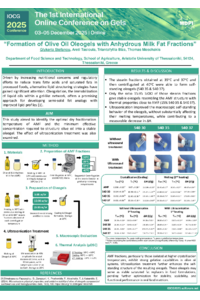
Poster Oleogels_Stefanou Glykeria.pdf
Recent Advancements in Gel Materials for Green Chemical Processes, Clean Energy, and Environmental Solutions.
Active Edible Coatings for Fresh Food as a Suitable Alternative to Plastic