Event submissions
Published
This submission belongs to the session S3. Gels in Agriculture and Food of the event The 1st International Online Conference on Gels
Published date
28 Nov, 2025
Academic Editor
'%3e%3cpath%20d='M12.6657%2010.9104C12.4185%2010.325%2012.0599%209.79327%2011.6097%209.34482C11.1609%208.89508%2010.6293%208.5365%2010.0442%208.28888C10.0389%208.28626%2010.0337%208.28495%2010.0285%208.28233C10.8446%207.69279%2011.3752%206.73249%2011.3752%205.64904C11.3752%203.8542%209.92103%202.39999%208.1262%202.39999C6.33136%202.39999%204.87715%203.8542%204.87715%205.64904C4.87715%206.73249%205.40774%207.69279%206.22393%208.28364C6.21869%208.28626%206.21345%208.28757%206.20821%208.29019C5.62129%208.5378%205.09463%208.89284%204.64265%209.34613C4.1929%209.79493%203.83432%2010.3266%203.58671%2010.9117C3.34345%2011.4845%203.21226%2012.0987%203.20023%2012.7209C3.19988%2012.7349%203.20233%2012.7488%203.20744%2012.7619C3.21255%2012.7749%203.22022%2012.7867%203.22998%2012.7968C3.23975%2012.8068%203.25142%2012.8147%203.26431%2012.8202C3.2772%2012.8256%203.29105%2012.8284%203.30504%2012.8284H4.09109C4.14874%2012.8284%204.19459%2012.7825%204.1959%2012.7262C4.2221%2011.7148%204.62823%2010.7676%205.34617%2010.0497C6.08899%209.30683%207.0755%208.89808%208.1262%208.89808C9.17689%208.89808%2010.1634%209.30683%2010.9062%2010.0497C11.6242%2010.7676%2012.0303%2011.7148%2012.0565%2012.7262C12.0578%2012.7838%2012.1037%2012.8284%2012.1613%2012.8284H12.9474C12.9613%2012.8284%2012.9752%2012.8256%2012.9881%2012.8202C13.001%2012.8147%2013.0126%2012.8068%2013.0224%2012.7968C13.0322%2012.7867%2013.0398%2012.7749%2013.0449%2012.7619C13.0501%2012.7488%2013.0525%2012.7349%2013.0522%2012.7209C13.0391%2012.0947%2012.9094%2011.4855%2012.6657%2010.9104ZM8.1262%207.9024C7.52486%207.9024%206.9589%207.6679%206.53312%207.24211C6.10733%206.81633%205.87283%206.25037%205.87283%205.64904C5.87283%205.0477%206.10733%204.48174%206.53312%204.05596C6.9589%203.63018%207.52486%203.39567%208.1262%203.39567C8.72753%203.39567%209.29349%203.63018%209.71927%204.05596C10.1451%204.48174%2010.3796%205.0477%2010.3796%205.64904C10.3796%206.25037%2010.1451%206.81633%209.71927%207.24211C9.29349%207.6679%208.72753%207.9024%208.1262%207.9024Z'%20fill='%235D1EE1'/%3e%3c/g%3e%3c/svg%3e) Luis Alfonso Trujillo-Cayado
Luis Alfonso Trujillo-CayadoCitation
Beatriz Gutiérrez Portal, Andrés Felipe Vélez Linares, Leire Ruiz Rubio, Leyre Pérez Álvarez, Estibaliz Hernaez Laviña, Active Edible Coatings for Fresh Food as a Suitable Alternative to Plastic, in Proceedings of The 1st International Online Conference on Gels, 3 December–5 December 2025, MDPI: Basel, Switzerland
Share
Email
Facebook
Twitter
LinkedIn
Active Edible Coatings for Fresh Food as a Suitable Alternative to Plastic
'%3e%3cpath%20d='M12.6647%2010.9104C12.4176%2010.325%2012.0589%209.7933%2011.6088%209.34485C11.16%208.89511%2010.6283%208.53653%2010.0432%208.28891C10.038%208.28629%2010.0327%208.28498%2010.0275%208.28236C10.8437%207.69282%2011.3743%206.73252%2011.3743%205.64907C11.3743%203.85423%209.92005%202.40002%208.12522%202.40002C6.33038%202.40002%204.87618%203.85423%204.87618%205.64907C4.87618%206.73252%205.40677%207.69282%206.22296%208.28367C6.21772%208.28629%206.21248%208.2876%206.20724%208.29022C5.62031%208.53783%205.09365%208.89287%204.64167%209.34616C4.19192%209.79496%203.83334%2010.3266%203.58573%2010.9117C3.34247%2011.4846%203.21128%2012.0987%203.19925%2012.721C3.1989%2012.735%203.20135%2012.7489%203.20646%2012.7619C3.21157%2012.7749%203.21924%2012.7868%203.22901%2012.7968C3.23877%2012.8068%203.25045%2012.8148%203.26334%2012.8202C3.27623%2012.8256%203.29007%2012.8284%203.30406%2012.8284H4.09012C4.14776%2012.8284%204.19362%2012.7825%204.19493%2012.7262C4.22113%2011.7148%204.62726%2010.7676%205.34519%2010.0497C6.08802%209.30686%207.07452%208.89811%208.12522%208.89811C9.17592%208.89811%2010.1624%209.30686%2010.9052%2010.0497C11.6232%2010.7676%2012.0293%2011.7148%2012.0555%2012.7262C12.0568%2012.7839%2012.1027%2012.8284%2012.1603%2012.8284H12.9464C12.9604%2012.8284%2012.9742%2012.8256%2012.9871%2012.8202C13%2012.8148%2013.0117%2012.8068%2013.0214%2012.7968C13.0312%2012.7868%2013.0389%2012.7749%2013.044%2012.7619C13.0491%2012.7489%2013.0515%2012.735%2013.0512%2012.721C13.0381%2012.0947%2012.9084%2011.4856%2012.6647%2010.9104ZM8.12522%207.90243C7.52388%207.90243%206.95792%207.66793%206.53214%207.24215C6.10636%206.81636%205.87185%206.2504%205.87185%205.64907C5.87185%205.04773%206.10636%204.48177%206.53214%204.05599C6.95792%203.63021%207.52388%203.3957%208.12522%203.3957C8.72655%203.3957%209.29252%203.63021%209.7183%204.05599C10.1441%204.48177%2010.3786%205.04773%2010.3786%205.64907C10.3786%206.2504%2010.1441%206.81636%209.7183%207.24215C9.29252%207.66793%208.72655%207.90243%208.12522%207.90243Z'%20fill='%235D1EE1'/%3e%3c/g%3e%3c/svg%3e)
Beatriz Gutiérrez Portal 1
Andrés Felipe Vélez Linares 1

Leire Ruiz Rubio 1,2

Leyre Pérez Álvarez 1,2
Estibaliz Hernaez Laviña 1
1. Innovative Macromolecular Materials (Imacromat), Department of Physical Chemistry, University of the Basque Country UPV/EHU, 48940 Leioa, Spain, Spain
2. Basque Center for Materials, Applications and Nanostructures, UPV/EHU Science Park, 48940 Leioa, Spain
Abstract
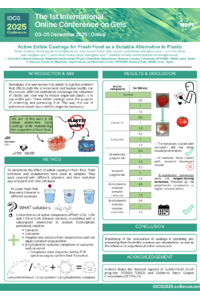
Nowadays, it is well-known that plastic is a global problem that affects both the environment and human health. For this reason, different institutions encourage the reduction of plastic use. One way to reduce single-use plastic is to use edible gels. These edible coatings serve the purpose of protecting and preserving fruit. This way, the use of petroleum-based plastic will no longer be necessary.
To determine the effect ofedible coatings, fresh tomatoes were used as samples. These were covered with different edible coating solutions, and their evolution was analysed over time. The effects of the concentration of active compounds were studied at 0.5%, 1.0%, and 1.5% in 0.5% chitosan solutions, crosslinked with a subsequent immersion in sodium triphosphate pentabasic solution, with the active compounds being carvacrol, curcumin, and polyphenolic extracts obtained from strawberries and red algae (Gelidium sesquipedale). Also, coatings were formulated with β-cyclodextrin inclusion complexes of curcumin and carvacrol. Both complexes were characterised by FTIR spectroscopy to confirm their formation. The tomatoes were stored in a refrigerator at 4 °C.
Through visual analysis, it was determined that the tomatoes coated with curcumin did not show mould proliferation. In contrast, those coated with carvacrol developed mould. In addition, different decomposition processes were observed depending on the type of active compound used. Compared to the control tomatoes, it was noticed that the coatings delayed their decomposition, with the β-cyclodextrin complexes resulting in the longest-lasting tomatoes, followed by the polyphenolic compounds at higher concentrations.
Through this work, the importance of the composition of the coatings in protecting and preserving fresh foods like tomatoes, as well as the influence of the proportions of the active compounds, was determined. Nevertheless, it is advisable to carry out further studies, such as biological analyses, to determine the chemical interactions of coatings with food.
Keywords
edible coatings
gel-derived coatings
food packaging alternatives
marine polysaccharides
β-cyclodextrin inclusion complexes
poliphenolic extracts
Poster
Poster-Active Edible Coatings for Fresh Food as a Suitable Alternative to Plastic.pdf
Formation of olive oil oleogels with anhydrous milk fat fractions
Synthesis of a Chitosan–Carrageenan-Based Bigel Using Aquatic Lipid as a Sustainable Liquid Phase for Fat-Reduced Chocolate