Event submissions
Published
This submission belongs to the session S3. Gels in Agriculture and Food of the event The 1st International Online Conference on Gels
Published date
28 Nov, 2025
Academic Editor
'%3e%3cpath%20d='M12.6657%2010.9104C12.4185%2010.325%2012.0599%209.79327%2011.6097%209.34482C11.1609%208.89508%2010.6293%208.5365%2010.0442%208.28888C10.0389%208.28626%2010.0337%208.28495%2010.0285%208.28233C10.8446%207.69279%2011.3752%206.73249%2011.3752%205.64904C11.3752%203.8542%209.92103%202.39999%208.1262%202.39999C6.33136%202.39999%204.87715%203.8542%204.87715%205.64904C4.87715%206.73249%205.40774%207.69279%206.22393%208.28364C6.21869%208.28626%206.21345%208.28757%206.20821%208.29019C5.62129%208.5378%205.09463%208.89284%204.64265%209.34613C4.1929%209.79493%203.83432%2010.3266%203.58671%2010.9117C3.34345%2011.4845%203.21226%2012.0987%203.20023%2012.7209C3.19988%2012.7349%203.20233%2012.7488%203.20744%2012.7619C3.21255%2012.7749%203.22022%2012.7867%203.22998%2012.7968C3.23975%2012.8068%203.25142%2012.8147%203.26431%2012.8202C3.2772%2012.8256%203.29105%2012.8284%203.30504%2012.8284H4.09109C4.14874%2012.8284%204.19459%2012.7825%204.1959%2012.7262C4.2221%2011.7148%204.62823%2010.7676%205.34617%2010.0497C6.08899%209.30683%207.0755%208.89808%208.1262%208.89808C9.17689%208.89808%2010.1634%209.30683%2010.9062%2010.0497C11.6242%2010.7676%2012.0303%2011.7148%2012.0565%2012.7262C12.0578%2012.7838%2012.1037%2012.8284%2012.1613%2012.8284H12.9474C12.9613%2012.8284%2012.9752%2012.8256%2012.9881%2012.8202C13.001%2012.8147%2013.0126%2012.8068%2013.0224%2012.7968C13.0322%2012.7867%2013.0398%2012.7749%2013.0449%2012.7619C13.0501%2012.7488%2013.0525%2012.7349%2013.0522%2012.7209C13.0391%2012.0947%2012.9094%2011.4855%2012.6657%2010.9104ZM8.1262%207.9024C7.52486%207.9024%206.9589%207.6679%206.53312%207.24211C6.10733%206.81633%205.87283%206.25037%205.87283%205.64904C5.87283%205.0477%206.10733%204.48174%206.53312%204.05596C6.9589%203.63018%207.52486%203.39567%208.1262%203.39567C8.72753%203.39567%209.29349%203.63018%209.71927%204.05596C10.1451%204.48174%2010.3796%205.0477%2010.3796%205.64904C10.3796%206.25037%2010.1451%206.81633%209.71927%207.24211C9.29349%207.6679%208.72753%207.9024%208.1262%207.9024Z'%20fill='%235D1EE1'/%3e%3c/g%3e%3c/svg%3e) Luis Alfonso Trujillo-Cayado
Luis Alfonso Trujillo-CayadoCitation
Wahyu Ramadhan, Aliyah Indira Sari, Sugeng Heri Suseno, Fajar Domychen Sihombing, Synthesis of a Chitosan–Carrageenan-Based Bigel Using Aquatic Lipid as a Sustainable Liquid Phase for Fat-Reduced Chocolate, in Proceedings of The 1st International Online Conference on Gels, 3 December–5 December 2025, MDPI: Basel, Switzerland
Share
Email
Facebook
Twitter
LinkedIn
Synthesis of a Chitosan–Carrageenan-Based Bigel Using Aquatic Lipid as a Sustainable Liquid Phase for Fat-Reduced Chocolate

Wahyu Ramadhan 1,2,3
'%3e%3cpath%20d='M12.6647%2010.9104C12.4176%2010.325%2012.0589%209.7933%2011.6088%209.34485C11.16%208.89511%2010.6283%208.53653%2010.0432%208.28891C10.038%208.28629%2010.0327%208.28498%2010.0275%208.28236C10.8437%207.69282%2011.3743%206.73252%2011.3743%205.64907C11.3743%203.85423%209.92005%202.40002%208.12522%202.40002C6.33038%202.40002%204.87618%203.85423%204.87618%205.64907C4.87618%206.73252%205.40677%207.69282%206.22296%208.28367C6.21772%208.28629%206.21248%208.2876%206.20724%208.29022C5.62031%208.53783%205.09365%208.89287%204.64167%209.34616C4.19192%209.79496%203.83334%2010.3266%203.58573%2010.9117C3.34247%2011.4846%203.21128%2012.0987%203.19925%2012.721C3.1989%2012.735%203.20135%2012.7489%203.20646%2012.7619C3.21157%2012.7749%203.21924%2012.7868%203.22901%2012.7968C3.23877%2012.8068%203.25045%2012.8148%203.26334%2012.8202C3.27623%2012.8256%203.29007%2012.8284%203.30406%2012.8284H4.09012C4.14776%2012.8284%204.19362%2012.7825%204.19493%2012.7262C4.22113%2011.7148%204.62726%2010.7676%205.34519%2010.0497C6.08802%209.30686%207.07452%208.89811%208.12522%208.89811C9.17592%208.89811%2010.1624%209.30686%2010.9052%2010.0497C11.6232%2010.7676%2012.0293%2011.7148%2012.0555%2012.7262C12.0568%2012.7839%2012.1027%2012.8284%2012.1603%2012.8284H12.9464C12.9604%2012.8284%2012.9742%2012.8256%2012.9871%2012.8202C13%2012.8148%2013.0117%2012.8068%2013.0214%2012.7968C13.0312%2012.7868%2013.0389%2012.7749%2013.044%2012.7619C13.0491%2012.7489%2013.0515%2012.735%2013.0512%2012.721C13.0381%2012.0947%2012.9084%2011.4856%2012.6647%2010.9104ZM8.12522%207.90243C7.52388%207.90243%206.95792%207.66793%206.53214%207.24215C6.10636%206.81636%205.87185%206.2504%205.87185%205.64907C5.87185%205.04773%206.10636%204.48177%206.53214%204.05599C6.95792%203.63021%207.52388%203.3957%208.12522%203.3957C8.72655%203.3957%209.29252%203.63021%209.7183%204.05599C10.1441%204.48177%2010.3786%205.04773%2010.3786%205.64907C10.3786%206.2504%2010.1441%206.81636%209.7183%207.24215C9.29252%207.66793%208.72655%207.90243%208.12522%207.90243Z'%20fill='%235D1EE1'/%3e%3c/g%3e%3c/svg%3e)
Aliyah Indira Sari 1,3
Sugeng Heri Suseno 1
Fajar Domychen Sihombing 1
1. Department of Aquatic Products Technology, Faculty of Fisheries and Marine Sciences, IPB University, Bogor, Indonesia, Indonesia
2. Center for Coastal and Marine Resources Studies, International Research Institute for Maritime, Ocean and Fisheries, IPB University, Bogor 16127, Indonesia
3. Aquatic Gels for Future Advanced Materials and Technologies Research Unit, IPB University, Bogor 16680, Indonesia
Abstract
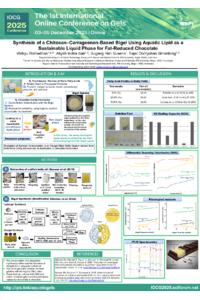
Fat reduction in chocolate confectionery can be achieved by partially replacing cocoa butter with structured systems such as bigels. Bigels are biphasic systems consisting of hydrogel and oleogel domains, which form interpenetrated networks to deliver both aqueous and lipid functionalities. In this study, a bigel system based on chitosan and kappa-carrageenan hydrogels incorporated into an oleogel matrix was synthesized and applied as a sustainable fat substitute in chocolate products. The oleogel was prepared using glycerol monostearate (GMS) as the structuring agent combined with pangasius oil, an aquatic lipid phase derived from a freshwater aquaculture by-product, characterized by low polyunsaturated fatty acid content and favorable sensory attributes. Compared to commercial plant-derived oils, this lipid source exhibited no detectable fishy odor, making it highly suitable for incorporation into sweet confectionery systems. Three ratios of hydrogel-forming agents (chitosan, a cationic polysaccharide: kappa-carrageenan, a sulfated polysaccharide = 25:75, 50:50, and 75:25) were evaluated in terms of oil binding capacity (OBC), thermal behavior, viscoelastic properties (frequency sweep), and proximate composition of the final chocolate formulation. The color, total fat content, and total energy were also assessed to determine the functional performance of the bigel system. Among all tested formulations, the 50:50 chitosan–kappa-carrageenan ratio exhibited the highest oil binding capacity (98.75%) and stable thermal characteristics, as indicated by a melting point shift on the thermogram, suggesting strong internal structuring and oil entrapment. The incorporation of this bigel (containing chitosan and GMS-structured oleogel) into the chocolate matrix resulted in a significant reduction in total fat content compared to commercial chocolate, while maintaining acceptable physical properties. These findings demonstrate the potential of sustainable hydrogel-in-oleogel systems structured with GMS and pangasius oil as functional fat replacers in chocolate products. Furthermore, the valorization of aquatic by-products such as pangasius oil offers a promising strategy to enhance the sustainability and nutritional profile of confectionery formulations.
Keywords
chocolate
direct gelation
hydrogel-in-oleogel
pangasius oil.
Poster
Rev_Poster_Wahyu Ramadhan.pdf
Active Edible Coatings for Fresh Food as a Suitable Alternative to Plastic
Innovative agriculture: bicontinuous structures as delivery systems for fertilizers and pesticides