Event submissions
Published
This submission belongs to the session S4. Plant Taxonomy of the event The 1st International Online Conference on Taxonomy
Published date
01 Dec, 2025
Academic Editor
'%3e%3cpath%20d='M12.6657%2010.9104C12.4185%2010.325%2012.0599%209.79327%2011.6097%209.34482C11.1609%208.89508%2010.6293%208.5365%2010.0442%208.28888C10.0389%208.28626%2010.0337%208.28495%2010.0285%208.28233C10.8446%207.69279%2011.3752%206.73249%2011.3752%205.64904C11.3752%203.8542%209.92103%202.39999%208.1262%202.39999C6.33136%202.39999%204.87715%203.8542%204.87715%205.64904C4.87715%206.73249%205.40774%207.69279%206.22393%208.28364C6.21869%208.28626%206.21345%208.28757%206.20821%208.29019C5.62129%208.5378%205.09463%208.89284%204.64265%209.34613C4.1929%209.79493%203.83432%2010.3266%203.58671%2010.9117C3.34345%2011.4845%203.21226%2012.0987%203.20023%2012.7209C3.19988%2012.7349%203.20233%2012.7488%203.20744%2012.7619C3.21255%2012.7749%203.22022%2012.7867%203.22998%2012.7968C3.23975%2012.8068%203.25142%2012.8147%203.26431%2012.8202C3.2772%2012.8256%203.29105%2012.8284%203.30504%2012.8284H4.09109C4.14874%2012.8284%204.19459%2012.7825%204.1959%2012.7262C4.2221%2011.7148%204.62823%2010.7676%205.34617%2010.0497C6.08899%209.30683%207.0755%208.89808%208.1262%208.89808C9.17689%208.89808%2010.1634%209.30683%2010.9062%2010.0497C11.6242%2010.7676%2012.0303%2011.7148%2012.0565%2012.7262C12.0578%2012.7838%2012.1037%2012.8284%2012.1613%2012.8284H12.9474C12.9613%2012.8284%2012.9752%2012.8256%2012.9881%2012.8202C13.001%2012.8147%2013.0126%2012.8068%2013.0224%2012.7968C13.0322%2012.7867%2013.0398%2012.7749%2013.0449%2012.7619C13.0501%2012.7488%2013.0525%2012.7349%2013.0522%2012.7209C13.0391%2012.0947%2012.9094%2011.4855%2012.6657%2010.9104ZM8.1262%207.9024C7.52486%207.9024%206.9589%207.6679%206.53312%207.24211C6.10733%206.81633%205.87283%206.25037%205.87283%205.64904C5.87283%205.0477%206.10733%204.48174%206.53312%204.05596C6.9589%203.63018%207.52486%203.39567%208.1262%203.39567C8.72753%203.39567%209.29349%203.63018%209.71927%204.05596C10.1451%204.48174%2010.3796%205.0477%2010.3796%205.64904C10.3796%206.25037%2010.1451%206.81633%209.71927%207.24211C9.29349%207.6679%208.72753%207.9024%208.1262%207.9024Z'%20fill='%235D1EE1'/%3e%3c/g%3e%3c/svg%3e) Mathias Harzhauser
Mathias HarzhauserCitation
Ivan Luis Fernandez-De la Cruz, Joaquina Albán-Castillo, Briggitthe Melchor-Castro, Javier Javier, Between extinction and uncertainty: Nomenclature revision of genus Dalea L. (Papilionoideae, Fabaceae) in Cajamarca, Peru, in Proceedings of The 1st International Online Conference on Taxonomy, 3 December–4 December 2025, MDPI: Basel, Switzerland
Share
Email
Facebook
Twitter
LinkedIn
Between extinction and uncertainty: Nomenclature revision of genus Dalea L. (Papilionoideae, Fabaceae) in Cajamarca, Peru
'%3e%3cpath%20d='M12.6647%2010.9104C12.4176%2010.325%2012.0589%209.7933%2011.6088%209.34485C11.16%208.89511%2010.6283%208.53653%2010.0432%208.28891C10.038%208.28629%2010.0327%208.28498%2010.0275%208.28236C10.8437%207.69282%2011.3743%206.73252%2011.3743%205.64907C11.3743%203.85423%209.92005%202.40002%208.12522%202.40002C6.33038%202.40002%204.87618%203.85423%204.87618%205.64907C4.87618%206.73252%205.40677%207.69282%206.22296%208.28367C6.21772%208.28629%206.21248%208.2876%206.20724%208.29022C5.62031%208.53783%205.09365%208.89287%204.64167%209.34616C4.19192%209.79496%203.83334%2010.3266%203.58573%2010.9117C3.34247%2011.4846%203.21128%2012.0987%203.19925%2012.721C3.1989%2012.735%203.20135%2012.7489%203.20646%2012.7619C3.21157%2012.7749%203.21924%2012.7868%203.22901%2012.7968C3.23877%2012.8068%203.25045%2012.8148%203.26334%2012.8202C3.27623%2012.8256%203.29007%2012.8284%203.30406%2012.8284H4.09012C4.14776%2012.8284%204.19362%2012.7825%204.19493%2012.7262C4.22113%2011.7148%204.62726%2010.7676%205.34519%2010.0497C6.08802%209.30686%207.07452%208.89811%208.12522%208.89811C9.17592%208.89811%2010.1624%209.30686%2010.9052%2010.0497C11.6232%2010.7676%2012.0293%2011.7148%2012.0555%2012.7262C12.0568%2012.7839%2012.1027%2012.8284%2012.1603%2012.8284H12.9464C12.9604%2012.8284%2012.9742%2012.8256%2012.9871%2012.8202C13%2012.8148%2013.0117%2012.8068%2013.0214%2012.7968C13.0312%2012.7868%2013.0389%2012.7749%2013.044%2012.7619C13.0491%2012.7489%2013.0515%2012.735%2013.0512%2012.721C13.0381%2012.0947%2012.9084%2011.4856%2012.6647%2010.9104ZM8.12522%207.90243C7.52388%207.90243%206.95792%207.66793%206.53214%207.24215C6.10636%206.81636%205.87185%206.2504%205.87185%205.64907C5.87185%205.04773%206.10636%204.48177%206.53214%204.05599C6.95792%203.63021%207.52388%203.3957%208.12522%203.3957C8.72655%203.3957%209.29252%203.63021%209.7183%204.05599C10.1441%204.48177%2010.3786%205.04773%2010.3786%205.64907C10.3786%206.2504%2010.1441%206.81636%209.7183%207.24215C9.29252%207.66793%208.72655%207.90243%208.12522%207.90243Z'%20fill='%235D1EE1'/%3e%3c/g%3e%3c/svg%3e)
Ivan Luis Fernandez-De la Cruz 1,2
Javier Javier 1,2
Joaquina Albán-Castillo 1,2
Briggitthe Melchor-Castro 1,3,4
1. Department of Ethnobotany and Economic Botany, Museum of Natural History, Lima 15072, Peru, Peru
2. Faculty of Biological Sciences, National University of San Marcos, Lima 15081, Peru
3. School of Biological Sciences, University of Edinburgh, Edinburgh EH9 3JW, The United Kingdom
4. Acience Division, Royal Botanic Garden Edinburgh, Edinburgh EH3 5LR, The United Kingdom
Abstract
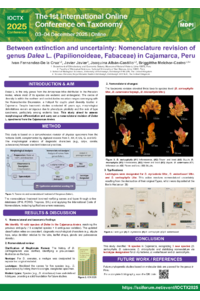
Dalea L. is the only genus from the Amorpheae tribe distributed in the Peruvian Andes, where most of its species are endemic and endangered. The centre of diversity is within northern and central Andes mountain ranges converging with the Huancabamba Depression, a hotspot for cryptic plant diversity located in Cajamarca. Despite taxonomic studies conducted 40 years ago, morphological delimitations remain ambiguous due to phenotypic plasticity and the lack of type specimens, particularly among endemic taxa. This study aimed to assess morphological differentiation and carry out a nomenclatural revision of Dalea L. (13 species and 8 varieties) from the Cajamarcan Andes. As a result, we identifies 16 species in Cajamarca, based on distinctive morphological characters, including in stipule type; leaflet shape, pubescence density and number; inflorescence type; bract morphology; length of calyx distal tooth relative to its tube; number of glands per intercostal margin of the calyx; and fruit morphology. Nomenclatural changes were proposed for certain infraspecific taxa through their elevation to species rank, establishing: D. sericophylla Ulbr., D. cutervoana Szyszyl. and D. microphylla Kunth. The remainig varieties were reduced to synonymy under their respective species. Additionally, lectotypifications were carried out for the species D. myriadenia Ulbr., D. sericophylla Ulbr. and D. weberbaueri Ulbr., due to the loss of their holotypes which had been deposited at the Berlin Herbarium.
Keywords
Leguminosae
Andes
Amorpheae
endemic flora
taxonomy
Oral Presentation
Between extinction and uncertainty_ Nomenclature revision of genus Dalea L. (Papilionoideae, Fabaceae) in Cajamarca, Peru.pptx.pdf
Poster
Between extinction and uncertainty_ Nomenclature revision of genus Dalea L. (Papilionoideae, Fabaceae) in Cajamarca, Peru.pptx.pdf
Exploring Chiococceae (Rubiaceae) in Mexico: Morphology, Diversity, and Endemism Uncovered
Uncovering karyotype and phylogenetic diversity within the North African Allium subgenus Amerallium Traub: Insights on taxonomy and evolution.