Event submissions
Published
This submission belongs to the session S3. Animal Taxonomy of the event The 1st International Online Conference on Taxonomy
Published date
01 Dec, 2025
Academic Editor
'%3e%3cpath%20d='M12.6657%2010.9104C12.4185%2010.325%2012.0599%209.79327%2011.6097%209.34482C11.1609%208.89508%2010.6293%208.5365%2010.0442%208.28888C10.0389%208.28626%2010.0337%208.28495%2010.0285%208.28233C10.8446%207.69279%2011.3752%206.73249%2011.3752%205.64904C11.3752%203.8542%209.92103%202.39999%208.1262%202.39999C6.33136%202.39999%204.87715%203.8542%204.87715%205.64904C4.87715%206.73249%205.40774%207.69279%206.22393%208.28364C6.21869%208.28626%206.21345%208.28757%206.20821%208.29019C5.62129%208.5378%205.09463%208.89284%204.64265%209.34613C4.1929%209.79493%203.83432%2010.3266%203.58671%2010.9117C3.34345%2011.4845%203.21226%2012.0987%203.20023%2012.7209C3.19988%2012.7349%203.20233%2012.7488%203.20744%2012.7619C3.21255%2012.7749%203.22022%2012.7867%203.22998%2012.7968C3.23975%2012.8068%203.25142%2012.8147%203.26431%2012.8202C3.2772%2012.8256%203.29105%2012.8284%203.30504%2012.8284H4.09109C4.14874%2012.8284%204.19459%2012.7825%204.1959%2012.7262C4.2221%2011.7148%204.62823%2010.7676%205.34617%2010.0497C6.08899%209.30683%207.0755%208.89808%208.1262%208.89808C9.17689%208.89808%2010.1634%209.30683%2010.9062%2010.0497C11.6242%2010.7676%2012.0303%2011.7148%2012.0565%2012.7262C12.0578%2012.7838%2012.1037%2012.8284%2012.1613%2012.8284H12.9474C12.9613%2012.8284%2012.9752%2012.8256%2012.9881%2012.8202C13.001%2012.8147%2013.0126%2012.8068%2013.0224%2012.7968C13.0322%2012.7867%2013.0398%2012.7749%2013.0449%2012.7619C13.0501%2012.7488%2013.0525%2012.7349%2013.0522%2012.7209C13.0391%2012.0947%2012.9094%2011.4855%2012.6657%2010.9104ZM8.1262%207.9024C7.52486%207.9024%206.9589%207.6679%206.53312%207.24211C6.10733%206.81633%205.87283%206.25037%205.87283%205.64904C5.87283%205.0477%206.10733%204.48174%206.53312%204.05596C6.9589%203.63018%207.52486%203.39567%208.1262%203.39567C8.72753%203.39567%209.29349%203.63018%209.71927%204.05596C10.1451%204.48174%2010.3796%205.0477%2010.3796%205.64904C10.3796%206.25037%2010.1451%206.81633%209.71927%207.24211C9.29349%207.6679%208.72753%207.9024%208.1262%207.9024Z'%20fill='%235D1EE1'/%3e%3c/g%3e%3c/svg%3e) Mathias Harzhauser
Mathias HarzhauserCitation
TOJI THOMAS, E M Abdussamad, Badarul Sijad, COI-Based Phylogenetic Analysis Uncovers Cryptic Speciation and Misidentification in the Genus Dermogenys (Teleostei: Zenarchopteridae), in Proceedings of The 1st International Online Conference on Taxonomy, 3 December–4 December 2025, MDPI: Basel, Switzerland
Share
Email
Facebook
Twitter
LinkedIn
COI-Based Phylogenetic Analysis Uncovers Cryptic Speciation and Misidentification in the Genus Dermogenys (Teleostei: Zenarchopteridae)
'%3e%3cpath%20d='M12.6647%2010.9104C12.4176%2010.325%2012.0589%209.7933%2011.6088%209.34485C11.16%208.89511%2010.6283%208.53653%2010.0432%208.28891C10.038%208.28629%2010.0327%208.28498%2010.0275%208.28236C10.8437%207.69282%2011.3743%206.73252%2011.3743%205.64907C11.3743%203.85423%209.92005%202.40002%208.12522%202.40002C6.33038%202.40002%204.87618%203.85423%204.87618%205.64907C4.87618%206.73252%205.40677%207.69282%206.22296%208.28367C6.21772%208.28629%206.21248%208.2876%206.20724%208.29022C5.62031%208.53783%205.09365%208.89287%204.64167%209.34616C4.19192%209.79496%203.83334%2010.3266%203.58573%2010.9117C3.34247%2011.4846%203.21128%2012.0987%203.19925%2012.721C3.1989%2012.735%203.20135%2012.7489%203.20646%2012.7619C3.21157%2012.7749%203.21924%2012.7868%203.22901%2012.7968C3.23877%2012.8068%203.25045%2012.8148%203.26334%2012.8202C3.27623%2012.8256%203.29007%2012.8284%203.30406%2012.8284H4.09012C4.14776%2012.8284%204.19362%2012.7825%204.19493%2012.7262C4.22113%2011.7148%204.62726%2010.7676%205.34519%2010.0497C6.08802%209.30686%207.07452%208.89811%208.12522%208.89811C9.17592%208.89811%2010.1624%209.30686%2010.9052%2010.0497C11.6232%2010.7676%2012.0293%2011.7148%2012.0555%2012.7262C12.0568%2012.7839%2012.1027%2012.8284%2012.1603%2012.8284H12.9464C12.9604%2012.8284%2012.9742%2012.8256%2012.9871%2012.8202C13%2012.8148%2013.0117%2012.8068%2013.0214%2012.7968C13.0312%2012.7868%2013.0389%2012.7749%2013.044%2012.7619C13.0491%2012.7489%2013.0515%2012.735%2013.0512%2012.721C13.0381%2012.0947%2012.9084%2011.4856%2012.6647%2010.9104ZM8.12522%207.90243C7.52388%207.90243%206.95792%207.66793%206.53214%207.24215C6.10636%206.81636%205.87185%206.2504%205.87185%205.64907C5.87185%205.04773%206.10636%204.48177%206.53214%204.05599C6.95792%203.63021%207.52388%203.3957%208.12522%203.3957C8.72655%203.3957%209.29252%203.63021%209.7183%204.05599C10.1441%204.48177%2010.3786%205.04773%2010.3786%205.64907C10.3786%206.2504%2010.1441%206.81636%209.7183%207.24215C9.29252%207.66793%208.72655%207.90243%208.12522%207.90243Z'%20fill='%235D1EE1'/%3e%3c/g%3e%3c/svg%3e)
TOJI THOMAS 1,2
E M Abdussamad 1
Badarul Sijad 1
1. Finfish Fisheries Division, ICAR- CMFRI (Central Marine Fisheries Research Institute), Kochi- 682018, Kerala, India, India
2. Department of Biosciences, Mangalore University, Mangalagangothri- 574199, Karnataka, India
Abstract
Introduction
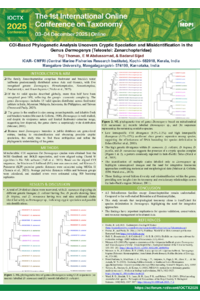
The family Zenarchopteridae, comprising freshwater and brackish water halfbeaks, is restricted to Asia and Oceania and includes five genera: Dermogenys, Hemirhamphodon, Nomorhamphus, Tondanichthys, and Zenarchopterus. Of the 64 valid species, over half were described after 1950, reflecting considerable taxonomic complexity. The genus Dermogenys contains 13 species found in freshwater habitats across South and Southeast Asia. Despite this diversity, molecular studies are limited and indicate the presence of cryptic speciation. This study explores the barcode library for Zenarchopteridae, demonstrates the efficacy of DNA barcoding techniques for differentiating Dermogenys species, and demonstrates the potential thereof in species discovery.
Methods
In this study, mitochondrial Cytochrome Oxidase subunit I (COI) gene sequences obtained from publicly available databases were analysed to evaluate species-level diversity and phylogenetic relationships within Dermogenys. Maximum Likelihood analysis for reconstructing the phylogenetic tree and mean genetic distances were calculated using MEGA X.
Results
The resulting phylogenetic tree uncovered significant incongruence between morphological identification and genetic clustering. A total of 29 distinct clades were recovered, with D. siamensis and D. collettei each displaying six different genetic lineages; D. bispina and D. pusilla showing three; D. sumatrana having two; and nine additional clades identified solely as Dermogenys sp., indicating cryptic speciation and possible misidentifications. A minimum genetic divergence threshold of approximately 2% in COI sequences, commonly used for species delineation in teleost fishes, supports the presence of cryptic taxa within the group.
Conclusion
All Beloniformes families except Scomberesocidae have been recorded from Indian waters. Compared to the well-studied Belonidae and Hemiramphidae, Zenarchopteridae remains understudied, with the genus Dermogenys represented by only one species, D. brachynotopterus. This study reveals that morphological taxonomy alone is insufficient for species delimitation in Dermogenys, highlighting the need for integrative approaches. The findings have important implications for species validation, conservation, and resource management in Southeast Asia.
Keywords
Molecular taxonomy
halfbeaks
southeast Asia
freshwater
Phylogenetic analysis
Poster
Toji Thomas- IOCT.pdf
Integrative taxonomic assessment of Cruzia sp. (Nematoda: Cosmocercoidea, Kathlaniidae) from the Argentine black and white tegu lizard: insights into the long-standing Kathlaniidae taxonomic puzzle
The taxonomic robustness and complementarity of eDNA metabarcoding provide an effective fish biodiversity assessment in the offshore Colombian Eastern Tropical Pacific