Event submissions
Published
This submission belongs to the session S2. Nanosciences, Chemistry and Materials Science of the event The 6th International Electronic Conference on Applied Sciences
Published date
03 Dec, 2025
Academic Editor
'%3e%3cpath%20d='M12.6657%2010.9104C12.4185%2010.325%2012.0599%209.79327%2011.6097%209.34482C11.1609%208.89508%2010.6293%208.5365%2010.0442%208.28888C10.0389%208.28626%2010.0337%208.28495%2010.0285%208.28233C10.8446%207.69279%2011.3752%206.73249%2011.3752%205.64904C11.3752%203.8542%209.92103%202.39999%208.1262%202.39999C6.33136%202.39999%204.87715%203.8542%204.87715%205.64904C4.87715%206.73249%205.40774%207.69279%206.22393%208.28364C6.21869%208.28626%206.21345%208.28757%206.20821%208.29019C5.62129%208.5378%205.09463%208.89284%204.64265%209.34613C4.1929%209.79493%203.83432%2010.3266%203.58671%2010.9117C3.34345%2011.4845%203.21226%2012.0987%203.20023%2012.7209C3.19988%2012.7349%203.20233%2012.7488%203.20744%2012.7619C3.21255%2012.7749%203.22022%2012.7867%203.22998%2012.7968C3.23975%2012.8068%203.25142%2012.8147%203.26431%2012.8202C3.2772%2012.8256%203.29105%2012.8284%203.30504%2012.8284H4.09109C4.14874%2012.8284%204.19459%2012.7825%204.1959%2012.7262C4.2221%2011.7148%204.62823%2010.7676%205.34617%2010.0497C6.08899%209.30683%207.0755%208.89808%208.1262%208.89808C9.17689%208.89808%2010.1634%209.30683%2010.9062%2010.0497C11.6242%2010.7676%2012.0303%2011.7148%2012.0565%2012.7262C12.0578%2012.7838%2012.1037%2012.8284%2012.1613%2012.8284H12.9474C12.9613%2012.8284%2012.9752%2012.8256%2012.9881%2012.8202C13.001%2012.8147%2013.0126%2012.8068%2013.0224%2012.7968C13.0322%2012.7867%2013.0398%2012.7749%2013.0449%2012.7619C13.0501%2012.7488%2013.0525%2012.7349%2013.0522%2012.7209C13.0391%2012.0947%2012.9094%2011.4855%2012.6657%2010.9104ZM8.1262%207.9024C7.52486%207.9024%206.9589%207.6679%206.53312%207.24211C6.10733%206.81633%205.87283%206.25037%205.87283%205.64904C5.87283%205.0477%206.10733%204.48174%206.53312%204.05596C6.9589%203.63018%207.52486%203.39567%208.1262%203.39567C8.72753%203.39567%209.29349%203.63018%209.71927%204.05596C10.1451%204.48174%2010.3796%205.0477%2010.3796%205.64904C10.3796%206.25037%2010.1451%206.81633%209.71927%207.24211C9.29349%207.6679%208.72753%207.9024%208.1262%207.9024Z'%20fill='%235D1EE1'/%3e%3c/g%3e%3c/svg%3e) Alberto Jiménez Suárez
Alberto Jiménez SuárezCitation
Patrycja Kula, Izabela Barszczewska-Rybarek, Modification of acrylamide-N,N'-methylenebisacrylamide hydrogel with quaternary ammonium monomethacrylate., in Proceedings of The 6th International Electronic Conference on Applied Sciences, 9 December–11 December 2025, MDPI: Basel, Switzerland
Share
Email
Facebook
Twitter
LinkedIn
Modification of acrylamide-N,N'-methylenebisacrylamide hydrogel with quaternary ammonium monomethacrylate.
'%3e%3cpath%20d='M12.6647%2010.9104C12.4176%2010.325%2012.0589%209.7933%2011.6088%209.34485C11.16%208.89511%2010.6283%208.53653%2010.0432%208.28891C10.038%208.28629%2010.0327%208.28498%2010.0275%208.28236C10.8437%207.69282%2011.3743%206.73252%2011.3743%205.64907C11.3743%203.85423%209.92005%202.40002%208.12522%202.40002C6.33038%202.40002%204.87618%203.85423%204.87618%205.64907C4.87618%206.73252%205.40677%207.69282%206.22296%208.28367C6.21772%208.28629%206.21248%208.2876%206.20724%208.29022C5.62031%208.53783%205.09365%208.89287%204.64167%209.34616C4.19192%209.79496%203.83334%2010.3266%203.58573%2010.9117C3.34247%2011.4846%203.21128%2012.0987%203.19925%2012.721C3.1989%2012.735%203.20135%2012.7489%203.20646%2012.7619C3.21157%2012.7749%203.21924%2012.7868%203.22901%2012.7968C3.23877%2012.8068%203.25045%2012.8148%203.26334%2012.8202C3.27623%2012.8256%203.29007%2012.8284%203.30406%2012.8284H4.09012C4.14776%2012.8284%204.19362%2012.7825%204.19493%2012.7262C4.22113%2011.7148%204.62726%2010.7676%205.34519%2010.0497C6.08802%209.30686%207.07452%208.89811%208.12522%208.89811C9.17592%208.89811%2010.1624%209.30686%2010.9052%2010.0497C11.6232%2010.7676%2012.0293%2011.7148%2012.0555%2012.7262C12.0568%2012.7839%2012.1027%2012.8284%2012.1603%2012.8284H12.9464C12.9604%2012.8284%2012.9742%2012.8256%2012.9871%2012.8202C13%2012.8148%2013.0117%2012.8068%2013.0214%2012.7968C13.0312%2012.7868%2013.0389%2012.7749%2013.044%2012.7619C13.0491%2012.7489%2013.0515%2012.735%2013.0512%2012.721C13.0381%2012.0947%2012.9084%2011.4856%2012.6647%2010.9104ZM8.12522%207.90243C7.52388%207.90243%206.95792%207.66793%206.53214%207.24215C6.10636%206.81636%205.87185%206.2504%205.87185%205.64907C5.87185%205.04773%206.10636%204.48177%206.53214%204.05599C6.95792%203.63021%207.52388%203.3957%208.12522%203.3957C8.72655%203.3957%209.29252%203.63021%209.7183%204.05599C10.1441%204.48177%2010.3786%205.04773%2010.3786%205.64907C10.3786%206.2504%2010.1441%206.81636%209.7183%207.24215C9.29252%207.66793%208.72655%207.90243%208.12522%207.90243Z'%20fill='%235D1EE1'/%3e%3c/g%3e%3c/svg%3e)
Patrycja Kula 1

Izabela Barszczewska-Rybarek 1
1. Department of Physical Chemistry and Technology of Polymers, Faculty of Chemistry, Silesian University of Technology, Gliwice, Poland, Poland
Abstract
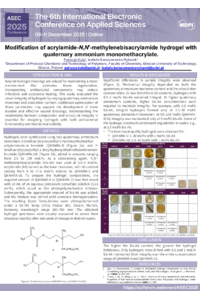
Introduction: Wound hydrogel dressings are valued for maintaining a moist environment that promotes tissue regeneration. Incorporating antibacterial components may reduce infections and accelerate healing. This study evaluated the visual integrity of hydrogels by varying quaternary ammonium monomer and crosslinker content.
Methods: As monomers containing quaternary ammonium groups, 2-(methacryloyloxy)ethyl-2-hydroxyethylmethyloctylammonium bromide (QAHAMA-8) and 2-(methacryloyloxy)ethyl-2-decylhydroxyethylmethylammonium bromide (QAHAMA-10) were used in amounts ranging from 2.5 to 100 mol.%. As the crosslinker N,N′-methylenebisacrylamide (bis-AA) was used, and its content ranged from 0.5 to 5 mol.%. As the basic monomer acrylamide (AA) was used, and its content ranged from 0 to 97.5 mol.%, in respect to QAHAMA-10.
Results: Significant differences in sample integrity were observed. The mechanical integrity of the obtained hydrogels depended on both cross-link density and the content of quaternary ammonium monomer. At lower QAHAMA-8 and QAHAMA-10 contents, hydrogels with lower cross-linker amount, i.e., 0.5 and 1 mol.%, were integral. At higher QAHAMA-8 and QAHAMA-10 contents, hydrogels cross-linked with higher bis-AA contents were more integral. For example, for 0.5 mol.% bis-AA integral hydrogels were obtained for 2.5 mol.% to 10 mol.%, whereas for 50 and 100 mol.% of the quaternary ammonium monomer, integral hydrogels were obtained for 5 mol.% bis-AA. Overall, hydrogels of the higher visual quality were obtained for 1 mol.% of bis-AA and quaternary ammonium monomer for 5 mol.% to 30 mol.% (QAHAMA-8) and for 2.5 mol.% to 30 mol.% (QAHAMA-10).
Conclusions: The higher the bis-AA content, the greater the hydrogel brittleness. Only hydrogels cross-linked with 0.5 and 1 mol.% bis AA maintained their integrity over the entire concentration range of QAHAMA-8 and QAHAMA-10.
Keywords
hydrogels
quaternary ammonium group
crosslinking
photopolymerization.
Poster
poster MDPI.pdf
Therapeutic Opportunities in Disorder: Integrated Analysis of Cancer-Linked IDPs Reveals Druggable Motifs and Interaction Hubs
Duplex biocomposites with high sorption and antipathogen activity via surface immobilization of chitosan onto a modified carbonaceous substrates