Event submissions
Published
This submission belongs to the session S1. Applied Biosciences and Bioengineering of the event The 6th International Electronic Conference on Applied Sciences
Published date
03 Dec, 2025
Academic Editor
'%3e%3cpath%20d='M12.6657%2010.9104C12.4185%2010.325%2012.0599%209.79327%2011.6097%209.34482C11.1609%208.89508%2010.6293%208.5365%2010.0442%208.28888C10.0389%208.28626%2010.0337%208.28495%2010.0285%208.28233C10.8446%207.69279%2011.3752%206.73249%2011.3752%205.64904C11.3752%203.8542%209.92103%202.39999%208.1262%202.39999C6.33136%202.39999%204.87715%203.8542%204.87715%205.64904C4.87715%206.73249%205.40774%207.69279%206.22393%208.28364C6.21869%208.28626%206.21345%208.28757%206.20821%208.29019C5.62129%208.5378%205.09463%208.89284%204.64265%209.34613C4.1929%209.79493%203.83432%2010.3266%203.58671%2010.9117C3.34345%2011.4845%203.21226%2012.0987%203.20023%2012.7209C3.19988%2012.7349%203.20233%2012.7488%203.20744%2012.7619C3.21255%2012.7749%203.22022%2012.7867%203.22998%2012.7968C3.23975%2012.8068%203.25142%2012.8147%203.26431%2012.8202C3.2772%2012.8256%203.29105%2012.8284%203.30504%2012.8284H4.09109C4.14874%2012.8284%204.19459%2012.7825%204.1959%2012.7262C4.2221%2011.7148%204.62823%2010.7676%205.34617%2010.0497C6.08899%209.30683%207.0755%208.89808%208.1262%208.89808C9.17689%208.89808%2010.1634%209.30683%2010.9062%2010.0497C11.6242%2010.7676%2012.0303%2011.7148%2012.0565%2012.7262C12.0578%2012.7838%2012.1037%2012.8284%2012.1613%2012.8284H12.9474C12.9613%2012.8284%2012.9752%2012.8256%2012.9881%2012.8202C13.001%2012.8147%2013.0126%2012.8068%2013.0224%2012.7968C13.0322%2012.7867%2013.0398%2012.7749%2013.0449%2012.7619C13.0501%2012.7488%2013.0525%2012.7349%2013.0522%2012.7209C13.0391%2012.0947%2012.9094%2011.4855%2012.6657%2010.9104ZM8.1262%207.9024C7.52486%207.9024%206.9589%207.6679%206.53312%207.24211C6.10733%206.81633%205.87283%206.25037%205.87283%205.64904C5.87283%205.0477%206.10733%204.48174%206.53312%204.05596C6.9589%203.63018%207.52486%203.39567%208.1262%203.39567C8.72753%203.39567%209.29349%203.63018%209.71927%204.05596C10.1451%204.48174%2010.3796%205.0477%2010.3796%205.64904C10.3796%206.25037%2010.1451%206.81633%209.71927%207.24211C9.29349%207.6679%208.72753%207.9024%208.1262%207.9024Z'%20fill='%235D1EE1'/%3e%3c/g%3e%3c/svg%3e) Roger Narayan
Roger NarayanCitation
Sheetal Sandip Buddhadev, Dave Purva, Jhanvi Chauhan, Belim Sahir, Maheta Shivam, Meghnathi Omishgiri, Epigenetic Switches for Next‑Generation Genomic Intervention: From Synthetic Biology to Personalized Medicine, in Proceedings of The 6th International Electronic Conference on Applied Sciences, 9 December–11 December 2025, MDPI: Basel, Switzerland
Share
Email
Facebook
Twitter
LinkedIn
Epigenetic Switches for Next‑Generation Genomic Intervention: From Synthetic Biology to Personalized Medicine

Sheetal Sandip Buddhadev 1
'%3e%3cpath%20d='M12.6647%2010.9104C12.4176%2010.325%2012.0589%209.7933%2011.6088%209.34485C11.16%208.89511%2010.6283%208.53653%2010.0432%208.28891C10.038%208.28629%2010.0327%208.28498%2010.0275%208.28236C10.8437%207.69282%2011.3743%206.73252%2011.3743%205.64907C11.3743%203.85423%209.92005%202.40002%208.12522%202.40002C6.33038%202.40002%204.87618%203.85423%204.87618%205.64907C4.87618%206.73252%205.40677%207.69282%206.22296%208.28367C6.21772%208.28629%206.21248%208.2876%206.20724%208.29022C5.62031%208.53783%205.09365%208.89287%204.64167%209.34616C4.19192%209.79496%203.83334%2010.3266%203.58573%2010.9117C3.34247%2011.4846%203.21128%2012.0987%203.19925%2012.721C3.1989%2012.735%203.20135%2012.7489%203.20646%2012.7619C3.21157%2012.7749%203.21924%2012.7868%203.22901%2012.7968C3.23877%2012.8068%203.25045%2012.8148%203.26334%2012.8202C3.27623%2012.8256%203.29007%2012.8284%203.30406%2012.8284H4.09012C4.14776%2012.8284%204.19362%2012.7825%204.19493%2012.7262C4.22113%2011.7148%204.62726%2010.7676%205.34519%2010.0497C6.08802%209.30686%207.07452%208.89811%208.12522%208.89811C9.17592%208.89811%2010.1624%209.30686%2010.9052%2010.0497C11.6232%2010.7676%2012.0293%2011.7148%2012.0555%2012.7262C12.0568%2012.7839%2012.1027%2012.8284%2012.1603%2012.8284H12.9464C12.9604%2012.8284%2012.9742%2012.8256%2012.9871%2012.8202C13%2012.8148%2013.0117%2012.8068%2013.0214%2012.7968C13.0312%2012.7868%2013.0389%2012.7749%2013.044%2012.7619C13.0491%2012.7489%2013.0515%2012.735%2013.0512%2012.721C13.0381%2012.0947%2012.9084%2011.4856%2012.6647%2010.9104ZM8.12522%207.90243C7.52388%207.90243%206.95792%207.66793%206.53214%207.24215C6.10636%206.81636%205.87185%206.2504%205.87185%205.64907C5.87185%205.04773%206.10636%204.48177%206.53214%204.05599C6.95792%203.63021%207.52388%203.3957%208.12522%203.3957C8.72655%203.3957%209.29252%203.63021%209.7183%204.05599C10.1441%204.48177%2010.3786%205.04773%2010.3786%205.64907C10.3786%206.2504%2010.1441%206.81636%209.7183%207.24215C9.29252%207.66793%208.72655%207.90243%208.12522%207.90243Z'%20fill='%235D1EE1'/%3e%3c/g%3e%3c/svg%3e)
Dave Purva 1
Jhanvi Chauhan 1
Belim Sahir 1

Maheta Shivam 1
Meghnathi Omishgiri 1
1. Faculty of Pharmacy, Noble University, Junagadh, Gujarat, 362310, India, India
Abstract
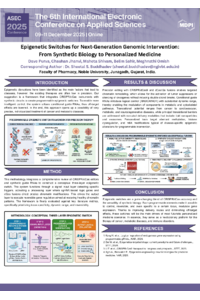
Epigenetic engineering is a novel aspect of genomic control, which makes such regulation with precision, programmability, and reversibility capable of controlling gene expression far beyond the capabilities of other genome methods. The method is essential to the development of personalized medicine, synthetic biology, and functional genomics in that it allows for a change in chromatin states without causing permanent changes to DNA, so it may potentially address irreversible mutagenesis.
Programmable proteins (such as deactivated Cas9 (dCas9), zinc-finger domains, and TALE fusions) are used as epigenetic switches to activate or silence epigenetic marks to create tunable and heritable gene expression. Experimental evidence of Saccharomyces cerevisiae has shown that epigenetic switching provides a selective benefit during unstable environments by swapping cellular identity states as fast as possible by switching the expression state of genes, but also adapts cellular identity in genetic silence by avoiding genetic mutations. Modular CRISPR-dCas9 systems have been used to target methylation and demethylation stability at specific loci within genomic systems (e.g., BACH2, HNF1A, IL6ST, MGAT3) to induce long-lasting transcriptional effects up to 30 days following transfection in mammalian systems. Also, optimization of dCas9-fusion protein expression reduces off-target epigenomic activities, thus increasing specificity and biosafety.
All this evidence shows that combinatorially designed high-resolution epigenetic switches coupled with advances in synthetic biology revolutionize genomic interventions. The modality is a safer, reversible, and more accurate modality for personalized therapies and disease modeling, as well as more flexible and specific synthetic biology applications due to higher functional flexibility and specificity.
Keywords
Epigenetic Engineering
CRISPR/dCas9
Programmable Gene Regulation
Epigenetic Switching
Personalized Medicine.
Oral Presentation
Epigenetic final (1).pdf
Poster
Epigenetic final.pdf
Multi-trophic-level toxicity assessment of selected bromophenols
Adaptive Neuro-Fuzzy Control of a Small Wind Turbine Integrated with Battery Storage for Remote Villages in Uzbekistan