Event submissions
Published
This submission belongs to the session S1. Applied Biosciences and Bioengineering of the event The 6th International Electronic Conference on Applied Sciences
Published date
03 Dec, 2025
Academic Editor
'%3e%3cpath%20d='M12.6657%2010.9104C12.4185%2010.325%2012.0599%209.79327%2011.6097%209.34482C11.1609%208.89508%2010.6293%208.5365%2010.0442%208.28888C10.0389%208.28626%2010.0337%208.28495%2010.0285%208.28233C10.8446%207.69279%2011.3752%206.73249%2011.3752%205.64904C11.3752%203.8542%209.92103%202.39999%208.1262%202.39999C6.33136%202.39999%204.87715%203.8542%204.87715%205.64904C4.87715%206.73249%205.40774%207.69279%206.22393%208.28364C6.21869%208.28626%206.21345%208.28757%206.20821%208.29019C5.62129%208.5378%205.09463%208.89284%204.64265%209.34613C4.1929%209.79493%203.83432%2010.3266%203.58671%2010.9117C3.34345%2011.4845%203.21226%2012.0987%203.20023%2012.7209C3.19988%2012.7349%203.20233%2012.7488%203.20744%2012.7619C3.21255%2012.7749%203.22022%2012.7867%203.22998%2012.7968C3.23975%2012.8068%203.25142%2012.8147%203.26431%2012.8202C3.2772%2012.8256%203.29105%2012.8284%203.30504%2012.8284H4.09109C4.14874%2012.8284%204.19459%2012.7825%204.1959%2012.7262C4.2221%2011.7148%204.62823%2010.7676%205.34617%2010.0497C6.08899%209.30683%207.0755%208.89808%208.1262%208.89808C9.17689%208.89808%2010.1634%209.30683%2010.9062%2010.0497C11.6242%2010.7676%2012.0303%2011.7148%2012.0565%2012.7262C12.0578%2012.7838%2012.1037%2012.8284%2012.1613%2012.8284H12.9474C12.9613%2012.8284%2012.9752%2012.8256%2012.9881%2012.8202C13.001%2012.8147%2013.0126%2012.8068%2013.0224%2012.7968C13.0322%2012.7867%2013.0398%2012.7749%2013.0449%2012.7619C13.0501%2012.7488%2013.0525%2012.7349%2013.0522%2012.7209C13.0391%2012.0947%2012.9094%2011.4855%2012.6657%2010.9104ZM8.1262%207.9024C7.52486%207.9024%206.9589%207.6679%206.53312%207.24211C6.10733%206.81633%205.87283%206.25037%205.87283%205.64904C5.87283%205.0477%206.10733%204.48174%206.53312%204.05596C6.9589%203.63018%207.52486%203.39567%208.1262%203.39567C8.72753%203.39567%209.29349%203.63018%209.71927%204.05596C10.1451%204.48174%2010.3796%205.0477%2010.3796%205.64904C10.3796%206.25037%2010.1451%206.81633%209.71927%207.24211C9.29349%207.6679%208.72753%207.9024%208.1262%207.9024Z'%20fill='%235D1EE1'/%3e%3c/g%3e%3c/svg%3e) Roger Narayan
Roger NarayanCitation
Martín A. Fernández Baldo, Yuliana García, Matías Regiart, Francisco G. Ortega, Gonzalo R. Tortella, Electrochemical immunosensor for the determination of fibronectin as a breast cancer diagnosis biomarker, in Proceedings of The 6th International Electronic Conference on Applied Sciences, 9 December–11 December 2025, MDPI: Basel, Switzerland
Share
Email
Facebook
Twitter
LinkedIn
Electrochemical immunosensor for the determination of fibronectin as a breast cancer diagnosis biomarker
'%3e%3cpath%20d='M12.6647%2010.9104C12.4176%2010.325%2012.0589%209.7933%2011.6088%209.34485C11.16%208.89511%2010.6283%208.53653%2010.0432%208.28891C10.038%208.28629%2010.0327%208.28498%2010.0275%208.28236C10.8437%207.69282%2011.3743%206.73252%2011.3743%205.64907C11.3743%203.85423%209.92005%202.40002%208.12522%202.40002C6.33038%202.40002%204.87618%203.85423%204.87618%205.64907C4.87618%206.73252%205.40677%207.69282%206.22296%208.28367C6.21772%208.28629%206.21248%208.2876%206.20724%208.29022C5.62031%208.53783%205.09365%208.89287%204.64167%209.34616C4.19192%209.79496%203.83334%2010.3266%203.58573%2010.9117C3.34247%2011.4846%203.21128%2012.0987%203.19925%2012.721C3.1989%2012.735%203.20135%2012.7489%203.20646%2012.7619C3.21157%2012.7749%203.21924%2012.7868%203.22901%2012.7968C3.23877%2012.8068%203.25045%2012.8148%203.26334%2012.8202C3.27623%2012.8256%203.29007%2012.8284%203.30406%2012.8284H4.09012C4.14776%2012.8284%204.19362%2012.7825%204.19493%2012.7262C4.22113%2011.7148%204.62726%2010.7676%205.34519%2010.0497C6.08802%209.30686%207.07452%208.89811%208.12522%208.89811C9.17592%208.89811%2010.1624%209.30686%2010.9052%2010.0497C11.6232%2010.7676%2012.0293%2011.7148%2012.0555%2012.7262C12.0568%2012.7839%2012.1027%2012.8284%2012.1603%2012.8284H12.9464C12.9604%2012.8284%2012.9742%2012.8256%2012.9871%2012.8202C13%2012.8148%2013.0117%2012.8068%2013.0214%2012.7968C13.0312%2012.7868%2013.0389%2012.7749%2013.044%2012.7619C13.0491%2012.7489%2013.0515%2012.735%2013.0512%2012.721C13.0381%2012.0947%2012.9084%2011.4856%2012.6647%2010.9104ZM8.12522%207.90243C7.52388%207.90243%206.95792%207.66793%206.53214%207.24215C6.10636%206.81636%205.87185%206.2504%205.87185%205.64907C5.87185%205.04773%206.10636%204.48177%206.53214%204.05599C6.95792%203.63021%207.52388%203.3957%208.12522%203.3957C8.72655%203.3957%209.29252%203.63021%209.7183%204.05599C10.1441%204.48177%2010.3786%205.04773%2010.3786%205.64907C10.3786%206.2504%2010.1441%206.81636%209.7183%207.24215C9.29252%207.66793%208.72655%207.90243%208.12522%207.90243Z'%20fill='%235D1EE1'/%3e%3c/g%3e%3c/svg%3e)
Yuliana García 1
Matías Regiart 2
Francisco G. Ortega 3,4

Gonzalo R. Tortella 5

Martín A. Fernández Baldo 2
1. Instituto de Química de San Luis, INQUISAL (UNSL - CONICET), Facultad de Química, Bioquímica y Farmacia, Universidad Nacional de San Luis, Av. Ejército de los Andes 950, D5700BWS, San Luis, Argentina., Argentina
2. Facultad de Química, Bioquímica y Farmacia, Instituto de Química de San Luis, INQUISAL (UNSL - CONICET), Universidad Nacional de San Luis, Av. Ejército de los Andes 950, D5700BWS, San Luis, Argentina., Argentina
3. Instituto de Investigación Biosanitaria de Granada (ibs.GRANADA), 18012 Granada, Spain, Spain
4. Center for Genomics and Oncological Research—Centro de Genómica e Investigación Oncológica (GENYO), 18016 Granada, Spain
5. Centro de Excelencia en Investigación Biotecnológica Aplicada al Medio Ambiente (CIBAMA), Facultad de Ingeniería y Ciencias, Universidad de La Frontera, Av. Francisco Salazar 01145, Temuco 4811230, Chile., Chile
Abstract
Introduction: Cancer is one of the leading causes of death worldwide. Deaths from cancer are mainly due to metastasis. The metastatic process involves the spread of cells from the primary tumor to distant locations, either within the same organ or to other organs. This is generally responsible for patient death as it affects the proper functioning of organs. The present work reports an electrochemical immunosensor based on magnetic nanoparticles (MNPs) that can determine the fibronectin (FN) biomarker in epithelial extracellular vesicle (EpEV) patient samples.
Methods: Our method employs MNPs as an immobilization platform. In this work, we report an electrochemical sandwich-type assay for assessing FN + EpEVs in the early stages of breast cancer. Through the immobilization of the monoclonal anti-FN on NH2-MNPs, its incubation with EpEVs, and a conjugated antibody labeled with horseradish peroxidase was performed. The amperometric detection of the affinity reaction was performed using disposable screen-printed carbon electrodes (SPCEs) and the hydroquinone (HQ)/H2O2 system.
Results: The detection limit for the proposed sensor and the commercial ELISA test were 8 pg mL−1 and 0.1 ng mL−1, and the intra- and inter-assay coefficients of variation were below 3.80% and 6.51%, respectively. Moreover, the total analysis time was around 30 minutes.
Conclusions: Our immunosensor could be an interesting analytical tool for breast cancer diagnosis and prognosis.
Keywords
electrochemical immunosensor
magnetic nanoparticles
fibronectin
biomarker
breast cancer
diagnosis
Poster
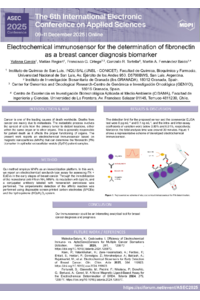
Poster-Yuliana-García.pdf
Comprehensive Characterization of Moringa oleifera from Ghardaïa: Phytochemical Profiling, Antioxidant Capacities, and Antimicrobial Efficacy Against Pathogens Bacterial
Development and characterization of cellulose triacetate-based membranes for water filtration applications