Event submissions
Published
This submission belongs to the session S2. Nanosciences, Chemistry and Materials Science of the event The 6th International Electronic Conference on Applied Sciences
Published date
03 Dec, 2025
Academic Editor
'%3e%3cpath%20d='M12.6657%2010.9104C12.4185%2010.325%2012.0599%209.79327%2011.6097%209.34482C11.1609%208.89508%2010.6293%208.5365%2010.0442%208.28888C10.0389%208.28626%2010.0337%208.28495%2010.0285%208.28233C10.8446%207.69279%2011.3752%206.73249%2011.3752%205.64904C11.3752%203.8542%209.92103%202.39999%208.1262%202.39999C6.33136%202.39999%204.87715%203.8542%204.87715%205.64904C4.87715%206.73249%205.40774%207.69279%206.22393%208.28364C6.21869%208.28626%206.21345%208.28757%206.20821%208.29019C5.62129%208.5378%205.09463%208.89284%204.64265%209.34613C4.1929%209.79493%203.83432%2010.3266%203.58671%2010.9117C3.34345%2011.4845%203.21226%2012.0987%203.20023%2012.7209C3.19988%2012.7349%203.20233%2012.7488%203.20744%2012.7619C3.21255%2012.7749%203.22022%2012.7867%203.22998%2012.7968C3.23975%2012.8068%203.25142%2012.8147%203.26431%2012.8202C3.2772%2012.8256%203.29105%2012.8284%203.30504%2012.8284H4.09109C4.14874%2012.8284%204.19459%2012.7825%204.1959%2012.7262C4.2221%2011.7148%204.62823%2010.7676%205.34617%2010.0497C6.08899%209.30683%207.0755%208.89808%208.1262%208.89808C9.17689%208.89808%2010.1634%209.30683%2010.9062%2010.0497C11.6242%2010.7676%2012.0303%2011.7148%2012.0565%2012.7262C12.0578%2012.7838%2012.1037%2012.8284%2012.1613%2012.8284H12.9474C12.9613%2012.8284%2012.9752%2012.8256%2012.9881%2012.8202C13.001%2012.8147%2013.0126%2012.8068%2013.0224%2012.7968C13.0322%2012.7867%2013.0398%2012.7749%2013.0449%2012.7619C13.0501%2012.7488%2013.0525%2012.7349%2013.0522%2012.7209C13.0391%2012.0947%2012.9094%2011.4855%2012.6657%2010.9104ZM8.1262%207.9024C7.52486%207.9024%206.9589%207.6679%206.53312%207.24211C6.10733%206.81633%205.87283%206.25037%205.87283%205.64904C5.87283%205.0477%206.10733%204.48174%206.53312%204.05596C6.9589%203.63018%207.52486%203.39567%208.1262%203.39567C8.72753%203.39567%209.29349%203.63018%209.71927%204.05596C10.1451%204.48174%2010.3796%205.0477%2010.3796%205.64904C10.3796%206.25037%2010.1451%206.81633%209.71927%207.24211C9.29349%207.6679%208.72753%207.9024%208.1262%207.9024Z'%20fill='%235D1EE1'/%3e%3c/g%3e%3c/svg%3e) Alberto Jiménez Suárez
Alberto Jiménez SuárezCitation
Irina Kaurova, Anton Mushtakov, Daniil Valeshny, Viktor Demin, Galina Kuz’micheva, Ekaterina Markova, Four-component substitutional solid solutions of metal–organic frameworks with rare earth metal ions, in Proceedings of The 6th International Electronic Conference on Applied Sciences, 9 December–11 December 2025, MDPI: Basel, Switzerland
Share
Email
Facebook
Twitter
LinkedIn
Four-component substitutional solid solutions of metal–organic frameworks with rare earth metal ions
'%3e%3cpath%20d='M12.6647%2010.9104C12.4176%2010.325%2012.0589%209.7933%2011.6088%209.34485C11.16%208.89511%2010.6283%208.53653%2010.0432%208.28891C10.038%208.28629%2010.0327%208.28498%2010.0275%208.28236C10.8437%207.69282%2011.3743%206.73252%2011.3743%205.64907C11.3743%203.85423%209.92005%202.40002%208.12522%202.40002C6.33038%202.40002%204.87618%203.85423%204.87618%205.64907C4.87618%206.73252%205.40677%207.69282%206.22296%208.28367C6.21772%208.28629%206.21248%208.2876%206.20724%208.29022C5.62031%208.53783%205.09365%208.89287%204.64167%209.34616C4.19192%209.79496%203.83334%2010.3266%203.58573%2010.9117C3.34247%2011.4846%203.21128%2012.0987%203.19925%2012.721C3.1989%2012.735%203.20135%2012.7489%203.20646%2012.7619C3.21157%2012.7749%203.21924%2012.7868%203.22901%2012.7968C3.23877%2012.8068%203.25045%2012.8148%203.26334%2012.8202C3.27623%2012.8256%203.29007%2012.8284%203.30406%2012.8284H4.09012C4.14776%2012.8284%204.19362%2012.7825%204.19493%2012.7262C4.22113%2011.7148%204.62726%2010.7676%205.34519%2010.0497C6.08802%209.30686%207.07452%208.89811%208.12522%208.89811C9.17592%208.89811%2010.1624%209.30686%2010.9052%2010.0497C11.6232%2010.7676%2012.0293%2011.7148%2012.0555%2012.7262C12.0568%2012.7839%2012.1027%2012.8284%2012.1603%2012.8284H12.9464C12.9604%2012.8284%2012.9742%2012.8256%2012.9871%2012.8202C13%2012.8148%2013.0117%2012.8068%2013.0214%2012.7968C13.0312%2012.7868%2013.0389%2012.7749%2013.044%2012.7619C13.0491%2012.7489%2013.0515%2012.735%2013.0512%2012.721C13.0381%2012.0947%2012.9084%2011.4856%2012.6647%2010.9104ZM8.12522%207.90243C7.52388%207.90243%206.95792%207.66793%206.53214%207.24215C6.10636%206.81636%205.87185%206.2504%205.87185%205.64907C5.87185%205.04773%206.10636%204.48177%206.53214%204.05599C6.95792%203.63021%207.52388%203.3957%208.12522%203.3957C8.72655%203.3957%209.29252%203.63021%209.7183%204.05599C10.1441%204.48177%2010.3786%205.04773%2010.3786%205.64907C10.3786%206.2504%2010.1441%206.81636%209.7183%207.24215C9.29252%207.66793%208.72655%207.90243%208.12522%207.90243Z'%20fill='%235D1EE1'/%3e%3c/g%3e%3c/svg%3e)
Anton Mushtakov 1,2
Daniil Valeshny 3
Viktor Demin 4

Irina Kaurova 3

Galina Kuz’micheva 3
Ekaterina Markova 1,2
1. Peoples' Friendship University of Russia, 6 Miklukho-Maklaya st., Moscow 117198, Russia, Russia
2. MIREA - Russian Technological University, Vernadsky pr., 78, Moscow, 119454, Russia
3. MIREA - Russian Technological University, Vernadsky pr., 78, Moscow, 119454, Russia, Russia
4. A. N. Frumkin Institute of Physical Chemistry and Electrochemistry of Russian Academy of Sciences, 31 Leninsky av., Moscow 119071, Russia, Russia
Abstract
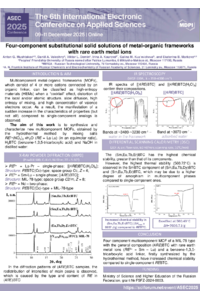
Multicomponent substitutional solid solutions with several ions with similar crystal-chemical properties in one site exhibit property characteristics significantly exceeding those of single-component compounds. Interest is currently focused on metal–organic frameworks (MOFs), which consist of cations connected by an organic linker. The aim is to synthesize and characterize new multicomponent MOFs, obtained using a hydrothermal method by mixing RE3+(NO3)3·xH2O (RE=La-Lu), H3BTC (benzene-1,3,5-tricarboxylic acid), and NaOH in distilled water.
XRPD showed that single-phase (Eu,Tb,Dy,Er)BTC, (Sm,Eu,Tb,Dy)BTC, and (Sm,Eu,Tb,Er)ВТС crystallize in MIL-78-type (sp.gr. C2/m, Z=4; [(4RE)BTC]) and two-phase samples (usually with adding RE=La-Pr) and have REBTC(Сс) (sp.gr. Сс, Z=4; [(4RE)BTC(H2O)6]) and MIL-78 structures. In diffraction patterns of (4RE)BTC, redistribution of the intensities of main peaks is observed, which is caused by the type and content of RE in (4RE)BTC.
IR spectra of [(4RE)BTC] and [(4RE)BTC(H2O)6] confirm their compositions: the weak band at ~3070 cm-1 and weak bands ~3480-~3230 cm-1 correspond to adsorbed water and water in the framework, respectively.
According to DSC, (Sm,Eu,Tb,Er)ВТС has the highest chemical stability (DН=8057.0 J/g), which is greater than the other components. However, the highest thermal stability (560.72°C) is observed in the SmBTC component of (Sm,Eu,Tb,Dy)BTC and (Sm,Eu,Tb,Er)ВТС, which may be due to a higher degree of amorphism in multicomponent phases compared to single-component ones.
Funding: This study was funded by the Ministry of Science and Higher Education of the Russian Federation, grant № FSFZ-2024-0003.
Keywords
metal-organic frameworks
rare earth ions
solid solutions
hydrothermal synthesis
X-ray diffraction
IR spectroscopy
thermal properties
Poster
ВЭ MDPI.pdf
A Quantum-Based Parallel Model Approach for the Classification of Alzheimer’s Disease Stages: An Application on OASIS-1 and ADNI Datasets
Comparison of magnetic data from Swarm and CSES satellites flying in opposite hemispheres on the occasion of Pi2 pulsations