Event submissions
Published
This submission belongs to the session S2. Nanosciences, Chemistry and Materials Science of the event The 6th International Electronic Conference on Applied Sciences
Published date
03 Dec, 2025
Academic Editor
'%3e%3cpath%20d='M12.6657%2010.9104C12.4185%2010.325%2012.0599%209.79327%2011.6097%209.34482C11.1609%208.89508%2010.6293%208.5365%2010.0442%208.28888C10.0389%208.28626%2010.0337%208.28495%2010.0285%208.28233C10.8446%207.69279%2011.3752%206.73249%2011.3752%205.64904C11.3752%203.8542%209.92103%202.39999%208.1262%202.39999C6.33136%202.39999%204.87715%203.8542%204.87715%205.64904C4.87715%206.73249%205.40774%207.69279%206.22393%208.28364C6.21869%208.28626%206.21345%208.28757%206.20821%208.29019C5.62129%208.5378%205.09463%208.89284%204.64265%209.34613C4.1929%209.79493%203.83432%2010.3266%203.58671%2010.9117C3.34345%2011.4845%203.21226%2012.0987%203.20023%2012.7209C3.19988%2012.7349%203.20233%2012.7488%203.20744%2012.7619C3.21255%2012.7749%203.22022%2012.7867%203.22998%2012.7968C3.23975%2012.8068%203.25142%2012.8147%203.26431%2012.8202C3.2772%2012.8256%203.29105%2012.8284%203.30504%2012.8284H4.09109C4.14874%2012.8284%204.19459%2012.7825%204.1959%2012.7262C4.2221%2011.7148%204.62823%2010.7676%205.34617%2010.0497C6.08899%209.30683%207.0755%208.89808%208.1262%208.89808C9.17689%208.89808%2010.1634%209.30683%2010.9062%2010.0497C11.6242%2010.7676%2012.0303%2011.7148%2012.0565%2012.7262C12.0578%2012.7838%2012.1037%2012.8284%2012.1613%2012.8284H12.9474C12.9613%2012.8284%2012.9752%2012.8256%2012.9881%2012.8202C13.001%2012.8147%2013.0126%2012.8068%2013.0224%2012.7968C13.0322%2012.7867%2013.0398%2012.7749%2013.0449%2012.7619C13.0501%2012.7488%2013.0525%2012.7349%2013.0522%2012.7209C13.0391%2012.0947%2012.9094%2011.4855%2012.6657%2010.9104ZM8.1262%207.9024C7.52486%207.9024%206.9589%207.6679%206.53312%207.24211C6.10733%206.81633%205.87283%206.25037%205.87283%205.64904C5.87283%205.0477%206.10733%204.48174%206.53312%204.05596C6.9589%203.63018%207.52486%203.39567%208.1262%203.39567C8.72753%203.39567%209.29349%203.63018%209.71927%204.05596C10.1451%204.48174%2010.3796%205.0477%2010.3796%205.64904C10.3796%206.25037%2010.1451%206.81633%209.71927%207.24211C9.29349%207.6679%208.72753%207.9024%208.1262%207.9024Z'%20fill='%235D1EE1'/%3e%3c/g%3e%3c/svg%3e) Alberto Jiménez Suárez
Alberto Jiménez SuárezCitation
Ayesha Zaheer, Aldobenedetto Zotti, Vincenzo Iannotti, Ulf Wiedwald, Anna Borriello, Antonio Cassinese, Facile Spin-Coating of 2D Ti₃C₂-MXene/AuNPs Nanocomposites in a PMMA Matrix: Toward Stable Coatings for Memristive Applications, in Proceedings of The 6th International Electronic Conference on Applied Sciences, 9 December–11 December 2025, MDPI: Basel, Switzerland
Share
Email
Facebook
Twitter
LinkedIn
Facile Spin-Coating of 2D Ti₃C₂-MXene/AuNPs Nanocomposites in a PMMA Matrix: Toward Stable Coatings for Memristive Applications

Ayesha Zaheer 1
'%3e%3cpath%20d='M12.6647%2010.9104C12.4176%2010.325%2012.0589%209.7933%2011.6088%209.34485C11.16%208.89511%2010.6283%208.53653%2010.0432%208.28891C10.038%208.28629%2010.0327%208.28498%2010.0275%208.28236C10.8437%207.69282%2011.3743%206.73252%2011.3743%205.64907C11.3743%203.85423%209.92005%202.40002%208.12522%202.40002C6.33038%202.40002%204.87618%203.85423%204.87618%205.64907C4.87618%206.73252%205.40677%207.69282%206.22296%208.28367C6.21772%208.28629%206.21248%208.2876%206.20724%208.29022C5.62031%208.53783%205.09365%208.89287%204.64167%209.34616C4.19192%209.79496%203.83334%2010.3266%203.58573%2010.9117C3.34247%2011.4846%203.21128%2012.0987%203.19925%2012.721C3.1989%2012.735%203.20135%2012.7489%203.20646%2012.7619C3.21157%2012.7749%203.21924%2012.7868%203.22901%2012.7968C3.23877%2012.8068%203.25045%2012.8148%203.26334%2012.8202C3.27623%2012.8256%203.29007%2012.8284%203.30406%2012.8284H4.09012C4.14776%2012.8284%204.19362%2012.7825%204.19493%2012.7262C4.22113%2011.7148%204.62726%2010.7676%205.34519%2010.0497C6.08802%209.30686%207.07452%208.89811%208.12522%208.89811C9.17592%208.89811%2010.1624%209.30686%2010.9052%2010.0497C11.6232%2010.7676%2012.0293%2011.7148%2012.0555%2012.7262C12.0568%2012.7839%2012.1027%2012.8284%2012.1603%2012.8284H12.9464C12.9604%2012.8284%2012.9742%2012.8256%2012.9871%2012.8202C13%2012.8148%2013.0117%2012.8068%2013.0214%2012.7968C13.0312%2012.7868%2013.0389%2012.7749%2013.044%2012.7619C13.0491%2012.7489%2013.0515%2012.735%2013.0512%2012.721C13.0381%2012.0947%2012.9084%2011.4856%2012.6647%2010.9104ZM8.12522%207.90243C7.52388%207.90243%206.95792%207.66793%206.53214%207.24215C6.10636%206.81636%205.87185%206.2504%205.87185%205.64907C5.87185%205.04773%206.10636%204.48177%206.53214%204.05599C6.95792%203.63021%207.52388%203.3957%208.12522%203.3957C8.72655%203.3957%209.29252%203.63021%209.7183%204.05599C10.1441%204.48177%2010.3786%205.04773%2010.3786%205.64907C10.3786%206.2504%2010.1441%206.81636%209.7183%207.24215C9.29252%207.66793%208.72655%207.90243%208.12522%207.90243Z'%20fill='%235D1EE1'/%3e%3c/g%3e%3c/svg%3e)
Aldobenedetto Zotti 2

Vincenzo Iannotti 1,3
Ulf Wiedwald 4

Anna Borriello 2

Antonio Cassinese 1
1. Department of Physics "E. Pancini", University of Naples Federico II, Via Cintia 26, 80126, Naples, Italy, Italy
2. Institute for Polymers, Composites and Biomaterials, National Research Council (CNR-IPCB), P. le Fermi, 1, 80055 Portici, Naples, Italy, Italy
3. CNR-SPIN c/o Department of Physics “E. Pancini”, Piazzale V. Tecchio 80, 80125, Naples, Italy
4. Faculty of Physics and Center for Nanointegration Duisburg-Essen, University of Duisburg-Essen, Duisburg 47057, Germany, Germany
Abstract
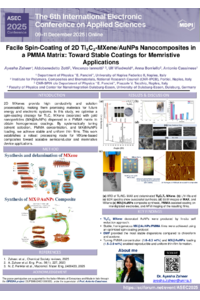
Developing reliable processing protocols for two-dimensional materials is essential for their integration into future energy and electronic systems. In this study, we optimized a spin-coating strategy for depositing 2D Ti₃C₂ MXene decorated with gold nanoparticles (MX@AuNPs), dispersed in a polymethyl methacrylate (PMMA) matrix, yielding homogeneous coatings. The MAX-phase precursor was etched using a mixture of HF and HCl¹ and delaminated with LiCl to obtain stable single- and few-layer MXene flakes (single layers being ~200 nm in lateral size), which were subsequently decorated with AuNPs. Characterization using SEM, TEM, and UV–Vis confirmed successful composite formation, with TEM images showing uniform AuNP decoration on MXene flakes2 and UV–Vis spectra revealing the characteristic plasmonic peak of AuNPs alongside MXene features. For spin coating, colloidal solutions were prepared in different solvents, including chloroform, acetone, and N, N-dimethylformamide (DMF), and systematically evaluated. DMF yielded the most stable dispersions, exhibiting excellent solubility for both pristine MXene and MX@AuNP nanocomposites. In addition, the effect of polymer and composite concentration was investigated by varying PMMA content in DMF (1.6 wt% and 8.3 wt%) and MX@AuNPs content in PMMA (1.5 wt% and 3.0 wt%) under different spin-coating speeds and times. Overall, this work establishes a robust spin-coating protocol for MXene-based composites providing a practical pathway toward semiconductor technologies, including memristive devices and future electronic networks.
Keywords
2D MXene
Ti₃C₂
MX@AuNPs
Nanocomposites
Spin Coating
PMMA
Memristor
Poster
Poster.pdf
Microwave-Assisted Extraction (MAE) of Propolis from Tetragonula biroi (Philippine Kiwot Bee) Hives
Plasmonic coupling in GaN films by Au and Ag Nanoparticles: Synthesis and characterization