Event submissions
Published
This submission belongs to the session S2. Nanosciences, Chemistry and Materials Science of the event The 6th International Electronic Conference on Applied Sciences
Published date
03 Dec, 2025
Academic Editor
'%3e%3cpath%20d='M12.6657%2010.9104C12.4185%2010.325%2012.0599%209.79327%2011.6097%209.34482C11.1609%208.89508%2010.6293%208.5365%2010.0442%208.28888C10.0389%208.28626%2010.0337%208.28495%2010.0285%208.28233C10.8446%207.69279%2011.3752%206.73249%2011.3752%205.64904C11.3752%203.8542%209.92103%202.39999%208.1262%202.39999C6.33136%202.39999%204.87715%203.8542%204.87715%205.64904C4.87715%206.73249%205.40774%207.69279%206.22393%208.28364C6.21869%208.28626%206.21345%208.28757%206.20821%208.29019C5.62129%208.5378%205.09463%208.89284%204.64265%209.34613C4.1929%209.79493%203.83432%2010.3266%203.58671%2010.9117C3.34345%2011.4845%203.21226%2012.0987%203.20023%2012.7209C3.19988%2012.7349%203.20233%2012.7488%203.20744%2012.7619C3.21255%2012.7749%203.22022%2012.7867%203.22998%2012.7968C3.23975%2012.8068%203.25142%2012.8147%203.26431%2012.8202C3.2772%2012.8256%203.29105%2012.8284%203.30504%2012.8284H4.09109C4.14874%2012.8284%204.19459%2012.7825%204.1959%2012.7262C4.2221%2011.7148%204.62823%2010.7676%205.34617%2010.0497C6.08899%209.30683%207.0755%208.89808%208.1262%208.89808C9.17689%208.89808%2010.1634%209.30683%2010.9062%2010.0497C11.6242%2010.7676%2012.0303%2011.7148%2012.0565%2012.7262C12.0578%2012.7838%2012.1037%2012.8284%2012.1613%2012.8284H12.9474C12.9613%2012.8284%2012.9752%2012.8256%2012.9881%2012.8202C13.001%2012.8147%2013.0126%2012.8068%2013.0224%2012.7968C13.0322%2012.7867%2013.0398%2012.7749%2013.0449%2012.7619C13.0501%2012.7488%2013.0525%2012.7349%2013.0522%2012.7209C13.0391%2012.0947%2012.9094%2011.4855%2012.6657%2010.9104ZM8.1262%207.9024C7.52486%207.9024%206.9589%207.6679%206.53312%207.24211C6.10733%206.81633%205.87283%206.25037%205.87283%205.64904C5.87283%205.0477%206.10733%204.48174%206.53312%204.05596C6.9589%203.63018%207.52486%203.39567%208.1262%203.39567C8.72753%203.39567%209.29349%203.63018%209.71927%204.05596C10.1451%204.48174%2010.3796%205.0477%2010.3796%205.64904C10.3796%206.25037%2010.1451%206.81633%209.71927%207.24211C9.29349%207.6679%208.72753%207.9024%208.1262%207.9024Z'%20fill='%235D1EE1'/%3e%3c/g%3e%3c/svg%3e) Alberto Jiménez Suárez
Alberto Jiménez SuárezCitation
Peniel Jean Gildo, John Andrei Allam, Ella Angelan, Christine Mae Cahayon, Nicole Llarena, Mikhaela Lumunsad, Joseph Rey H. Sta. Agueda, John Ray C. Estrellado, Microwave-Assisted Extraction (MAE) of Propolis from Tetragonula biroi (Philippine Kiwot Bee) Hives, in Proceedings of The 6th International Electronic Conference on Applied Sciences, 9 December–11 December 2025, MDPI: Basel, Switzerland
Share
Email
Facebook
Twitter
LinkedIn
Microwave-Assisted Extraction (MAE) of Propolis from Tetragonula biroi (Philippine Kiwot Bee) Hives
'%3e%3cpath%20d='M12.6647%2010.9104C12.4176%2010.325%2012.0589%209.7933%2011.6088%209.34485C11.16%208.89511%2010.6283%208.53653%2010.0432%208.28891C10.038%208.28629%2010.0327%208.28498%2010.0275%208.28236C10.8437%207.69282%2011.3743%206.73252%2011.3743%205.64907C11.3743%203.85423%209.92005%202.40002%208.12522%202.40002C6.33038%202.40002%204.87618%203.85423%204.87618%205.64907C4.87618%206.73252%205.40677%207.69282%206.22296%208.28367C6.21772%208.28629%206.21248%208.2876%206.20724%208.29022C5.62031%208.53783%205.09365%208.89287%204.64167%209.34616C4.19192%209.79496%203.83334%2010.3266%203.58573%2010.9117C3.34247%2011.4846%203.21128%2012.0987%203.19925%2012.721C3.1989%2012.735%203.20135%2012.7489%203.20646%2012.7619C3.21157%2012.7749%203.21924%2012.7868%203.22901%2012.7968C3.23877%2012.8068%203.25045%2012.8148%203.26334%2012.8202C3.27623%2012.8256%203.29007%2012.8284%203.30406%2012.8284H4.09012C4.14776%2012.8284%204.19362%2012.7825%204.19493%2012.7262C4.22113%2011.7148%204.62726%2010.7676%205.34519%2010.0497C6.08802%209.30686%207.07452%208.89811%208.12522%208.89811C9.17592%208.89811%2010.1624%209.30686%2010.9052%2010.0497C11.6232%2010.7676%2012.0293%2011.7148%2012.0555%2012.7262C12.0568%2012.7839%2012.1027%2012.8284%2012.1603%2012.8284H12.9464C12.9604%2012.8284%2012.9742%2012.8256%2012.9871%2012.8202C13%2012.8148%2013.0117%2012.8068%2013.0214%2012.7968C13.0312%2012.7868%2013.0389%2012.7749%2013.044%2012.7619C13.0491%2012.7489%2013.0515%2012.735%2013.0512%2012.721C13.0381%2012.0947%2012.9084%2011.4856%2012.6647%2010.9104ZM8.12522%207.90243C7.52388%207.90243%206.95792%207.66793%206.53214%207.24215C6.10636%206.81636%205.87185%206.2504%205.87185%205.64907C5.87185%205.04773%206.10636%204.48177%206.53214%204.05599C6.95792%203.63021%207.52388%203.3957%208.12522%203.3957C8.72655%203.3957%209.29252%203.63021%209.7183%204.05599C10.1441%204.48177%2010.3786%205.04773%2010.3786%205.64907C10.3786%206.2504%2010.1441%206.81636%209.7183%207.24215C9.29252%207.66793%208.72655%207.90243%208.12522%207.90243Z'%20fill='%235D1EE1'/%3e%3c/g%3e%3c/svg%3e)
Peniel Jean Gildo 1
John Andrei Allam 1
Ella Angelan 1
Christine Mae Cahayon 1
Nicole Llarena 1
Mikhaela Lumunsad 1
Joseph Rey H. Sta. Agueda 2

John Ray C. Estrellado 3
1. Department of Chemical Engineering,
College of Engineering,
Pamantasan ng Lungsod ng Maynila,
Intramuros, Manila, 1002,
Philippines, Philippines
2. Department of Manufacturing Engineering and Management,
Gokongwei College of Engineering,
De La Salle University,
2401 Taft Avenue, Malate, Manila,
1004, Philippines, Philippines
3. Department of Chemical Engineering,
Gokongwei College of Engineering,
De La Salle University,
2401 Taft Avenue, Malate, Manila,
1004, Philippines, Philippines
Abstract
Propolis is a resinous substance known for its bioactive compounds, such as phenolics and flavonoids, which exhibit antioxidant, antibacterial, and anti-inflammatory benefits. While this can be harvested from sources globally, it can also be derived from the native stingless Philippine kiwot bees. This study used microwave-assisted extraction (MAE) using ethanol, changing the solvent-to-sample ratio (5mL/g, 10mL/g, and 15mL/g), solvent concentration (35%v/v, 65%v/v, and 95%v/v), and extraction time (60s, 180s, and 300s), to determine their effects on the yield and phenolic and flavonoid contents. The extracted propolis was concentrated using rotary evaporator and freeze-dried. Phenolic content was determined through Folin–Ciocalteu method, while flavonoid content was identified through aluminum chloride complex formation in methanol solution. Interactions between solvent-to-sample ratio and solvent concentration significantly affected yield, while extraction time did not. Results show that using MAE with ethanol as a solvent successfully extracted propolis. Lower solvent-to-sample ratios with increasing solvent concentration resulted in higher yields. Conversely, high solvent concentrations with increasing solvent-to-sample ratio decreases yield. The highest yield (0.144 g/g) was obtained with 5mL/g solvent-to-sample ratio, 95%v/v solvent concentration, and 300s extraction time. Highest phenolic content (180.145 mgGAE/g propolis) was observed with 5mL/g solvent-to-sample ratio, 95%v/v solvent concentration, and 60s extraction time, while highest flavonoid content (124.190 mg QE/g propolis) was determined with 10mL/g solvent-to-sample ratio, 35%v/v solvent concentration, and 180s extraction time. Effects of extraction parameters were determined, which can further optimize the quantity and quality of propolis.
Keywords
Microwave-assisted extraction (MAE)
propolis
stingless bees
ethanol
phenolics
flavonoids
yield
Poster
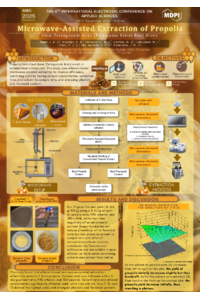
ASEC 2025 Conference Poster - MAE of Propolis.pdf
Application of cryogels with noble metal nanoparticles as flow through catalyst for "green" decomposition of phenol derivatives
Facile Spin-Coating of 2D Ti₃C₂-MXene/AuNPs Nanocomposites in a PMMA Matrix: Toward Stable Coatings for Memristive Applications