Event submissions
Published
This submission belongs to the session S2. Nanosciences, Chemistry and Materials Science of the event The 6th International Electronic Conference on Applied Sciences
Published date
03 Dec, 2025
Academic Editor
'%3e%3cpath%20d='M12.6657%2010.9104C12.4185%2010.325%2012.0599%209.79327%2011.6097%209.34482C11.1609%208.89508%2010.6293%208.5365%2010.0442%208.28888C10.0389%208.28626%2010.0337%208.28495%2010.0285%208.28233C10.8446%207.69279%2011.3752%206.73249%2011.3752%205.64904C11.3752%203.8542%209.92103%202.39999%208.1262%202.39999C6.33136%202.39999%204.87715%203.8542%204.87715%205.64904C4.87715%206.73249%205.40774%207.69279%206.22393%208.28364C6.21869%208.28626%206.21345%208.28757%206.20821%208.29019C5.62129%208.5378%205.09463%208.89284%204.64265%209.34613C4.1929%209.79493%203.83432%2010.3266%203.58671%2010.9117C3.34345%2011.4845%203.21226%2012.0987%203.20023%2012.7209C3.19988%2012.7349%203.20233%2012.7488%203.20744%2012.7619C3.21255%2012.7749%203.22022%2012.7867%203.22998%2012.7968C3.23975%2012.8068%203.25142%2012.8147%203.26431%2012.8202C3.2772%2012.8256%203.29105%2012.8284%203.30504%2012.8284H4.09109C4.14874%2012.8284%204.19459%2012.7825%204.1959%2012.7262C4.2221%2011.7148%204.62823%2010.7676%205.34617%2010.0497C6.08899%209.30683%207.0755%208.89808%208.1262%208.89808C9.17689%208.89808%2010.1634%209.30683%2010.9062%2010.0497C11.6242%2010.7676%2012.0303%2011.7148%2012.0565%2012.7262C12.0578%2012.7838%2012.1037%2012.8284%2012.1613%2012.8284H12.9474C12.9613%2012.8284%2012.9752%2012.8256%2012.9881%2012.8202C13.001%2012.8147%2013.0126%2012.8068%2013.0224%2012.7968C13.0322%2012.7867%2013.0398%2012.7749%2013.0449%2012.7619C13.0501%2012.7488%2013.0525%2012.7349%2013.0522%2012.7209C13.0391%2012.0947%2012.9094%2011.4855%2012.6657%2010.9104ZM8.1262%207.9024C7.52486%207.9024%206.9589%207.6679%206.53312%207.24211C6.10733%206.81633%205.87283%206.25037%205.87283%205.64904C5.87283%205.0477%206.10733%204.48174%206.53312%204.05596C6.9589%203.63018%207.52486%203.39567%208.1262%203.39567C8.72753%203.39567%209.29349%203.63018%209.71927%204.05596C10.1451%204.48174%2010.3796%205.0477%2010.3796%205.64904C10.3796%206.25037%2010.1451%206.81633%209.71927%207.24211C9.29349%207.6679%208.72753%207.9024%208.1262%207.9024Z'%20fill='%235D1EE1'/%3e%3c/g%3e%3c/svg%3e) Alberto Jiménez Suárez
Alberto Jiménez SuárezCitation
Chouaib Daoudi, Fathi Brioua, Numerical Investigation of Gold Nanoshell Heating Dynamics for Optimized Nanoshell-Assisted Cancer Photothermal Therapy, in Proceedings of The 6th International Electronic Conference on Applied Sciences, 9 December–11 December 2025, MDPI: Basel, Switzerland
Share
Email
Facebook
Twitter
LinkedIn
Numerical Investigation of Gold Nanoshell Heating Dynamics for Optimized Nanoshell-Assisted Cancer Photothermal Therapy
'%3e%3cpath%20d='M12.6647%2010.9104C12.4176%2010.325%2012.0589%209.7933%2011.6088%209.34485C11.16%208.89511%2010.6283%208.53653%2010.0432%208.28891C10.038%208.28629%2010.0327%208.28498%2010.0275%208.28236C10.8437%207.69282%2011.3743%206.73252%2011.3743%205.64907C11.3743%203.85423%209.92005%202.40002%208.12522%202.40002C6.33038%202.40002%204.87618%203.85423%204.87618%205.64907C4.87618%206.73252%205.40677%207.69282%206.22296%208.28367C6.21772%208.28629%206.21248%208.2876%206.20724%208.29022C5.62031%208.53783%205.09365%208.89287%204.64167%209.34616C4.19192%209.79496%203.83334%2010.3266%203.58573%2010.9117C3.34247%2011.4846%203.21128%2012.0987%203.19925%2012.721C3.1989%2012.735%203.20135%2012.7489%203.20646%2012.7619C3.21157%2012.7749%203.21924%2012.7868%203.22901%2012.7968C3.23877%2012.8068%203.25045%2012.8148%203.26334%2012.8202C3.27623%2012.8256%203.29007%2012.8284%203.30406%2012.8284H4.09012C4.14776%2012.8284%204.19362%2012.7825%204.19493%2012.7262C4.22113%2011.7148%204.62726%2010.7676%205.34519%2010.0497C6.08802%209.30686%207.07452%208.89811%208.12522%208.89811C9.17592%208.89811%2010.1624%209.30686%2010.9052%2010.0497C11.6232%2010.7676%2012.0293%2011.7148%2012.0555%2012.7262C12.0568%2012.7839%2012.1027%2012.8284%2012.1603%2012.8284H12.9464C12.9604%2012.8284%2012.9742%2012.8256%2012.9871%2012.8202C13%2012.8148%2013.0117%2012.8068%2013.0214%2012.7968C13.0312%2012.7868%2013.0389%2012.7749%2013.044%2012.7619C13.0491%2012.7489%2013.0515%2012.735%2013.0512%2012.721C13.0381%2012.0947%2012.9084%2011.4856%2012.6647%2010.9104ZM8.12522%207.90243C7.52388%207.90243%206.95792%207.66793%206.53214%207.24215C6.10636%206.81636%205.87185%206.2504%205.87185%205.64907C5.87185%205.04773%206.10636%204.48177%206.53214%204.05599C6.95792%203.63021%207.52388%203.3957%208.12522%203.3957C8.72655%203.3957%209.29252%203.63021%209.7183%204.05599C10.1441%204.48177%2010.3786%205.04773%2010.3786%205.64907C10.3786%206.2504%2010.1441%206.81636%209.7183%207.24215C9.29252%207.66793%208.72655%207.90243%208.12522%207.90243Z'%20fill='%235D1EE1'/%3e%3c/g%3e%3c/svg%3e)
Chouaib Daoudi 1
Fathi Brioua 2
1. Department of Electrical Engineering, University of Skikda, Skikda, Algeria, Algeria
2. Department Electrical Engineering, University of Ahmed Draia Adrar, Adrar, Algeria, Algeria
Abstract
Introduction
Gold nanoshells (AuNSs) with dielectric cores have emerged as promising agents for biomedical photothermal therapy due to their tunable plasmonic properties in the near-infrared region. Understanding their thermal responses under various laser excitations is crucial for optimizing their therapeutic efficiency and safety.
Methods
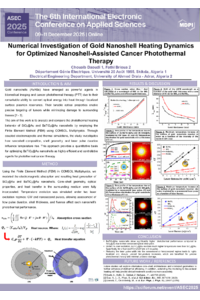
We employed finite element modeling (FEM) in COMSOL Multiphysics to investigate the spatiotemporal temperature evolution of SiO₂@Au and BaTiO₃@Au nanoshells, as well as nanobars, under continuous-wave (CW), nanosecond (ns), and femtosecond (fs) laser irradiation. The models coupled electromagnetic absorption with heat transfer, accounting for electron–phonon and phonon–environment interactions through one-, two-, and three-temperature models depending on the pulse duration.
Results
Our simulations show that BaTiO₃@Au nanoshells exhibit significantly higher absorption and heating than SiO₂@Au, particularly at 800 nm, a wavelength relevant for biomedical applications. Under CW excitation, the temperature rise is moderate and spatially uniform, reaching equilibrium within hundreds of nanoseconds. In contrast, ns pulses produced localized heating with delayed peak temperatures (~203 K for BaTiO₃@Au vs ~34 K for SiO₂@Au at 5 mJ/cm²), while fs pulses induced ultrafast electron heating (>3000 K) followed by energy transfer to the lattice and environment within a few nanoseconds. Parametric studies revealed a strong dependence of the thermal response on shell thickness, pulse duration, and fluence.
Conclusion
This work highlights the distinct thermal dynamics of gold nanoshells under different irradiation regimes and identifies BaTiO₃@Au as a highly efficient photothermal agent. These insights provide valuable guidance for designing nanoshell-assisted cancer therapies with controlled heating and minimal collateral damage.
Keywords
Gold nanoshells
Photothermal therapy
Finite element modeling (FEM)
Gold nanoshell
Plasmonic nanoparticles
Poster
MDPI conf Daoudi - Poster.pdf
Strength and Consolidation Characteristics of Expansive Clay Improved with Lime–Nano-Metakaolin and Sisal Fibre Reinforcement
Modular Composite Containers for Electric Marine Operations: Lightweight Design Using Vacuum-Infused Basalt Fibre Sandwich Panels