Event submissions
Published
This submission belongs to the session S1. Biostimulation and Biocontrol Strategies of the event The 5th International Electronic Conference on Agronomy
Published date
11 Dec, 2025
Academic Editor
'%3e%3cpath%20d='M12.6657%2010.9104C12.4185%2010.325%2012.0599%209.79327%2011.6097%209.34482C11.1609%208.89508%2010.6293%208.5365%2010.0442%208.28888C10.0389%208.28626%2010.0337%208.28495%2010.0285%208.28233C10.8446%207.69279%2011.3752%206.73249%2011.3752%205.64904C11.3752%203.8542%209.92103%202.39999%208.1262%202.39999C6.33136%202.39999%204.87715%203.8542%204.87715%205.64904C4.87715%206.73249%205.40774%207.69279%206.22393%208.28364C6.21869%208.28626%206.21345%208.28757%206.20821%208.29019C5.62129%208.5378%205.09463%208.89284%204.64265%209.34613C4.1929%209.79493%203.83432%2010.3266%203.58671%2010.9117C3.34345%2011.4845%203.21226%2012.0987%203.20023%2012.7209C3.19988%2012.7349%203.20233%2012.7488%203.20744%2012.7619C3.21255%2012.7749%203.22022%2012.7867%203.22998%2012.7968C3.23975%2012.8068%203.25142%2012.8147%203.26431%2012.8202C3.2772%2012.8256%203.29105%2012.8284%203.30504%2012.8284H4.09109C4.14874%2012.8284%204.19459%2012.7825%204.1959%2012.7262C4.2221%2011.7148%204.62823%2010.7676%205.34617%2010.0497C6.08899%209.30683%207.0755%208.89808%208.1262%208.89808C9.17689%208.89808%2010.1634%209.30683%2010.9062%2010.0497C11.6242%2010.7676%2012.0303%2011.7148%2012.0565%2012.7262C12.0578%2012.7838%2012.1037%2012.8284%2012.1613%2012.8284H12.9474C12.9613%2012.8284%2012.9752%2012.8256%2012.9881%2012.8202C13.001%2012.8147%2013.0126%2012.8068%2013.0224%2012.7968C13.0322%2012.7867%2013.0398%2012.7749%2013.0449%2012.7619C13.0501%2012.7488%2013.0525%2012.7349%2013.0522%2012.7209C13.0391%2012.0947%2012.9094%2011.4855%2012.6657%2010.9104ZM8.1262%207.9024C7.52486%207.9024%206.9589%207.6679%206.53312%207.24211C6.10733%206.81633%205.87283%206.25037%205.87283%205.64904C5.87283%205.0477%206.10733%204.48174%206.53312%204.05596C6.9589%203.63018%207.52486%203.39567%208.1262%203.39567C8.72753%203.39567%209.29349%203.63018%209.71927%204.05596C10.1451%204.48174%2010.3796%205.0477%2010.3796%205.64904C10.3796%206.25037%2010.1451%206.81633%209.71927%207.24211C9.29349%207.6679%208.72753%207.9024%208.1262%207.9024Z'%20fill='%235D1EE1'/%3e%3c/g%3e%3c/svg%3e) Monica Boscaiu
Monica BoscaiuCitation
Eva Sánchez-Hernández, Carmen Gómez-Lama Cabanás, Antonio Valverde-Corredor, Carlos Casanova-Muñoz, Alberto Santiago-Aliste, Jesús Martín-Gil, Pablo Martín-Ramos, In Planta Evaluation of Plant Extract-Loaded Chitosan Nanocarriers Against Fusarium Wilt: Efficacy Assessment in Controlled Environment Conditions, in Proceedings of The 5th International Electronic Conference on Agronomy, 15 December–18 December 2025, MDPI: Basel, Switzerland
Share
Email
Facebook
Twitter
LinkedIn
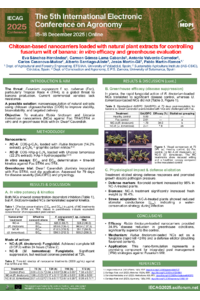
In Planta Evaluation of Plant Extract-Loaded Chitosan Nanocarriers Against Fusarium Wilt: Efficacy Assessment in Controlled Environment Conditions

Eva Sánchez-Hernández 1

Carmen Gómez-Lama Cabanás 2

Antonio Valverde-Corredor 2
'%3e%3cpath%20d='M12.6647%2010.9104C12.4176%2010.325%2012.0589%209.7933%2011.6088%209.34485C11.16%208.89511%2010.6283%208.53653%2010.0432%208.28891C10.038%208.28629%2010.0327%208.28498%2010.0275%208.28236C10.8437%207.69282%2011.3743%206.73252%2011.3743%205.64907C11.3743%203.85423%209.92005%202.40002%208.12522%202.40002C6.33038%202.40002%204.87618%203.85423%204.87618%205.64907C4.87618%206.73252%205.40677%207.69282%206.22296%208.28367C6.21772%208.28629%206.21248%208.2876%206.20724%208.29022C5.62031%208.53783%205.09365%208.89287%204.64167%209.34616C4.19192%209.79496%203.83334%2010.3266%203.58573%2010.9117C3.34247%2011.4846%203.21128%2012.0987%203.19925%2012.721C3.1989%2012.735%203.20135%2012.7489%203.20646%2012.7619C3.21157%2012.7749%203.21924%2012.7868%203.22901%2012.7968C3.23877%2012.8068%203.25045%2012.8148%203.26334%2012.8202C3.27623%2012.8256%203.29007%2012.8284%203.30406%2012.8284H4.09012C4.14776%2012.8284%204.19362%2012.7825%204.19493%2012.7262C4.22113%2011.7148%204.62726%2010.7676%205.34519%2010.0497C6.08802%209.30686%207.07452%208.89811%208.12522%208.89811C9.17592%208.89811%2010.1624%209.30686%2010.9052%2010.0497C11.6232%2010.7676%2012.0293%2011.7148%2012.0555%2012.7262C12.0568%2012.7839%2012.1027%2012.8284%2012.1603%2012.8284H12.9464C12.9604%2012.8284%2012.9742%2012.8256%2012.9871%2012.8202C13%2012.8148%2013.0117%2012.8068%2013.0214%2012.7968C13.0312%2012.7868%2013.0389%2012.7749%2013.044%2012.7619C13.0491%2012.7489%2013.0515%2012.735%2013.0512%2012.721C13.0381%2012.0947%2012.9084%2011.4856%2012.6647%2010.9104ZM8.12522%207.90243C7.52388%207.90243%206.95792%207.66793%206.53214%207.24215C6.10636%206.81636%205.87185%206.2504%205.87185%205.64907C5.87185%205.04773%206.10636%204.48177%206.53214%204.05599C6.95792%203.63021%207.52388%203.3957%208.12522%203.3957C8.72655%203.3957%209.29252%203.63021%209.7183%204.05599C10.1441%204.48177%2010.3786%205.04773%2010.3786%205.64907C10.3786%206.2504%2010.1441%206.81636%209.7183%207.24215C9.29252%207.66793%208.72655%207.90243%208.12522%207.90243Z'%20fill='%235D1EE1'/%3e%3c/g%3e%3c/svg%3e)
Carlos Casanova-Muñoz 2
Alberto Santiago-Aliste 3

Jesús Martín-Gil 1

Pablo Martín-Ramos 1
1. Department of Agricultural and Forestry Engineering, ETSIIAA, University of Valladolid, Avenida de Madrid 44, 34004 Palencia, Spain
2. Sustainable Agriculture Institute (IAS-CSIC), Avda. Menéndez Pidal s/n, 14004 Córdoba, Spain
3. Department of Construction and Agronomy, Escuela Politécnica Superior de Zamora, University of Salamanca, Av. de Requejo 33, 49029 Zamora, Spain
Abstract
Fusarium wilt caused by Fusarium oxysporum f. sp. cubense represents one of the most destructive banana diseases worldwide. With tropical race 4 (TR4) threatening global production and limited resistant varieties available, innovative biocontrol strategies are essential. Following promising in vitro results, this study evaluated the protective efficacy of chitosan-based nanocarriers loaded with Rubia tinctorum and Uncaria tomentosa extracts under controlled greenhouse conditions.
Banana plantlets were treated with nanocarrier formulations and subsequently inoculated with Foc. Disease severity was assessed using a 0-4 scale over 79 days, and the area under disease progress curve (AUDPC) was calculated. Additionally, physiological parameters including stomatal conductance, transpiration rate, and chlorophyll fluorescence were monitored using porometry and fluorometry.
Results demonstrated significant disease reduction with R. tinctorum-loaded nanocarriers, achieving 34.9% control efficacy compared to untreated infected plants (AUDPC: 134.5 vs 206.6). This treatment showed statistically significant differences in disease severity from 31 days post-inoculation onwards, with final severity scores of 2.6 compared to 3.6 in infected controls. In contrast, U. tomentosa formulations provided limited protection (7.8% efficacy, AUDPC: 190.5) with no significant differences from the infected control. Physiological analyses revealed enhanced stomatal conductance and transpiration rates in R. tinctorum-treated plants. Growth parameters demonstrated significant improvements in R. tinctorum-treated plants, including 10-15% increases in leaf width, enhanced leaf length and fresh weight (16% increase), alongside 36-43% higher chlorophyll content compared to controls. DUALEX measurements confirmed elevated flavonoid levels (621.2 vs 318.1) and anthocyanin content (231.0 vs 168.4) in R. tinctorum-treated plants, indicating enhanced stress tolerance.
These findings validate the transition from laboratory to greenhouse conditions, demonstrating that R. tinctorum-based nanocarriers offer substantial disease suppression potential. The integration of nanotechnology with natural bioactive compounds presents a promising sustainable approach for Fusarium wilt management, contributing to the development of environmentally friendly alternatives for banana crop protection in commercial production systems.
Keywords
Banana
Biocontrol
Disease severity
Nanotechnology
Rubia tinctorum
Stomatal conductance
Sustainable agriculture
Uncaria tomentosa
Poster
Poster sciforum-144624.pdf
AI-Powered Robotic System for Precision Irrigation and Pesticide Application in Sustainable Tomato
From wild plant to biostimulant: effects of Silene inflata extracts on lettuce growth and quality