Event submissions
Published
This submission belongs to the session S1. The Social Nature of Health and Well-Being of the event The 1st International Online Conference on Societies
Published date
19 Jan, 2026
Academic Editor
'%3e%3cpath%20d='M12.6657%2010.9104C12.4185%2010.325%2012.0599%209.79327%2011.6097%209.34482C11.1609%208.89508%2010.6293%208.5365%2010.0442%208.28888C10.0389%208.28626%2010.0337%208.28495%2010.0285%208.28233C10.8446%207.69279%2011.3752%206.73249%2011.3752%205.64904C11.3752%203.8542%209.92103%202.39999%208.1262%202.39999C6.33136%202.39999%204.87715%203.8542%204.87715%205.64904C4.87715%206.73249%205.40774%207.69279%206.22393%208.28364C6.21869%208.28626%206.21345%208.28757%206.20821%208.29019C5.62129%208.5378%205.09463%208.89284%204.64265%209.34613C4.1929%209.79493%203.83432%2010.3266%203.58671%2010.9117C3.34345%2011.4845%203.21226%2012.0987%203.20023%2012.7209C3.19988%2012.7349%203.20233%2012.7488%203.20744%2012.7619C3.21255%2012.7749%203.22022%2012.7867%203.22998%2012.7968C3.23975%2012.8068%203.25142%2012.8147%203.26431%2012.8202C3.2772%2012.8256%203.29105%2012.8284%203.30504%2012.8284H4.09109C4.14874%2012.8284%204.19459%2012.7825%204.1959%2012.7262C4.2221%2011.7148%204.62823%2010.7676%205.34617%2010.0497C6.08899%209.30683%207.0755%208.89808%208.1262%208.89808C9.17689%208.89808%2010.1634%209.30683%2010.9062%2010.0497C11.6242%2010.7676%2012.0303%2011.7148%2012.0565%2012.7262C12.0578%2012.7838%2012.1037%2012.8284%2012.1613%2012.8284H12.9474C12.9613%2012.8284%2012.9752%2012.8256%2012.9881%2012.8202C13.001%2012.8147%2013.0126%2012.8068%2013.0224%2012.7968C13.0322%2012.7867%2013.0398%2012.7749%2013.0449%2012.7619C13.0501%2012.7488%2013.0525%2012.7349%2013.0522%2012.7209C13.0391%2012.0947%2012.9094%2011.4855%2012.6657%2010.9104ZM8.1262%207.9024C7.52486%207.9024%206.9589%207.6679%206.53312%207.24211C6.10733%206.81633%205.87283%206.25037%205.87283%205.64904C5.87283%205.0477%206.10733%204.48174%206.53312%204.05596C6.9589%203.63018%207.52486%203.39567%208.1262%203.39567C8.72753%203.39567%209.29349%203.63018%209.71927%204.05596C10.1451%204.48174%2010.3796%205.0477%2010.3796%205.64904C10.3796%206.25037%2010.1451%206.81633%209.71927%207.24211C9.29349%207.6679%208.72753%207.9024%208.1262%207.9024Z'%20fill='%235D1EE1'/%3e%3c/g%3e%3c/svg%3e) Gregor Wolbring
Gregor WolbringCitation
Suzana Turcu, Cristiana Glavce, Monica Petrescu, Liviu Tatomirescu, Understanding Dementia through Caregivers’ Experiences: Behavioral Challenges and Quality of Life, in Proceedings of The 1st International Online Conference on Societies, 21 January–23 January 2026, MDPI: Basel, Switzerland
Share
Email
Facebook
Twitter
LinkedIn
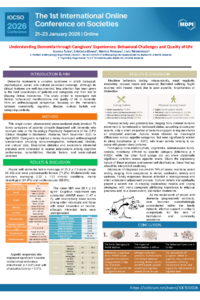
Understanding Dementia through Caregivers’ Experiences: Behavioral Challenges and Quality of Life

Suzana Turcu 1
'%3e%3cpath%20d='M12.6647%2010.9104C12.4176%2010.325%2012.0589%209.7933%2011.6088%209.34485C11.16%208.89511%2010.6283%208.53653%2010.0432%208.28891C10.038%208.28629%2010.0327%208.28498%2010.0275%208.28236C10.8437%207.69282%2011.3743%206.73252%2011.3743%205.64907C11.3743%203.85423%209.92005%202.40002%208.12522%202.40002C6.33038%202.40002%204.87618%203.85423%204.87618%205.64907C4.87618%206.73252%205.40677%207.69282%206.22296%208.28367C6.21772%208.28629%206.21248%208.2876%206.20724%208.29022C5.62031%208.53783%205.09365%208.89287%204.64167%209.34616C4.19192%209.79496%203.83334%2010.3266%203.58573%2010.9117C3.34247%2011.4846%203.21128%2012.0987%203.19925%2012.721C3.1989%2012.735%203.20135%2012.7489%203.20646%2012.7619C3.21157%2012.7749%203.21924%2012.7868%203.22901%2012.7968C3.23877%2012.8068%203.25045%2012.8148%203.26334%2012.8202C3.27623%2012.8256%203.29007%2012.8284%203.30406%2012.8284H4.09012C4.14776%2012.8284%204.19362%2012.7825%204.19493%2012.7262C4.22113%2011.7148%204.62726%2010.7676%205.34519%2010.0497C6.08802%209.30686%207.07452%208.89811%208.12522%208.89811C9.17592%208.89811%2010.1624%209.30686%2010.9052%2010.0497C11.6232%2010.7676%2012.0293%2011.7148%2012.0555%2012.7262C12.0568%2012.7839%2012.1027%2012.8284%2012.1603%2012.8284H12.9464C12.9604%2012.8284%2012.9742%2012.8256%2012.9871%2012.8202C13%2012.8148%2013.0117%2012.8068%2013.0214%2012.7968C13.0312%2012.7868%2013.0389%2012.7749%2013.044%2012.7619C13.0491%2012.7489%2013.0515%2012.735%2013.0512%2012.721C13.0381%2012.0947%2012.9084%2011.4856%2012.6647%2010.9104ZM8.12522%207.90243C7.52388%207.90243%206.95792%207.66793%206.53214%207.24215C6.10636%206.81636%205.87185%206.2504%205.87185%205.64907C5.87185%205.04773%206.10636%204.48177%206.53214%204.05599C6.95792%203.63021%207.52388%203.3957%208.12522%203.3957C8.72655%203.3957%209.29252%203.63021%209.7183%204.05599C10.1441%204.48177%2010.3786%205.04773%2010.3786%205.64907C10.3786%206.2504%2010.1441%206.81636%209.7183%207.24215C9.29252%207.66793%208.72655%207.90243%208.12522%207.90243Z'%20fill='%235D1EE1'/%3e%3c/g%3e%3c/svg%3e)
Cristiana Glavce 1
Monica Petrescu 1
Liviu Tatomirescu 1,2
1. Medical Anthropology Department, Francisc I. Rainer Institute of Anthropology, Romanian Academy, Bucharest, 050474, Romania, Romania
2. Psychiatry Department, “C.F.2” Clinical Hospital, Bucharest, 011464, Romania
Abstract
Background/Objectives: Dementia represents a complex syndrome in which biological, psychological, social, and cultural processes converge. Although its clinical features are well documented, less attention has been given to the lived experiences of patients and caregivers and their role in shaping illness trajectories. This study aimed to investigate risk factors, behavioral manifestations, and quality of life in dementia from an anthropological perspective, focusing on the interaction between comorbidity, cognition, lifestyle, cultural beliefs, and caregiving contexts.
Methods: A cross-sectional, observational study was carried out with family caregivers of individuals diagnosed with dementia who accessed specialized neurological and psychiatric care in Bucharest, Romania. Caregivers completed an anthropological questionnaire capturing socio-demographic data, comorbid conditions, lifestyle behaviors, relational dynamics, and cultural perspectives. Descriptive and inferential analyses examined associations between clinical, social, and cultural variables.
Results: Patients were predominantly older women living with multiple chronic conditions, most frequently neurological and cardiovascular. Cognitive impairment was more severe among individuals with lower levels of education and limited financial resources. Disturbances in appetite and sleep were common and frequently associated with diminished physical activity and reduced wellbeing. Disclosure of diagnosis elicited diverse emotional responses, with families describing processes of adaptation as ambivalent, nonlinear, and often marked by anxiety or sadness. Cultural beliefs and spirituality played a central role in shaping explanatory models and coping strategies, with reliance on religious practices, alternative therapies, and traditional interpretations frequently reported.
Conclusions: These findings suggest that dementia in this context is not solely a product of biological decline but is deeply embedded in socio-economic conditions and cultural frameworks. Addressing these intersecting influences through integrative, culturally responsive models of care may improve outcomes for both patients and caregivers.
Keywords
Dementia
risk factors
behaviour
quality of life,.
Poster
sciforum_152351_S1_slides_IOCS2026_POSTER_Understanding_Dementia_through_Caregivers_Experiences_Behavioral_Challenges_and_Quality_of_Life.pdf
Umuarama Circular: Social Transformations in the Construction of a Circular City
Wellbeing of Cancer Caregivers: Scoping Review